
Tokyo Exhibition Features Paintings, Documents from Wars in Asia Pacific Region, Including Pacific War and Vietnam War
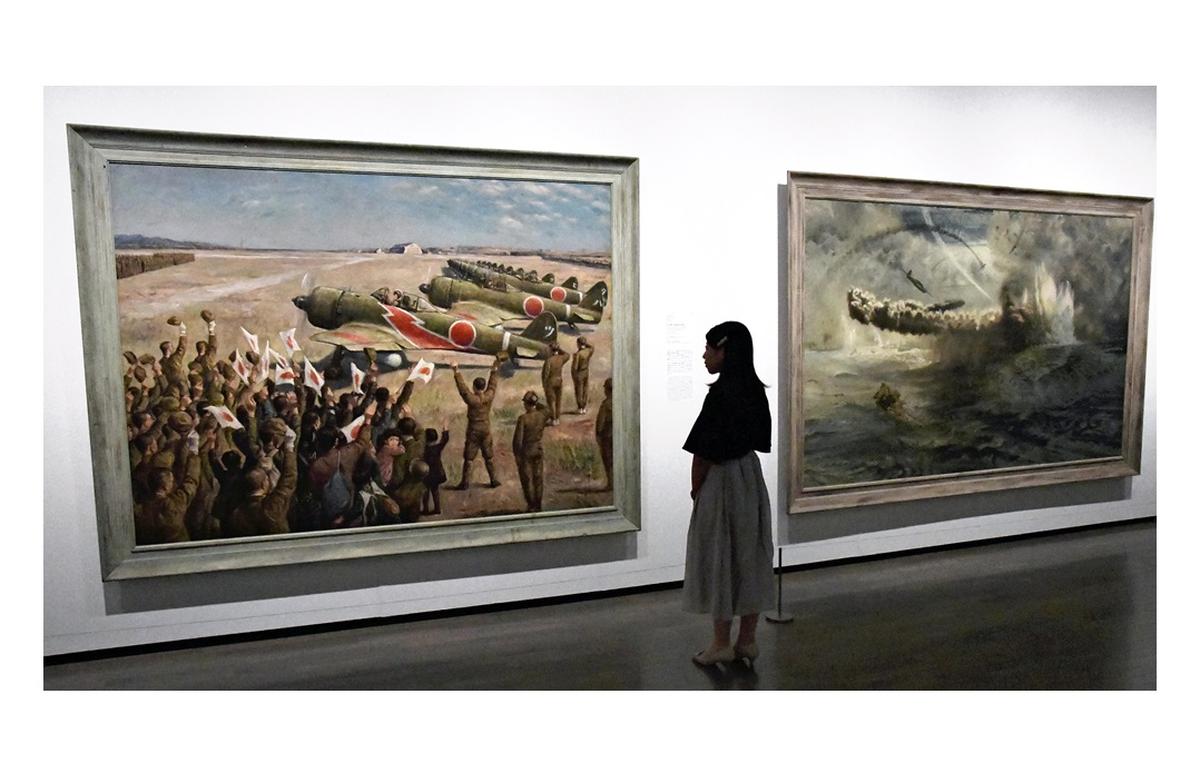
Usaburo Ihara’s “Special Attack Corps Setting Out from a Homeland Base I” (1944), left, and Saburo Miyamoto’s “Banda Unit Fighting Fiercely off Philippines” (1945) are seen at the National Museum of Modern Art, Tokyo.
20:00 JST, October 7, 2025
Paintings, documents and other images related to the wars in the Asia Pacific region, such as the Pacific War and the Vietnam War, are on display at the National Museum of Modern Art, Tokyo.
The exhibition “Opening Documents, Weaving Memories,” which includes large-scale war paintings, focuses on the documentary role of visual media through 280 items, including newspapers, newsreels and posters.
At the museum, there are 153 war paintings that were created during the Second Sino-Japanese War and the Pacific War. The pieces were returned to Japan on indefinite loan after the U.S. military confiscated them after World War II.
The exhibition features 24 war paintings, including Tsuguharu Fujita’s “Battle on the Banks of the Khalkha, Nomonhan” (1941) and “Final Fighting on Attu” (1943), as well works by Saburo Miyamoto and Ryohei Koiso.
Other items on display include posters and graphic magazines encouraging Japanese people to develop Manchuria and Mongolia. Travel brochures and postcards promoting tourism to China, Manchuria and the Korean peninsula can also be seen.
The exhibition also looks at the period after World War II.
Works by artists from Asian countries are also on display, such as “March First Independence Movement” by a Korean painter depicting the peninsula’s oppression under Japanese Imperial rule.
The pieces painted by atomic bomb survivors depicting the horrific scenes right after the atomic bomb was dropped are overwhelming.
“Stop the Killing” by Taro Okamoto, an anti-war piece created in response to the Vietnam War and vinyl records of old military songs that became popular again during that period can also be viewed at the exhibition.
“We hope that visitors will understand how art conveys the message of wars,” said a museum official.
The official added that the museum “hopes the exhibition will pose the question of how we, as a post-war generation that has never experienced an actual war, could weave the memory of war based on existing materials, such as war record paintings.”
The exhibition is scheduled to run through Oct. 26.





Most Read
Popular articles in the past 24 hours
-
Tokyo Skytree's Elevator Stops, Trapping 20 People; All Rescued (...
-

Japan’s Major Real Estate Firms Expanding Overseas Businesses to ...
-

Ukrainian Ambassador Closely Watching Japan’s Revision of Defense...
-
Emperor Turns 66 Ahead of Disaster Milestones
-

Milano Cortina 2026: Sakamoto Serves as Flag Bearer; Japan Earns ...
-

Milano Cortina 2026: There Were Cheers across the Country, after ...
-
Luna Sea Drummer Shinya Dies at 56; Powerful Drummer Behind ‘Desi...
-

Milano Cortina 2026: Riku-Ryu Duo Stick Together During Closing C...
Popular articles in the past week
-

Japan PM Takaichi’s Cabinet Resigns en Masse
-

Man Infected with Measles Reportedly Dined at Restaurant in Tokyo...
-

Sanae Takaichi Elected Prime Minister of Japan; Keeps All Cabinet...
-

Japan's Govt to Submit Road Map for Growth Strategy in March, PM ...
-

Bus Carrying 40 Passengers Catches Fire on Chuo Expressway; All E...
-

Milano Cortina 2026: Figure Skaters Riku Miura, Ryuichi Kihara Pa...
-

Japan, U.S. Name 3 Inaugural Investment Projects; Reached Agreeme...
-

U.S. Firm to Build Training Hub in Fukushima N-plant for Debris R...
Popular articles in the past month
-
Japan PM Takaichi’s Cabinet Resigns en Masse
-

Japan Institute to Use Domestic Commercial Optical Lattice Clock ...
-

Israeli Ambassador to Japan Speaks about Japan’s Role in the Reco...
-
Man Infected with Measles Reportedly Dined at Restaurant in Tokyo...
-

Videos Plagiarized, Reposted with False Subtitles Claiming ‘Ryuky...
-

Man Infected with Measles May Have Come in Contact with Many Peop...
-

Prudential Life Insurance Plans to Fully Compensate for Damages C...
-

Woman with Measles Visited Hospital in Tokyo Multiple Times Befor...
Top Articles in Society
-
Man Infected with Measles Reportedly Dined at Restaurant in Tokyo Station
-
Man Infected with Measles May Have Come in Contact with Many People in Tokyo, Went to Store, Restaurant Around When Symptoms Emerged
-
Woman with Measles Visited Hospital in Tokyo Multiple Times Before Being Diagnosed with Disease
-
Australian Woman Dies After Mishap on Ski Lift in Nagano Prefecture
-
Foreign Snowboarder in Serious Condition After Hanging in Midair from Chairlift in Nagano Prefecture
JN ACCESS RANKING
-
Japan PM Takaichi’s Cabinet Resigns en Masse
-
Japan Institute to Use Domestic Commercial Optical Lattice Clock to Set Japan Standard Time
-
Israeli Ambassador to Japan Speaks about Japan’s Role in the Reconstruction of Gaza
-
Man Infected with Measles Reportedly Dined at Restaurant in Tokyo Station
-
Videos Plagiarized, Reposted with False Subtitles Claiming ‘Ryukyu Belongs to China’; Anti-China False Information Also Posted in Japan