
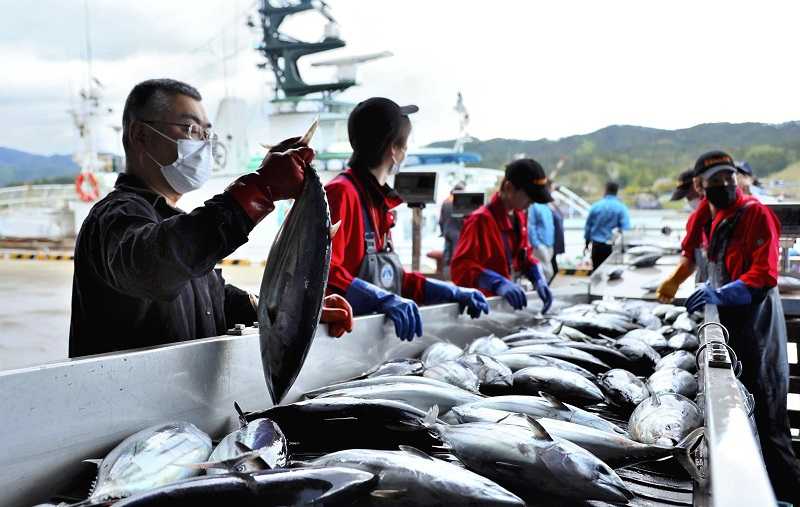
Bonitos landed at Kesennuma fishing port in Kesennuma, Miyagi Prefecture, in May last year
7:00 JST, May 17, 2022
The government is considering designating two or three “digital fisheries strategy centers” around March next year, to help revitalize the fisheries industry through the use of artificial intelligence and other digital technologies, it has been learned.
After verifying the centers’ viability, the government aims to expand the number of sites nationwide in the future.
The fisheries industry is facing a serious shortage of personnel. The government aims to revitalize the sector by promoting digitization, which will improve operational efficiency, strengthen production areas’ brand power, and increase the income of people engaged in fishery.
Grant aid may be used from the Vision for a Digital Garden City Nation, which was designed to narrow the disparities between urban and rural areas and promoted by Prime Minister Fumio Kishida.
Staff who are familiar with digitization will be dispatched to the centers to promote the integrated digitization of resource management, production, distribution, and other elements. For example, there are hopes of using AI to predict ocean and fishing conditions up to a week in advance, thereby facilitating efficient decisions on whether to go fishing and the selection of fishing grounds.
On board fishing vessels, catches might be instantly measured using image analysis technology, and the data shared with the market before the vessels return to port.
At markets, photos of the fish and information on their arrival would be displayed on a monitor, and bidding might begin before the vessels return to port, using tablet devices.
If the amount of fish caught and other information is shared even before the fish are landed, it will shorten the time it takes to win a bid and make it easier to prepare for transportation and other processes.
Digitization would also promote the operation of a traceability system that records the history of fishery operations from catch to sale. Product information, such as landing time, can be viewed through QR codes that consumers can read with their smartphones.
In conjunction with the designation of the centers, the government plans to set up a “fisheries digital human resource bank,” which will bring together startup companies and others interested in the fisheries industry. The bank will serve as a source of digitally savvy staffers to be dispatched to the centers and who will consult with fishermen there to formulate specific plans.






Most Read
Popular articles in the past 24 hours
-

Japan to Strictly Control Exports of Lethal Defense Equipment Whi...
-

High-Hydration Bread on the Rise, Seeing Increase in Specialty Sh...
-

Japan's Prime Minister Sanae Takaichi Is ‘World's Most Powerful W...
-

White and Pink Plum Blossoms Begin to Bloom at Yuki Shrine in Jap...
-
17-Year-Old Fatally Stabbed in Osaka’s Dotonbori; Suspect at Larg...
-

Reform of Retrial System: Diet Must Thoroughly Discuss Remedies f...
-
Gold Smuggling into Japan Running Rampant
-

Bear Found in Warehouse in Fukushima Prefecture Culled
Popular articles in the past week
-

Prudential Life Insurance Plans to Fully Compensate for Damages C...
-

Woman with Measles Visited Hospital in Tokyo Multiple Times Befor...
-

Woman with No Overseas Travel History Infected with Measles in Na...
-

Measles Patient Flew Between Tokyo, Hokkaido in Late January; Lik...
-

Milano Cortina 2026: Kokomo Murase Comes Out on Top After Overcom...
-
CRA Leadership Election Will Center on Party Rebuilding; Lower Ho...
-

Videos Plagiarized, Reposted with False Subtitles Claiming ‘Ryuky...
-
Crime in Japan Ticks Up for 4th Straight Year
Popular articles in the past month
-

Japan Institute to Use Domestic Commercial Optical Lattice Clock ...
-

Israeli Ambassador to Japan Speaks about Japan’s Role in the Reco...
-

Man Infected with Measles May Have Come in Contact with Many Peop...
-

China Eyes Rare Earth Foothold in Malaysia to Maintain Dominance,...
-
Prudential Life Insurance Plans to Fully Compensate for Damages C...
-
Woman with Measles Visited Hospital in Tokyo Multiple Times Befor...
-
Australian Woman Dies After Mishap on Ski Lift in Nagano Prefectu...
-
Foreign Snowboarder in Serious Condition After Hanging in Midair ...
Top Articles in Society
-
Man Infected with Measles May Have Come in Contact with Many People in Tokyo, Went to Store, Restaurant Around When Symptoms Emerged
-
Woman with Measles Visited Hospital in Tokyo Multiple Times Before Being Diagnosed with Disease
-
Australian Woman Dies After Mishap on Ski Lift in Nagano Prefecture
-
Foreign Snowboarder in Serious Condition After Hanging in Midair from Chairlift in Nagano Prefecture
-
Record-Breaking Snow Cripples Public Transport in Hokkaido; 7,000 People Stay Overnight at New Chitose Airport
JN ACCESS RANKING
-
Japan Institute to Use Domestic Commercial Optical Lattice Clock to Set Japan Standard Time
-
Israeli Ambassador to Japan Speaks about Japan’s Role in the Reconstruction of Gaza
-
Man Infected with Measles May Have Come in Contact with Many People in Tokyo, Went to Store, Restaurant Around When Symptoms Emerged
-
China Eyes Rare Earth Foothold in Malaysia to Maintain Dominance, Counter Japan, U.S.
-
Prudential Life Insurance Plans to Fully Compensate for Damages Caused by Fraudulent Actions Without Waiting for Third-Party Committee Review