
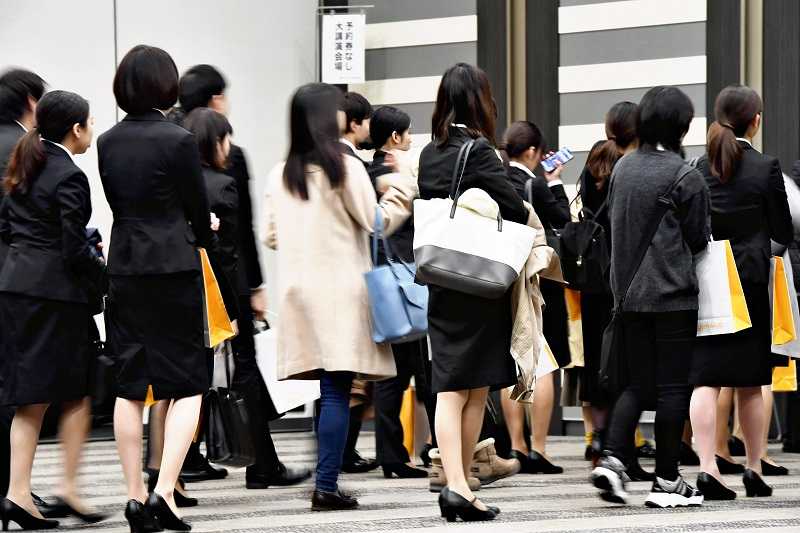
University students participate in a job seminar in Tokyo.
17:19 JST, May 7, 2022
TOKYO (Jiji Press) — Nearly half of university juniors in Japan who have provided care for family members are concerned about taking jobs, a welfare ministry survey showed.
Many of such students worry whether they can work while helping family members.
The online survey, conducted in December last year and January this year, asked some 300,000 university juniors across the country to answer questions about young carers. Valid responses came from 9,679 people.
In the poll, 6.2% replied that they had family members to take care of and 4.0% said they did not now but they did in the past, with the number of students who have provided care for family members totaling 987.
Nearly half of these students expressed concern about taking jobs, while 54.9% said they had no particular worry about finding employment.
The survey showed that 13.9% said they worried whether they would be able to land jobs as regular workers, 13.4% said the areas they could commute to were limited, and 11.4% said they worried whether they would be able to work without taking extra leave.
In addition, 7.8% said they did not have time to think about finding employment and 7.0% said they could only work for certain times of day. Respondents were allowed to pick one or more answer options.
The proportion of students who spend seven hours or more on a weekday to take care of family members stood at 6.4%. Strain resulting from providing care for family members may be affecting students’ options for the future.
Seigo Miyazaki, head of the Young Carers Association, who was involved in the survey, said some students did not recognize their own situation because they had not started looking for jobs.
Miyazaki was a young carer himself. While in college, “I cared for my mother with an intractable disease night and day. I experienced a great deal of difficulty when I tried to find a job,” Miyazaki said.
He joined a medical equipment maker where employees can get transferred to positions around the country. He quit after three years, however, because people at the company did not understand his circumstances.
“Back then, people didn’t believe young people provide care for family members,” Miyazaki said. With public awareness about young carers improving, it is important for companies and universities to understand and recognize their situations, he said.





Most Read
Popular articles in the past 24 hours
-

Milano Cortina 2026: Miho Takagi Won Bronze in Women’s 500-...
-

Sony's Entertainment Focus Becomes Even Clearer; Shift Away from ...
-

Japan’s Lotteria Restaurant Operator Co. Changes Name, Will Rebra...
-

Japan's Foreign Minister Says No Contact With China's Counterpart...
-

Revitalization of Shipbuilding Industry: Counter Chinese, S. Kore...
-

1st Overseas Suke-San Udon to Open in Taiwan; Company Aims for Mo...
-

Japan’s Nikkei Stock Average Dips as Soft Data, Post-Election Lul...
-
Toilet Vehicles Provide Comfort During Disaster; Vehicles Popular...
Popular articles in the past week
-

Prudential Life Insurance Plans to Fully Compensate for Damages C...
-

Woman with No Overseas Travel History Infected with Measles in Na...
-

Videos Plagiarized, Reposted with False Subtitles Claiming ‘Ryuky...
-

Milano Cortina 2026: Kokomo Murase Comes Out on Top After Overcom...
-
CRA Leadership Election Will Center on Party Rebuilding; Lower Ho...
-

Crime in Japan Ticks Up for 4th Straight Year
-

Japanese Constitutional Revision Debate Expected to be Revived Af...
-

Tokyo’s New Record-Breaking Fountain Named ‘Tokyo Aqua Symphony’
Popular articles in the past month
-

Japan Institute to Use Domestic Commercial Optical Lattice Clock ...
-

Israeli Ambassador to Japan Speaks about Japan’s Role in the Reco...
-

Man Infected with Measles May Have Come in Contact with Many Peop...
-

China Eyes Rare Earth Foothold in Malaysia to Maintain Dominance,...
-
Prudential Life Insurance Plans to Fully Compensate for Damages C...
-

Woman with Measles Visited Hospital in Tokyo Multiple Times Befor...
-
Australian Woman Dies After Mishap on Ski Lift in Nagano Prefectu...
-
Foreign Snowboarder in Serious Condition After Hanging in Midair ...
Top Articles in Society
-
Man Infected with Measles May Have Come in Contact with Many People in Tokyo, Went to Store, Restaurant Around When Symptoms Emerged
-
Woman with Measles Visited Hospital in Tokyo Multiple Times Before Being Diagnosed with Disease
-
Australian Woman Dies After Mishap on Ski Lift in Nagano Prefecture
-
Foreign Snowboarder in Serious Condition After Hanging in Midair from Chairlift in Nagano Prefecture
-
Record-Breaking Snow Cripples Public Transport in Hokkaido; 7,000 People Stay Overnight at New Chitose Airport
JN ACCESS RANKING
-
Japan Institute to Use Domestic Commercial Optical Lattice Clock to Set Japan Standard Time
-
Israeli Ambassador to Japan Speaks about Japan’s Role in the Reconstruction of Gaza
-
Man Infected with Measles May Have Come in Contact with Many People in Tokyo, Went to Store, Restaurant Around When Symptoms Emerged
-
Prudential Life Insurance Plans to Fully Compensate for Damages Caused by Fraudulent Actions Without Waiting for Third-Party Committee Review
-
Woman with Measles Visited Hospital in Tokyo Multiple Times Before Being Diagnosed with Disease