
16:30 JST, May 19, 2022
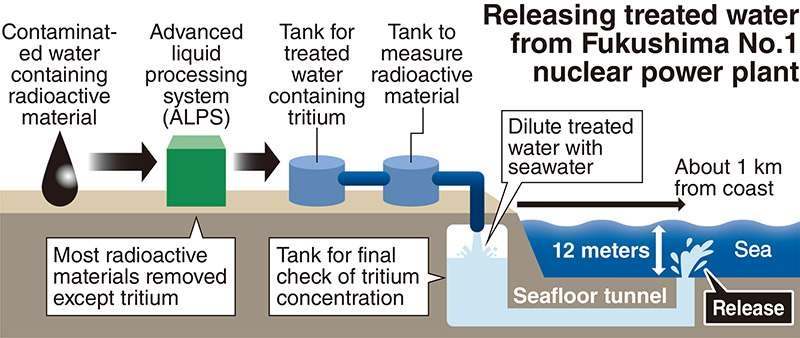
The Nuclear Regulatory Authority has thoroughly evaluated the effects of treated water on the human body. In particular, the authority has estimated the radiation dose based on the assumption that people eat marine products containing trace amounts of radioactive materials on a daily basis and are exposed to radiation from the seawater while aboard ships or spending an extended time on the coast.
As a result, the dose is estimated to be in the range of 0.03 to 0.4 microsieverts per year, according to the amount of treated water to be released and concentration of radioactive materials in the water based on Tokyo Electric Power Company Holdings, Inc.’s plan.
TEPCO has confirmed that the radioactive dose to the human body was sufficiently small as it has met the authority’s requirement of “considerably below 50 microsieverts per year.”
The government and TEPCO have doubled the number of monitoring points for tritium concentration in marine waters around the Fukushima No.1 nuclear power plant from 64 to 132, and also increasing monitoring frequency. The two parties will ask a third party to analyze seawater and compare the third party’s results with those conducted by TEPCO.







Most Read
Popular articles in the past 24 hours
-

Masako Ikeda, Voice of Maetel in ‘Galaxy Express 999,' Dies at 87
-

Japan Defense Agency to Develop AI Intelligence Analysis System f...
-

Government to Establish ‘Command Center’ for Developing Nuclear P...
-

Milano Cortina 2026: Japan’s Momoka Muraoka Takes Silver in...
-

Moai Statue Shows Lasting Bond Between Miyagi Pref. Town, Easter ...
-

Paw Patrol: Larry Marks 15 Years at 10 Downing Street
-

Milano Cortina 2026: Japan’s Oguri Wins Para Snowboard Silver at ...
-

CARTOON OF THE DAY (March 13)
Popular articles in the past week
-

Japan Figure Skating Legend Yuzuru Hanyu Is Proud Disaster Surviv...
-
Govt to Utilize ODA for Ensuring Economic Security; Securing Ener...
-
15 Measles Patients Confirmed in Tokyo in Past 6 Days; 1 May Have...
-
Massive Sewer Pipe Found Jutting Out of Highway in Osaka
-

Japan Govt to Tighten Requirements to Receive Permanent Residency...
-

Beckoning Cats Get Makeover to Fit Modern Lifestyles with Sleek D...
-
JR Tokai Breaks Ground on Yamanashi Maglev Station; Will Be Part ...
-
Power Outage Forces About 980 Passengers in Yokohama to Walk to T...
Popular articles in the past month
-

Producer Behind Pop Group XG Arrested for Cocaine Possession
-

Japan PM Takaichi’s Cabinet Resigns en Masse
-

Man Infected with Measles Reportedly Dined at Restaurant in Tokyo...
-

Videos Plagiarized, Reposted with False Subtitles Claiming ‘Ryuky...
-
Japan Figure Skating Legend Yuzuru Hanyu Is Proud Disaster Surviv...
-

iPS Treatments Pass Key Milestone, but Broader Applications Far f...
-

Sanae Takaichi Elected Prime Minister of Japan; Keeps All Cabinet...
-

Nepal Bus Crash Kills 19 People, Injures 25 Including One Japanes...
Top Articles in Science & Nature
-
iPS Treatments Pass Key Milestone, but Broader Applications Far from Guaranteed
-

Record 700 Startups to Gather at SusHi Tech Tokyo in April; Event Will Center on Themes Like Artificial Intelligence and Robotics
-
iPS Cell Products for Parkinson’s, Heart Disease OK’d for Commercialization by Japan Health Ministry Panel
-

Parents in Japan to Get Instagram Notifications When Teens Repeatedly Search for Suicide Content
-

Japan to Ban Use of Power Banks on Airplanes
JN ACCESS RANKING
-
Producer Behind Pop Group XG Arrested for Cocaine Possession
-
Japan PM Takaichi’s Cabinet Resigns en Masse
-
Man Infected with Measles Reportedly Dined at Restaurant in Tokyo Station
-
Videos Plagiarized, Reposted with False Subtitles Claiming ‘Ryukyu Belongs to China’; Anti-China False Information Also Posted in Japan
-
Japan Figure Skating Legend Yuzuru Hanyu Is Proud Disaster Survivor and Gold Medalist, Vows to Continue Support Efforts