
Prime Minister Takaichi Drives Ahead With Priority Policies, Promotes Discussion of Consumption Tax Cuts
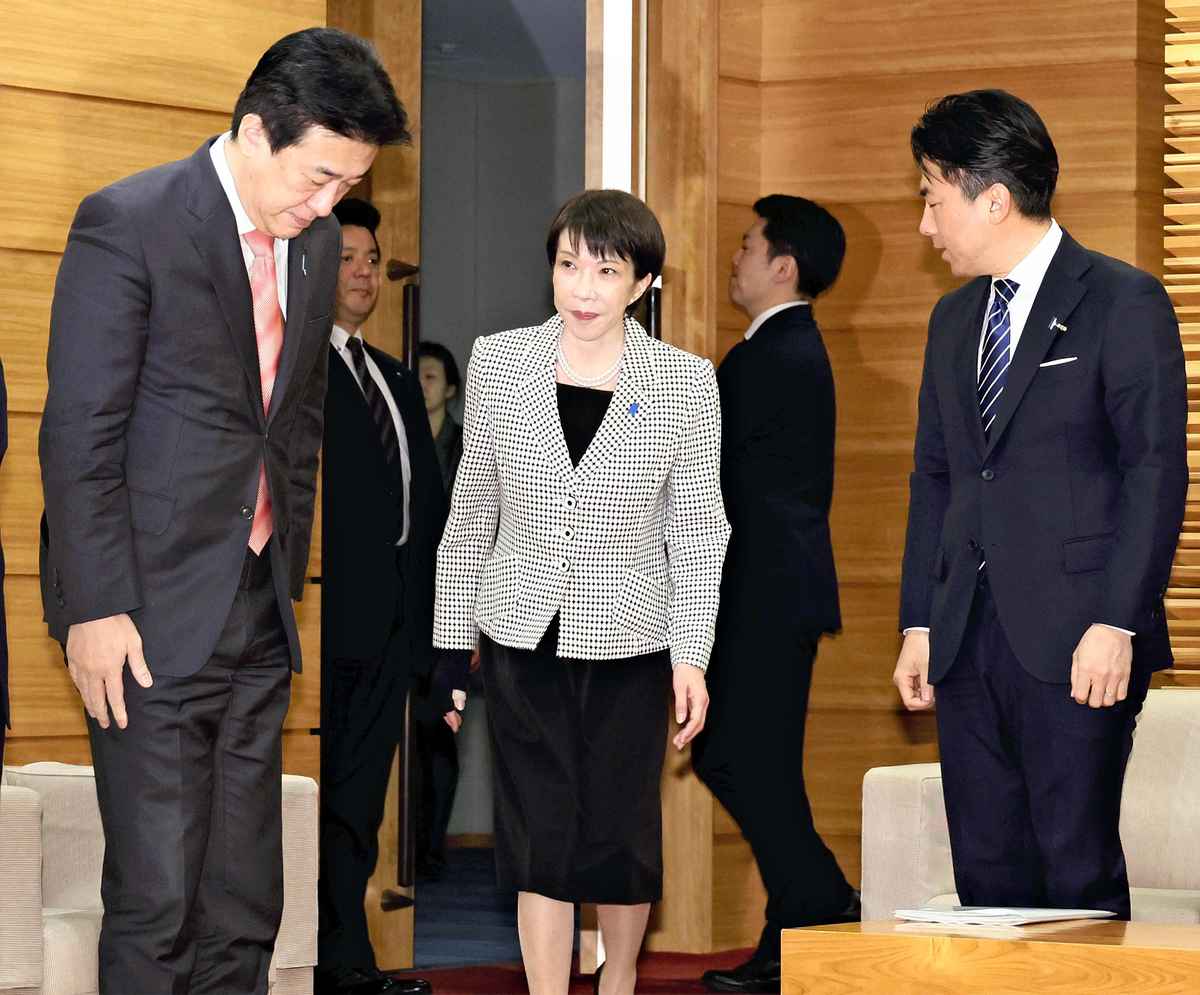
From left, Chief Cabinet Secretary Minoru Kihara, Prime Minister Sanae Takaichi and Defense Minister Shinjiro Koizumi attend a Cabinet meeting at the Prime Minister’s Office on Tuesday morning.
21:00 JST, February 11, 2026
Following the ruling Liberal Democratic Party’s historic victory in the House of Representatives election on Sunday, Prime Minister and LDP President Sanae Takaichi is moving ahead at full steam to realize her party’s policy pledges.
Takaichi will in particular speed up discussions on consumption tax cuts and the introduction of a system for “tax credits with cash payments” at an interparty national council. She is also expected to take the lead in promoting constitutional amendments and other conservative policies that she has supported for many years.
Among the LDP’s election pledges, Takaichi gives special priority to reducing the burden of taxes and social insurance premiums on middle- and low-income earners. At a press conference Monday, she stressed her commitment to introducing the “tax credits with cash payments” system, which would combine income tax cuts and cash benefits, and said it is at the “core” of planned reforms.
As it will take time to secure the data about income and other factors necessary to realize the policy, Takaichi has positioned zero consumption tax on food products as a “two-year stopgap measure.”
Systematic design
The systematic designs for these policies will be discussed at the interparty national council, which will include policy chiefs from both ruling and opposition parties. “We want to establish the council as quickly as possible and concurrently discuss the two policies to reach a conclusion,” Chief Cabinet Secretary Minoru Kihara said at a press conference Tuesday.
Takaichi said Monday, “We want to draft an interim plan at the national council before summer.”
To ensure speedy discussions, the prime minister intends to only allow opposition parties that support the tax credits with cash payments idea to participate in the council. A senior official at the Prime Minister’s Office said, “We will hold discussions at the national council with parties that share the same view, and in the Diet with those that do not.”
Some government officials believe the government should reflect the discussions at the national council in the “Basic Policy on Economic and Fiscal Management and Reform,” which will be formulated by June. Related laws would then be established at next year’s ordinary Diet session and the policies will be implemented within fiscal 2027. A source close to the Finance Ministry described that as “a realistic schedule.”
However, during a debate by party leaders on the day before the official start of the lower house election campaign, Takaichi said that if the national council came to a conclusion by summer, she would “aim” to submit related bills in the extraordinary Diet session to be convened in autumn and implement the policies in fiscal 2026.
An aide close to her said, “If things are done in the shortest possible time frame, as the prime minister says, it is possible that relevant laws will be established in the extraordinary Diet session and implemented by the end of fiscal 2026.”
Covering drop in revenue
However, discussions at the national council will not be easy. The biggest challenge is how to secure financial resources to cover the ¥5 trillion decrease in annual tax revenue, as the parties’ positions on this matter differ greatly.
Takaichi has made it clear that she will not issue deficit-covering bonds for funding and said that the money should be raised through such measures as increasing nontax revenues and reviewing subsidies.
“The prime minister’s explanation is in line with the discussions she has had with us,” Finance Minister Satsuki Katayama said at a press conference Tuesday. “We will find the best way to realize our plan as soon as possible.”
There has been little discussion within the LDP over the consumption tax cuts. If Takaichi rushes to a conclusion without exhaustive discussion at the party’s Research Commission on the Tax System, there could be backlash from within the LDP.
In the financial markets, there are concerns that fiscal uncertainty associated with tax cuts could lead to higher yields and a weaker yen. It would also be politically difficult to raise the consumption tax rate again once it has been lowered.
“To avoid criticism after the consumption tax rate is lowered, it’s important to have discussions between ruling and opposition parties at the national council,” a senior government official said.


Related Tags



Most Read
Popular articles in the past 24 hours
-
Seeking Nuclear Waste Site, Japan Eyes Remote Island of Minami-To...
-

Japan Ministry Asks to Conduct Nuclear Waste Disposal-related Sur...
-

Total Lunar Eclipse Visible for Some in Japan, While Clouds Block...
-

WBC to Begin: All the Pieces are in Place for Japan’s Second Stra...
-

Milano Cortina 2026: Ceremony for Winter Paralympic Torch Relay T...
-

Tokyo High Court Upholds Unification Church Dissolution Order; Li...
-

CARTOON OF THE DAY (March 4)
-

Japan to Set Up National Intelligence Bureau as Hub for Counterin...
Popular articles in the past week
-
Tokyo Spends Big on Children, Wins Over Parents
-
Japan’s Miura, Kihara Announce Withdrawal from Figure Skating Wor...
-

South Korea Tightens Rules on Foreigners Buying Homes in Seoul Me...
-
BOJ Keeping Eye on Economy and Takaichi's ‘Proactive Fiscal Polic...
-
Tokyo Measles Patient Traveled to Fukuoka Aboard JAL Planes; Susp...
-
Nidec Chairman Resigns Amid Accounting Scandal at Major Japanese ...
-

Strait of Hormuz Closure Shakes Markets; Prolonged Closure Could ...
-

Tourists Ignore Safety Barriers Near Famous Zao ‘Snow Monsters’ i...
Popular articles in the past month
-

Producer Behind Pop Group XG Arrested for Cocaine Possession
-

Japan PM Takaichi’s Cabinet Resigns en Masse
-

Man Infected with Measles Reportedly Dined at Restaurant in Tokyo...
-

Israeli Ambassador to Japan Speaks about Japan’s Role in the Reco...
-

Videos Plagiarized, Reposted with False Subtitles Claiming ‘Ryuky...
-

Prudential Life Insurance Plans to Fully Compensate for Damages C...
-

Woman with Measles Visited Hospital in Tokyo Multiple Times Befor...
-

iPS Treatments Pass Key Milestone, but Broader Applications Far f...
Top Articles in Politics
-
Japan PM Takaichi’s Cabinet Resigns en Masse
-

Sanae Takaichi Elected Prime Minister of Japan; Keeps All Cabinet Appointees from Previous Term
-

Japan’s Govt to Submit Road Map for Growth Strategy in March, PM Takaichi to Announce in Upcoming Policy Speech
-

LDP Wins Landslide Victory, Secures Single-party Majority; Ruling Coalition with JIP Poised to Secure Over 300 seats (UPDATE 1)
-

LDP Wins Historic Landslide Victory
JN ACCESS RANKING
-
Producer Behind Pop Group XG Arrested for Cocaine Possession
-
Japan PM Takaichi’s Cabinet Resigns en Masse
-
Man Infected with Measles Reportedly Dined at Restaurant in Tokyo Station
-
Israeli Ambassador to Japan Speaks about Japan’s Role in the Reconstruction of Gaza
-
Videos Plagiarized, Reposted with False Subtitles Claiming ‘Ryukyu Belongs to China’; Anti-China False Information Also Posted in Japan