
Japanese Govt to Trial Offering Bidding Preference to Construction Firms Proposing Heat Wave Countermeasures
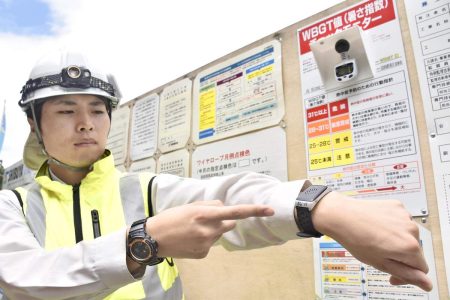
A worker wears a watch that sounds an alarm when one’s body heat or the ambient temperature gets too high in Yamagata in August.
21:00 JST, December 22, 2025
Land, Infrastructure, Transport and Tourism Ministry will trial a system next summer that gives preference to construction companies proposing heat wave countermeasures that utilize science and technology in their bids for civil engineering projects.
As heat waves become increasingly severe, the government aims to encourage innovative approaches to heatstroke prevention across the entire construction industry, with a goal of full implementation from 2027.
The ministry’s bidding primarily uses a scoring auction system, where technical capability, construction track record, price and other factors are scored. The contractor with the highest total score wins the bid.
According to sources, for some of the projects scheduled for bidding next summer, heat countermeasures utilizing science and technology will be added as an evaluation criterion under this scoring framework, and all participating contractors will be asked to submit proposals.
Possible countermeasures include introducing the latest technologies to shorten summer construction periods, utilizing remote operation to control heavy machinery from distant places such as indoor areas and managing workers’ risk of heatstroke through methods like measuring core body temperature.
Additionally, a system allowing contractors to choose summer construction schedules and working hours — such as suspending work during peak summer months — will be introduced next summer.
These measures will apply to all civil engineering projects except emergency work after events such as disasters. Special specifications detailing processes and construction methods will explicitly state that schedules and working hours can be flexibly set through consultation with clients. In addition to summer work stoppages, this will allow for early morning or late night work, as well as extended daytime breaks.
The ministry will soon announce these extreme heat countermeasures. “We will inform local governments and industry groups, aiming to expand these measures to projects commissioned by entities other than the national government,” said a ministry official.



Most Read
Popular articles in the past 24 hours
-
Prime Minister Sanae Takaichi to Visit Fukushima Pref. on 15th An...
-
Pass Rate for Overseas Driver's License Conversion Test in Japan ...
-
Tokyo High Court Upholds Unification Church Dissolution Order
-

WBC to Begin: All the Pieces are in Place for Japan’s Second Stra...
-

Milano Cortina 2026: Ceremony for Winter Paralympic Torch Relay T...
-

How Trump Assassination Attempts Played into His Decision to Atta...
-

Japanese Speedskater Takagi Announces Retirement
-
PM Sanae Takaichi: Iran Situation Won’t Immediately Affect Electr...
Popular articles in the past week
-
Tokyo Spends Big on Children, Wins Over Parents
-
Japan’s Miura, Kihara Announce Withdrawal from Figure Skating Wor...
-

Yokohama to Test Out Renewable-Powered Offshore Floating Data Cen...
-
BOJ Keeping Eye on Economy and Takaichi's ‘Proactive Fiscal Polic...
-
Tokyo Measles Patient Traveled to Fukuoka Aboard JAL Planes; Susp...
-
South Korea Tightens Rules on Foreigners Buying Homes in Seoul Me...
-
Nidec Chairman Resigns Amid Accounting Scandal at Major Japanese ...
-
Tourists Ignore Safety Barriers Near Famous Zao ‘Snow Monsters’ i...
Popular articles in the past month
-

Producer Behind Pop Group XG Arrested for Cocaine Possession
-

Japan PM Takaichi’s Cabinet Resigns en Masse
-

Man Infected with Measles Reportedly Dined at Restaurant in Tokyo...
-

Israeli Ambassador to Japan Speaks about Japan’s Role in the Reco...
-

Videos Plagiarized, Reposted with False Subtitles Claiming ‘Ryuky...
-

Prudential Life Insurance Plans to Fully Compensate for Damages C...
-

Woman with Measles Visited Hospital in Tokyo Multiple Times Befor...
-

iPS Treatments Pass Key Milestone, but Broader Applications Far f...
Top Articles in Politics
-
Japan PM Takaichi’s Cabinet Resigns en Masse
-

Sanae Takaichi Elected Prime Minister of Japan; Keeps All Cabinet Appointees from Previous Term
-

Japan’s Govt to Submit Road Map for Growth Strategy in March, PM Takaichi to Announce in Upcoming Policy Speech
-

LDP Wins Landslide Victory, Secures Single-party Majority; Ruling Coalition with JIP Poised to Secure Over 300 seats (UPDATE 1)
-

LDP Wins Historic Landslide Victory
JN ACCESS RANKING
-
Producer Behind Pop Group XG Arrested for Cocaine Possession
-
Japan PM Takaichi’s Cabinet Resigns en Masse
-
Man Infected with Measles Reportedly Dined at Restaurant in Tokyo Station
-
Israeli Ambassador to Japan Speaks about Japan’s Role in the Reconstruction of Gaza
-
Videos Plagiarized, Reposted with False Subtitles Claiming ‘Ryukyu Belongs to China’; Anti-China False Information Also Posted in Japan