
Yomiuri Survey: DPFP Loses Support After Failing to Unify Opposition Parties, Tamaki May Be Seen as Indecisive
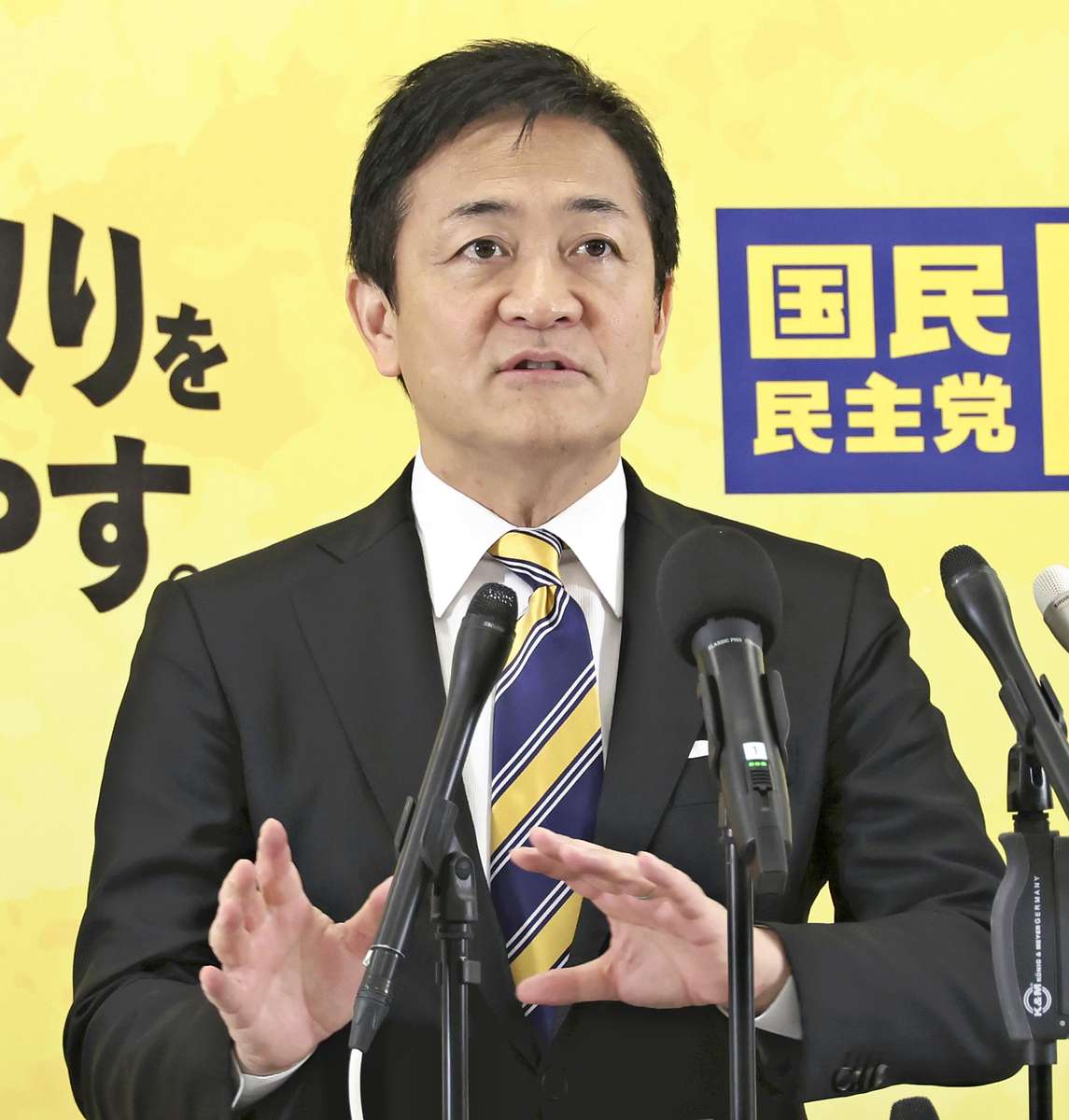
Yuichiro Tamaki speaks at the press conference on Tuesday in Tokyo.
15:44 JST, October 23, 2025
Support for the Democratic Party for the People has dropped to 5%, down four points from the previous survey results in September, according to a survey conducted by The Yomiuri Shimbun on Oct. 21-22.
One possible reason for the decline in support was party leader Yuichiro Tamaki’s perceived indecisiveness in negotiations with opposition and ruling parties ahead of the election for prime minister at the extraordinary Diet session. The DPFP ultimately failed to reach an agreement with other parties despite Tamaki’s declaration that, “I am prepared to serve as prime minister.”
Regarding the factors behind the decline in party support, Tamaki said, “Support may have shifted to the Liberal Democratic Party from our party after the LDP elected Takaichi, whose economic policies overlap with ours,” when speaking with The Yomiuri Shimbun on Wednesday.
After Sanae Takaichi was elected as LDP president on Oct.4, she requested the DPFP consider cooperation including that the party join the LDP in a coalition. However, Tamaki indicated he would prioritize policy implementation over cooperation, causing negotiations to stall.
The Constitutional Democratic Party of Japan named Tamaki as a possible strong joint candidate of the opposition parties for prime minister and explored potential cooperation with the Japan Innovation Party and DPFP. As a condition to accept cooperation between opposition parties, Tamaki demanded the CDPJ align with the DPFP on fundamental policies, such as energy and security, but they could not close the gap.
In the survey, while those who responded that they hoped for “the continuation of the LDP-centered government” stood at 58%, up from 35% from the survey in July, respondents who sought “the change of government to be opposition centered” declined from 47% to 26%.
Tamaki said, “Had the CDPJ adopted more realistic policies, a joint opposition candidate for prime minister would have been possible.” He added, “Perhaps people concluded that a government led by the largest opposition party [CDPJ] was not possible.”
CDPJ leader Yoshihiko Noda, asked Wednesday about the decline of support for the DPFP, pointed out “The reason could be the fact that the DPFP was not clear [on whether they were for forming a coalition with the LDP or cooperating with opposition parties].”
A sense of crisis has been spreading within the DPFP, as one junior member said, “We lost support partly because Tamaki was seen as lacking in determination to become prime minister.”





Most Read
Popular articles in the past 24 hours
-

Business Hotels Expanding into Regional Areas in Japan, Aiming to...
-

6 Injured at Naked Festival in Japan’s Okayama Prefecture; Police...
-

Fiji Defense Minister Hopes Japan Will Support Stabilization of P...
-

Space One Delays Launch of No. 3 Kairos Rocket; Company to Announ...
-

Milano Cortina 2026: Malinin Highlights Dangers of Social Media i...
-

Reciprocal Tariffs Ruled Illegal: Judiciary Would Not Tolerate Pr...
-

Japanese Film, Anymart, Wins Critics’ Award at International Film...
-

3rd Japan Pacific Islands Defense Dialogue to Begin in Tokyo on S...
Popular articles in the past week
-

Japan PM Takaichi’s Cabinet Resigns en Masse
-

Man Infected with Measles Reportedly Dined at Restaurant in Tokyo...
-

Sanae Takaichi Elected Prime Minister of Japan; Keeps All Cabinet...
-

Japan's Govt to Submit Road Map for Growth Strategy in March, PM ...
-

Bus Carrying 40 Passengers Catches Fire on Chuo Expressway; All E...
-

Milano Cortina 2026: Figure Skaters Riku Miura, Ryuichi Kihara Pa...
-

Japan, U.S. Name 3 Inaugural Investment Projects; Reached Agreeme...
-

U.S. Firm to Build Training Hub in Fukushima N-plant for Debris R...
Popular articles in the past month
-
Japan PM Takaichi’s Cabinet Resigns en Masse
-

Japan Institute to Use Domestic Commercial Optical Lattice Clock ...
-

Israeli Ambassador to Japan Speaks about Japan’s Role in the Reco...
-
Man Infected with Measles Reportedly Dined at Restaurant in Tokyo...
-

Videos Plagiarized, Reposted with False Subtitles Claiming ‘Ryuky...
-

Man Infected with Measles May Have Come in Contact with Many Peop...
-

Prudential Life Insurance Plans to Fully Compensate for Damages C...
-

Woman with Measles Visited Hospital in Tokyo Multiple Times Befor...
Top Articles in Politics
-
Japan PM Takaichi’s Cabinet Resigns en Masse
-
Sanae Takaichi Elected Prime Minister of Japan; Keeps All Cabinet Appointees from Previous Term
-
Japan’s Govt to Submit Road Map for Growth Strategy in March, PM Takaichi to Announce in Upcoming Policy Speech
-

LDP Wins Historic Landslide Victory
-

LDP Wins Landslide Victory, Secures Single-party Majority; Ruling Coalition with JIP Poised to Secure Over 300 seats (UPDATE 1)
JN ACCESS RANKING
-
Japan PM Takaichi’s Cabinet Resigns en Masse
-
Japan Institute to Use Domestic Commercial Optical Lattice Clock to Set Japan Standard Time
-
Israeli Ambassador to Japan Speaks about Japan’s Role in the Reconstruction of Gaza
-
Man Infected with Measles Reportedly Dined at Restaurant in Tokyo Station
-
Videos Plagiarized, Reposted with False Subtitles Claiming ‘Ryukyu Belongs to China’; Anti-China False Information Also Posted in Japan