
Women Express Hope as Takaichi Breaks Glass Ceiling, Offers Prospect of Changes for Japan
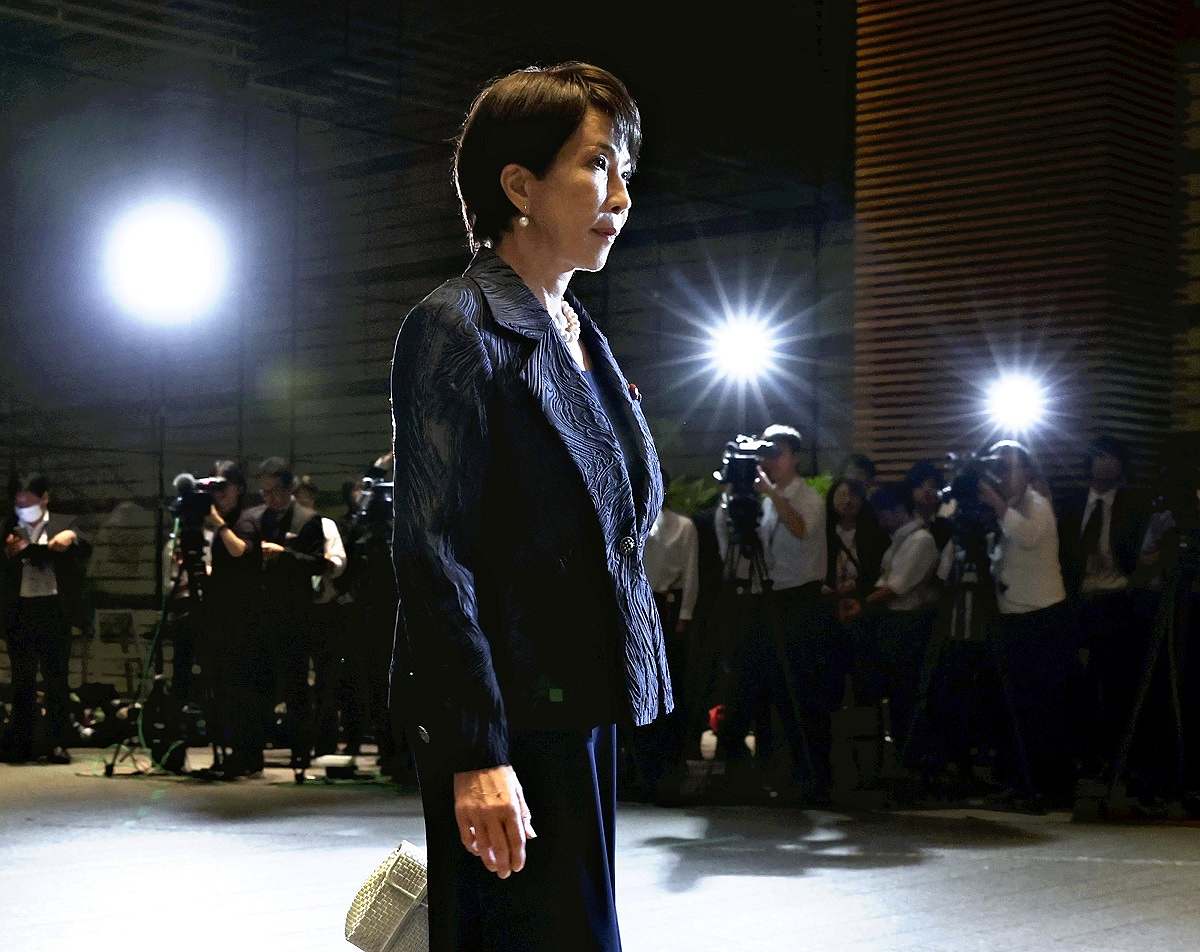
Liberal Democratic Party President Sanae Takaichi leaves the Prime Minister’s Office for her investiture ceremony at the Imperial Palace on Tuesday.
1:00 JST, October 23, 2025
Japan’s highest glass ceiling has been shattered for the first time in the country’s constitutional history.
On Tuesday, Liberal Democratic Party President Sanae Takaichi pledged to “work boldly without fear of change” when she became the nation’s first female prime minister, and her supporters and women in the country have expressed hopes for the future, including a hope that Japan may change.
5th in G7
The House of Representatives erupted with voices when it was announced at about 1:45 p.m. that Takaichi had secured 237 votes — four more than the majority — in the lower house’s prime ministerial election. After standing and bowing her head, Takaichi looked relieved.
At her office in Yamatokoriyama City, Nara Prefecture, her home turf, about 15 supporters had gathered to watch a televised broadcast of the election. Osamu Kikuchi, 66, chairman of an association of Takaichi’s supporters, rejoiced. “A woman has become the top leader,” he said. “This could be a chance to change Japan, where there’s a lingering sense of stagnation.”
The term glass ceiling describes an invisible barrier that hinders women’s advancement in society. In politics, former Environment Minister Yuriko Koike, former Internal Affairs and Communications Minister Seiko Noda and former Justice Minister Yoko Kamikawa have all tried to become president of the LDP with the aim of becoming prime minister, only to lose.
Takaichi secured the leadership position on her third attempt since 2021. Japan will be the fifth country with a female head of government to attend the Group of Seven summit, following Britain, Canada, Germany and Italy. Koike, who in 2016 transitioned from being a member of the House of Representatives to Tokyo’s first female governor, congratulated Takaichi on Tuesday, telling reporters, “I have high hopes for her, including in terms of women’s advancement.”
A 42-year-old female animator raising her 10-year-old daughter in Yokohama, expressed hope. “I want her to make life easier for those raising children,” she said.
Only 2 female ministers
Takaichi has only appointed two female ministers to her administration. Furthermore, women currently make up only 15.5% of lawmakers in the lower house and 29.8% in the House of Councillors. According to a survey by the Inter-Parliamentary Union and others, the proportion of female lawmakers in Japan’s lower house ranked 141st out of about 190 countries as of Oct. 1.
Japan has an environment that makes it difficult for women to work as lawmakers. In 2020, Sayo Honme, representative director of the organization “Woman Shift”, which is comprised of 50 female local assembly members, submitted a request to Takaichi, who at the time was the internal affairs and communications minister. Honme, who is also a member of the Taito Ward Assembly in Tokyo, requested that women be allowed to use their maiden names when running for election. Three days later, the ministry issued a notice to all local governments clearing the way for Homme’s request to become a reality.
“[Takaichi] understands the hardships faced by female lawmakers,” Honme, 43, said. “We hope she will advance reforms that make it easier for female lawmakers to work.”
At the press conference where Takaichi announced that she would run in the LDP presidential election, she revealed that she started suffering menopausal symptoms like excessive sweating in her 40s. The doctor who treated her said that Takaichi told her: “I’ve realized that Japan doesn’t properly address women’s health issues, so I want to promote measures to do that.”
The doctor said, “I hope she will bring about systems that enable Japanese women to live comfortable and fulfilling lives.”
Adaption to male-dominated culture
“Takaichi has risen to the top by adapting to a male-dominated political culture, so it’s difficult to say if she will become a role model for many women,” said Kiriu Minashita, professor of gender studies at Kokugakuin University. However, the professor added: “A woman becoming prime minister is symbolic and will influence changes in gender awareness in society going forward. I have hopes for her abilities to execute policies.”







Most Read
Popular articles in the past 24 hours
-

Business Hotels Expanding into Regional Areas in Japan, Aiming to...
-

6 Injured at Naked Festival in Japan’s Okayama Prefecture; Police...
-

Fiji Defense Minister Hopes Japan Will Support Stabilization of P...
-

Space One Delays Launch of No. 3 Kairos Rocket; Company to Announ...
-

Milano Cortina 2026: Malinin Highlights Dangers of Social Media i...
-

Reciprocal Tariffs Ruled Illegal: Judiciary Would Not Tolerate Pr...
-

Japanese Film, Anymart, Wins Critics’ Award at International Film...
-

3rd Japan Pacific Islands Defense Dialogue to Begin in Tokyo on S...
Popular articles in the past week
-

Japan PM Takaichi’s Cabinet Resigns en Masse
-

Man Infected with Measles Reportedly Dined at Restaurant in Tokyo...
-

Sanae Takaichi Elected Prime Minister of Japan; Keeps All Cabinet...
-

Japan's Govt to Submit Road Map for Growth Strategy in March, PM ...
-

Bus Carrying 40 Passengers Catches Fire on Chuo Expressway; All E...
-

Milano Cortina 2026: Figure Skaters Riku Miura, Ryuichi Kihara Pa...
-

Japan, U.S. Name 3 Inaugural Investment Projects; Reached Agreeme...
-

U.S. Firm to Build Training Hub in Fukushima N-plant for Debris R...
Popular articles in the past month
-
Japan PM Takaichi’s Cabinet Resigns en Masse
-

Japan Institute to Use Domestic Commercial Optical Lattice Clock ...
-

Israeli Ambassador to Japan Speaks about Japan’s Role in the Reco...
-
Man Infected with Measles Reportedly Dined at Restaurant in Tokyo...
-

Videos Plagiarized, Reposted with False Subtitles Claiming ‘Ryuky...
-

Man Infected with Measles May Have Come in Contact with Many Peop...
-

Prudential Life Insurance Plans to Fully Compensate for Damages C...
-

Woman with Measles Visited Hospital in Tokyo Multiple Times Befor...
Top Articles in Politics
-
Japan PM Takaichi’s Cabinet Resigns en Masse
-
Sanae Takaichi Elected Prime Minister of Japan; Keeps All Cabinet Appointees from Previous Term
-
Japan’s Govt to Submit Road Map for Growth Strategy in March, PM Takaichi to Announce in Upcoming Policy Speech
-

LDP Wins Historic Landslide Victory
-

LDP Wins Landslide Victory, Secures Single-party Majority; Ruling Coalition with JIP Poised to Secure Over 300 seats (UPDATE 1)
JN ACCESS RANKING
-
Japan PM Takaichi’s Cabinet Resigns en Masse
-
Japan Institute to Use Domestic Commercial Optical Lattice Clock to Set Japan Standard Time
-
Israeli Ambassador to Japan Speaks about Japan’s Role in the Reconstruction of Gaza
-
Man Infected with Measles Reportedly Dined at Restaurant in Tokyo Station
-
Videos Plagiarized, Reposted with False Subtitles Claiming ‘Ryukyu Belongs to China’; Anti-China False Information Also Posted in Japan