
Beloved Former PM ‘Ton-Chan’ Dedicated Himself to Helping Victims; Murayama Supported Victims of Sarin Attack, Minamata Disease, Atomic Bombings
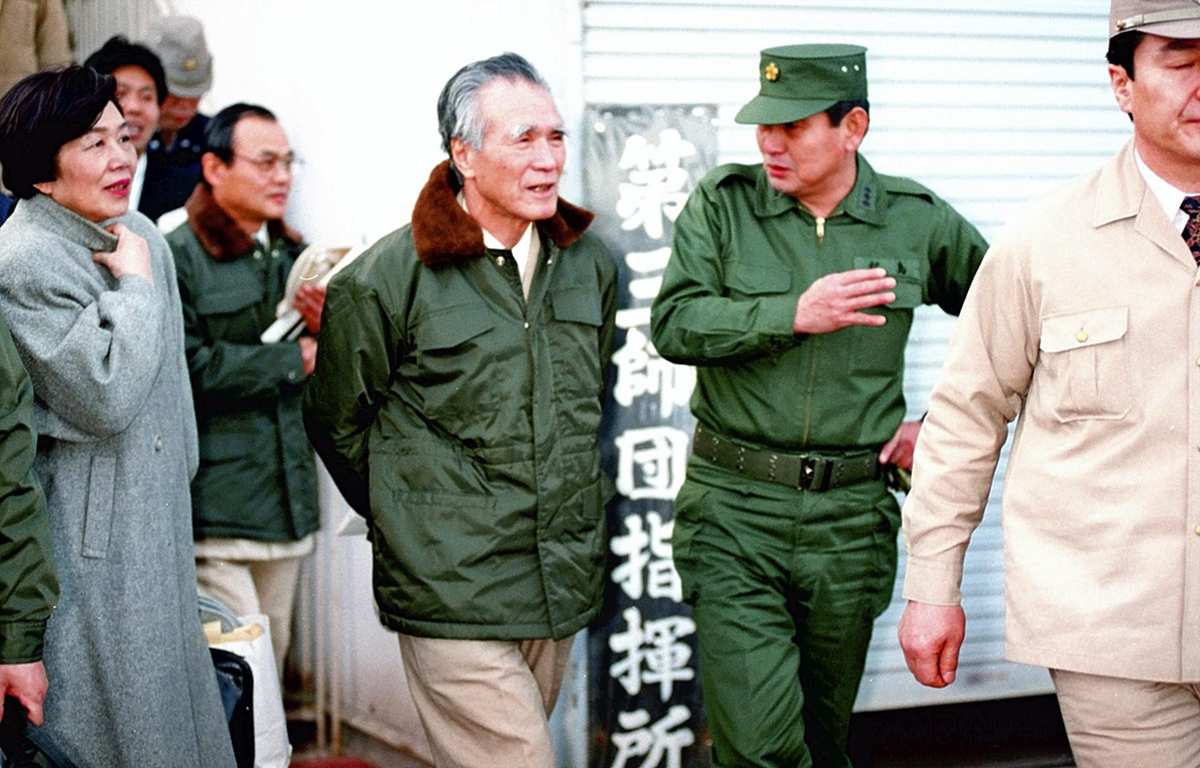
Then Prime Minister Tomiichi Murayama, center, and then House of Representatives Speaker Takako Doi, left, visit an area affected by the Great Hanshin Earthquake, in this photo taken on Jan. 19, 1995, in Kobe.
6:00 JST, October 19, 2025
Former Prime Minister Tomiichi Murayama, known for his trademark long eyebrows and nickname “Ton-chan,” passed away on Friday at the age of 101. During his tenure as prime minister, he advocated “politics gentle to people” and tackled such crises as the Tokyo subway sarin gas attack and the Great Hanshin Earthquake, both of which occurred in 1995.
Those close to him and people from his hometown, Oita, are mourning his death.
Crisis management tests leadership
During his premiership from 1994 to 1996, Murayama’s leadership was tested by successive large-scale incidents and disasters.
In March 1995, the sarin attack, committed by the Aum Supreme Truth cult, occurred.
In December that year, the Murayama administration requested that the cult be dissolved under the Subversive Activities Prevention Law. However, the request was rejected in 1997 by the Public Security Examination Commission , which found no reason to believe the cult would pose a danger in the future, a requirement for the dissolution.
After retiring from politics, Murayama contributed a memoir to a booklet published in 2007 by the “association of victims of the subway sarin incident.” He confessed, “Looking back on the years of sorrow and indignation endured by the victims, I felt renewed anger at this unforgivable act.” Thinking of the victims, he went on to write, “I pray for the swift arrival of peaceful days for them.”
Shizue Takahashi, 78, representative organizer of the victims’ association, recalled: “When we asked him to contribute a memoir, he readily agreed. Taking the leadership during such a big incident must have been incredibly difficult. We are deeply grateful for his consideration toward the victims.”
Two months before the incident in Tokyo, the Great Hanshin Earthquake had occurred, and the government was severely criticized for its delayed response. Former Hyogo Gov. Toshizo Ido, 80, affirmed that there were problems with the government’s initial response but praised the swift action that followed. “I am grateful [Murayama] directed the overall efforts and got the reconstruction started,” he said.
‘Politics gentle to people’
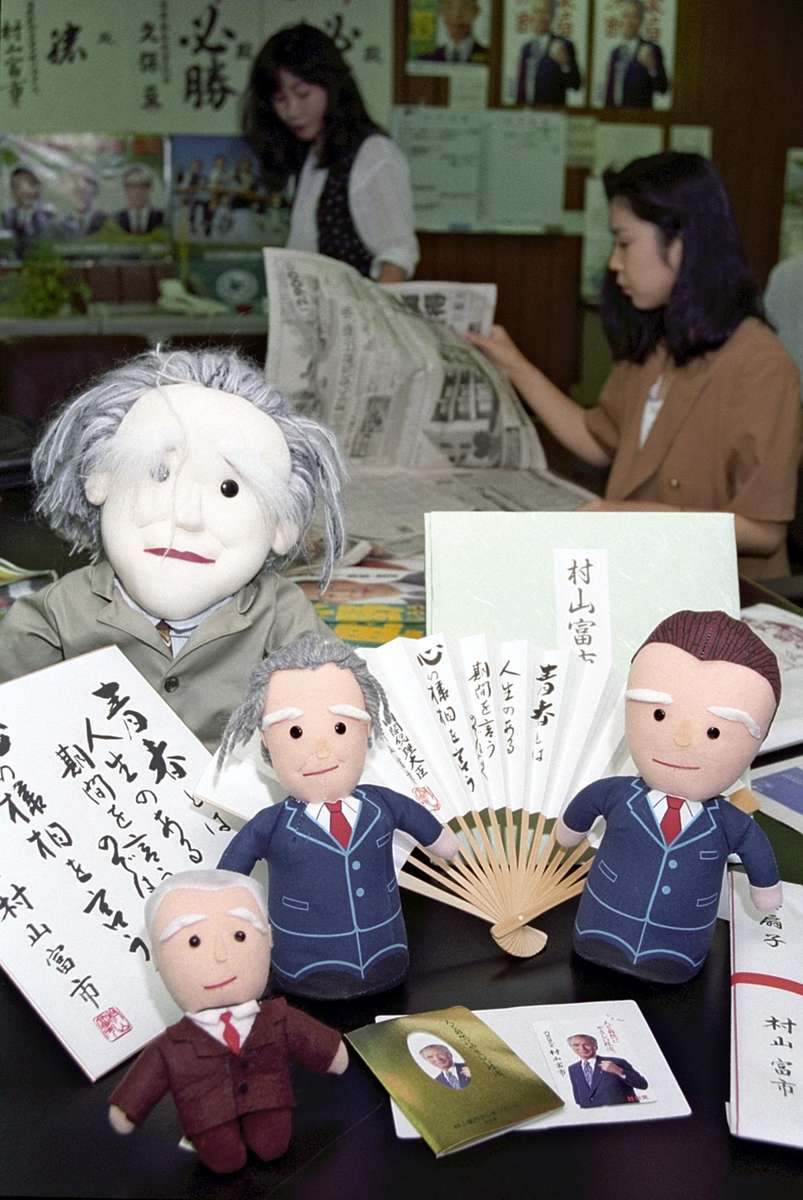
A “Ton-chan doll,” modeled after former Prime Minister Murayama, is seen in this photo taken in 1994.
Murayama dedicated himself to enacting the A-Bomb Survivors’ Support Law, which went into effect in 1994. The law stipulates that the national government will fully cover medical expenses for A-bomb-related illnesses.
“Unlike previous prime ministers, he worked hard to improve the victims’ situation while facing the survivors,” said Masao Tomonaga, 82, chairman of the Nagasaki Hibakusya Notebook Friendship Association, expressing thanks.
The former prime minister also strove to support victims of Minamata disease. In 1995, he made a move to provide lump-sum payments and medical expense coverage to people suffering from Minamata disease who are not officially recognized patients.
A 71-year-old secretary-general of a group for the unrecognized victims praised the move as “a historic decision that created a trend for the government to help people it had refused to recognize as patients.”
Approachable personality
Murayama, who continued to live at his home in Oita after he was prime minister, was beloved by his community for his approachable personality.
Until a few years ago, he enjoyed watching mikoshi portable shrines being carried at local festivals and even played the taiko drums. Around spring this year, he was seen going for a walk with the support of his family.
Murayama fell ill about a month and a half ago and was hospitalized at a hospital in Oita, according to officials of the Oita prefectural chapter of the Social Democratic Party. He was briefly discharged but later hospitalized again for rehabilitation and other reasons. He passed away peacefully at the hospital surrounded by his family and others.




Most Read
Popular articles in the past 24 hours
-

Business Hotels Expanding into Regional Areas in Japan, Aiming to...
-

6 Injured at Naked Festival in Japan’s Okayama Prefecture; Police...
-

Fiji Defense Minister Hopes Japan Will Support Stabilization of P...
-

Space One Delays Launch of No. 3 Kairos Rocket; Company to Announ...
-

Milano Cortina 2026: Malinin Highlights Dangers of Social Media i...
-

Reciprocal Tariffs Ruled Illegal: Judiciary Would Not Tolerate Pr...
-
Japanese Film, Anymart, Wins Critics’ Award at International Film...
-

3rd Japan Pacific Islands Defense Dialogue to Begin in Tokyo on S...
Popular articles in the past week
-

Japan PM Takaichi’s Cabinet Resigns en Masse
-

Man Infected with Measles Reportedly Dined at Restaurant in Tokyo...
-

Sanae Takaichi Elected Prime Minister of Japan; Keeps All Cabinet...
-
Japan's Govt to Submit Road Map for Growth Strategy in March, PM ...
-

Bus Carrying 40 Passengers Catches Fire on Chuo Expressway; All E...
-

Milano Cortina 2026: Figure Skaters Riku Miura, Ryuichi Kihara Pa...
-
Japan, U.S. Name 3 Inaugural Investment Projects; Reached Agreeme...
-

U.S. Firm to Build Training Hub in Fukushima N-plant for Debris R...
Popular articles in the past month
-
Japan PM Takaichi’s Cabinet Resigns en Masse
-

Japan Institute to Use Domestic Commercial Optical Lattice Clock ...
-

Israeli Ambassador to Japan Speaks about Japan’s Role in the Reco...
-
Man Infected with Measles Reportedly Dined at Restaurant in Tokyo...
-

Videos Plagiarized, Reposted with False Subtitles Claiming ‘Ryuky...
-

Man Infected with Measles May Have Come in Contact with Many Peop...
-

Prudential Life Insurance Plans to Fully Compensate for Damages C...
-

Woman with Measles Visited Hospital in Tokyo Multiple Times Befor...
Top Articles in Politics
-
Japan PM Takaichi’s Cabinet Resigns en Masse
-
Sanae Takaichi Elected Prime Minister of Japan; Keeps All Cabinet Appointees from Previous Term
-
Japan’s Govt to Submit Road Map for Growth Strategy in March, PM Takaichi to Announce in Upcoming Policy Speech
-

LDP Wins Historic Landslide Victory
-

LDP Wins Landslide Victory, Secures Single-party Majority; Ruling Coalition with JIP Poised to Secure Over 300 seats (UPDATE 1)
JN ACCESS RANKING
-
Japan PM Takaichi’s Cabinet Resigns en Masse
-
Japan Institute to Use Domestic Commercial Optical Lattice Clock to Set Japan Standard Time
-
Israeli Ambassador to Japan Speaks about Japan’s Role in the Reconstruction of Gaza
-
Man Infected with Measles Reportedly Dined at Restaurant in Tokyo Station
-
Videos Plagiarized, Reposted with False Subtitles Claiming ‘Ryukyu Belongs to China’; Anti-China False Information Also Posted in Japan