
Japan, Malaysia Sign Memorandum on Carbon Capture, Storage, but Realizing Commercialization Comes with Challenges
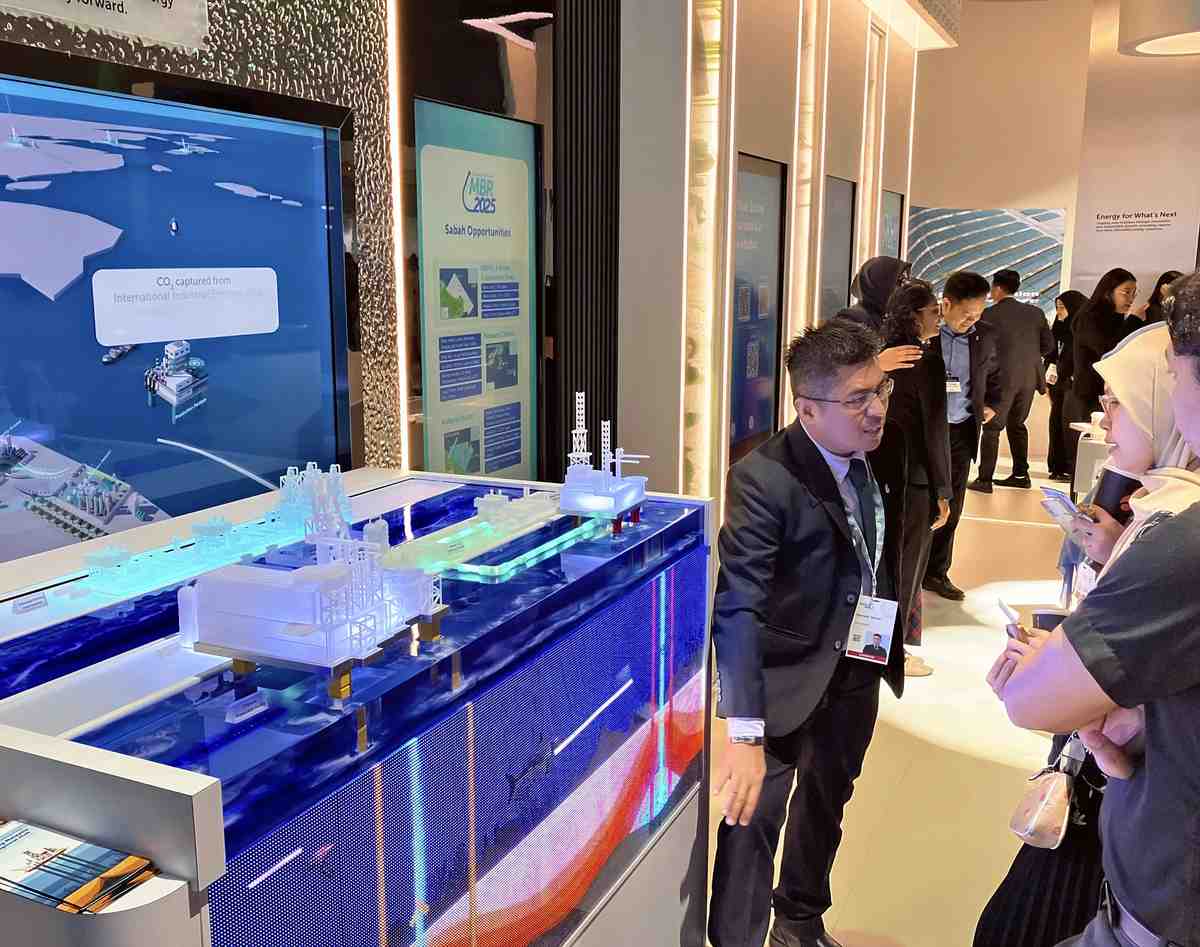
Malaysian state-run oil company Petronas holds an exhibition on carbon capture and storage in Kuala Lumpur.
16:38 JST, October 18, 2025
KUALA LUMPUR — The Japanese and Malaysian governments signed on Friday a memorandum for jointly promoting carbon capture and storage (CCS).
CCS is seen a promising technology to help realize carbon neutrality.
Though the Japanese government aims to accelerate decarbonization efforts by enhancing cooperation with Malaysia, there are many challenges to overcome in achieving the commercialization of CCS.
Economy, Trade and Industry Minister Yoji Muto held talks with Malaysia’s Science, Technology and Innovation Minister Chang Lih Kang, in Kuala Lumpur on Friday. They signed the memorandum on bilateral cooperation and enhancing information sharing on CCS.
At a press conference after the meeting, Muto emphasized the significance of the memorandum saying, “It is a great step toward the realization of businesses to transport and store CO2 in Malaysia.”
CCS involves the capture of CO2 emitted from manufacturing plants and thermal power plants, among other locations, and then storing the gas underground. The technology is attracting attention as it reduces the amount of CO2 emitted into the atmosphere and helps tackle the problem of global warming.
The Japanese government aims for the commercialization of CCS systems in around 2030.
Malaysia is a country with rich natural resources, including plentiful reserves of natural gas and oil. The country also has depleted oil wells and gas fields located in hard ground, which can easily be converted into storage sites for CO2.
For CO2 to be stored in Japan, it would be necessary to search for viable sites from which the CO2 cannot escape. Such searches would be time-consuming and costly because of the need to collect geological data. Transporting CO2 from Japan and storing it in Malaysia would save this time and money.
The Economy, Trade and Industry Ministry launched the Advanced CCS Projects initiative in fiscal 2023 to support the commercialization of CCS by providing companies with subsidies for relevant research.
The ministry has selected nine projects to date. Of them, three assume that storage will be conducted in Malaysia and that the country will store about 50% of the Japan’s target of about 20 million tons of CO2 a year.
Petronas, a Malaysian state-run oil company, will take part in the project and conduct the research for storage sites and other factors alongside Japanese companies including ENEOS Corp., Cosmo Oil Co. and JFE Steel Corp.
Malaysia is positive on cooperation with Japan, with Malaysian Prime Minister Anwar Bin Ibrahim saying that CCS could be a new revenue source for the country. Japan and Malaysia hoped to boost momentum toward realizing cooperation through the signing of the memorandum.
High economic hurdles
However, building a viable business model will not be easy.
It will be necessary to liquefy the CO2 captured in Japan and transport it by ship. However, the construction of ships capable of carrying liquefied CO2 is still in the planning stage.
Even if the ships do enter practical use, transporting the CO2 overseas will require fuel. Also, the ships will sail in principle return to Japan with empty tanks.
An official of a major energy company said, “Securing profitability is difficult and so the business cannot stand without subsidies from the government.”
At the press conference, Muto said: “Realizing the transportation and storage of CO2 to Malaysia will require technological progress in ship-based transportation and improvements in business environments. We will proceed with discussions over rules and other considerations with the Malaysian government.”





Most Read
Popular articles in the past 24 hours
-

Business Hotels Expanding into Regional Areas in Japan, Aiming to...
-

6 Injured at Naked Festival in Japan’s Okayama Prefecture; Police...
-

Fiji Defense Minister Hopes Japan Will Support Stabilization of P...
-

Space One Delays Launch of No. 3 Kairos Rocket; Company to Announ...
-

Milano Cortina 2026: Malinin Highlights Dangers of Social Media i...
-

Reciprocal Tariffs Ruled Illegal: Judiciary Would Not Tolerate Pr...
-

Japanese Film, Anymart, Wins Critics’ Award at International Film...
-
3rd Japan Pacific Islands Defense Dialogue to Begin in Tokyo on S...
Popular articles in the past week
-

Japan PM Takaichi’s Cabinet Resigns en Masse
-

Man Infected with Measles Reportedly Dined at Restaurant in Tokyo...
-

Sanae Takaichi Elected Prime Minister of Japan; Keeps All Cabinet...
-

Japan's Govt to Submit Road Map for Growth Strategy in March, PM ...
-

Bus Carrying 40 Passengers Catches Fire on Chuo Expressway; All E...
-

Milano Cortina 2026: Figure Skaters Riku Miura, Ryuichi Kihara Pa...
-

Japan, U.S. Name 3 Inaugural Investment Projects; Reached Agreeme...
-
U.S. Firm to Build Training Hub in Fukushima N-plant for Debris R...
Popular articles in the past month
-
Japan PM Takaichi’s Cabinet Resigns en Masse
-

Japan Institute to Use Domestic Commercial Optical Lattice Clock ...
-

Israeli Ambassador to Japan Speaks about Japan’s Role in the Reco...
-
Man Infected with Measles Reportedly Dined at Restaurant in Tokyo...
-

Videos Plagiarized, Reposted with False Subtitles Claiming ‘Ryuky...
-

Man Infected with Measles May Have Come in Contact with Many Peop...
-

Prudential Life Insurance Plans to Fully Compensate for Damages C...
-

Woman with Measles Visited Hospital in Tokyo Multiple Times Befor...
Top Articles in Politics
-
Japan PM Takaichi’s Cabinet Resigns en Masse
-
Sanae Takaichi Elected Prime Minister of Japan; Keeps All Cabinet Appointees from Previous Term
-
Japan’s Govt to Submit Road Map for Growth Strategy in March, PM Takaichi to Announce in Upcoming Policy Speech
-

LDP Wins Historic Landslide Victory
-

LDP Wins Landslide Victory, Secures Single-party Majority; Ruling Coalition with JIP Poised to Secure Over 300 seats (UPDATE 1)
JN ACCESS RANKING
-
Japan PM Takaichi’s Cabinet Resigns en Masse
-
Japan Institute to Use Domestic Commercial Optical Lattice Clock to Set Japan Standard Time
-
Israeli Ambassador to Japan Speaks about Japan’s Role in the Reconstruction of Gaza
-
Man Infected with Measles Reportedly Dined at Restaurant in Tokyo Station
-
Videos Plagiarized, Reposted with False Subtitles Claiming ‘Ryukyu Belongs to China’; Anti-China False Information Also Posted in Japan