
LDP, JIP Would Each Benefit From Political Tie-Up, But JIP Appears Unwilling to Make Concessions Easily
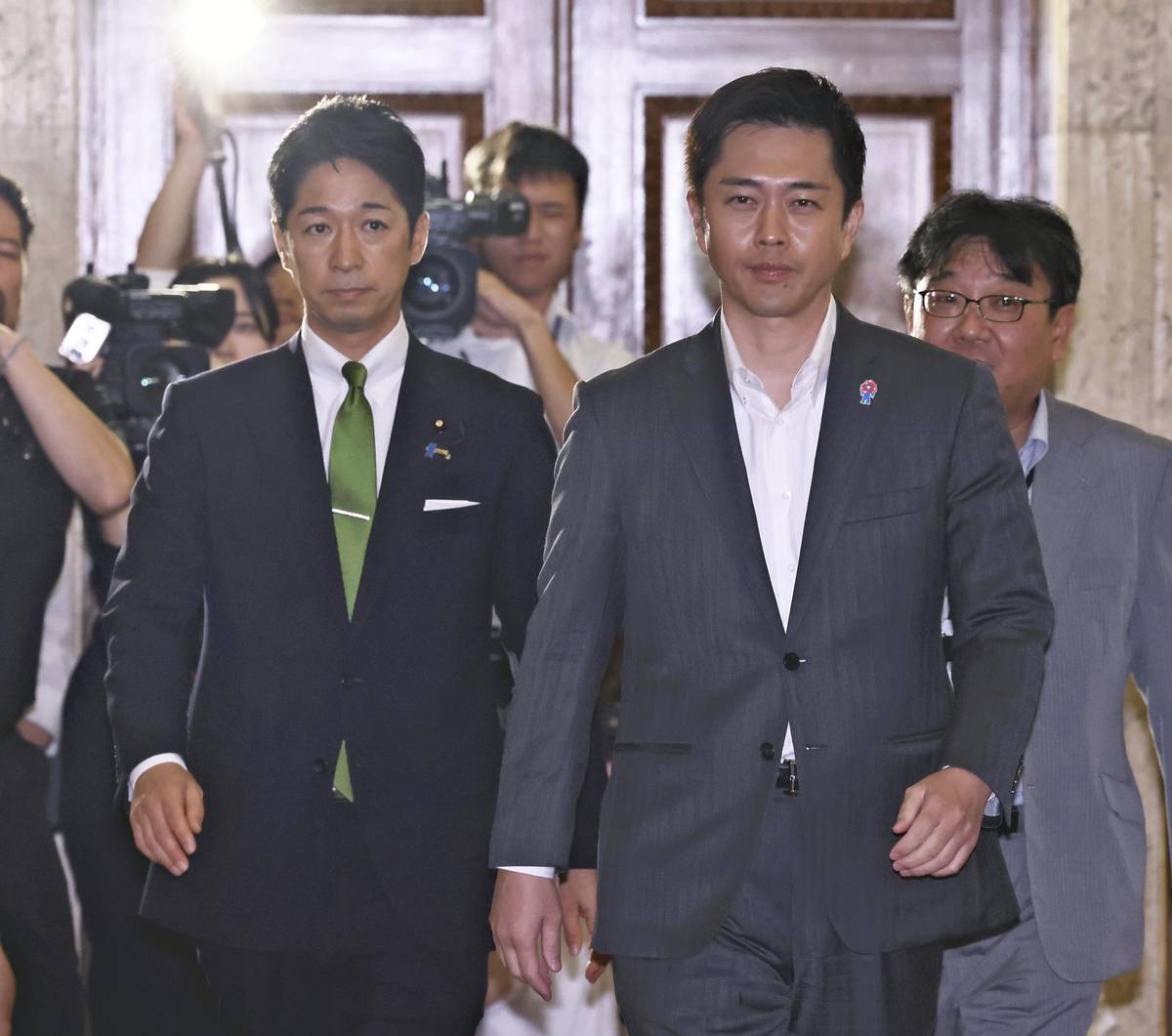
Japan Innovation Party leader Hirofumi Yoshimura, right, and co-leader Fumitake Fujita
16:35 JST, October 16, 2025
The decision by the Liberal Democratic Party and the Japan Innovation Party to hold policy discussions with a view to potentially forming a coalition reflects their shared understanding that such a collaboration could benefit both sides.
The LDP recently lost its coalition partner of 26 years, Komeito, while the JIP has been struggling to build up its support. In addition to addressing those predicaments, the sudden cozying up between the two parties has also muddied the prospects for the formation of an opposition government by the JIP, the Constitutional Democratic Party of Japan and the Democratic Party for the People.
LDP President Sanae Takaichi cut straight to the chase at the start of her meeting with JIP leader Hirofumi Yoshimura at the Diet Building on Wednesday afternoon.
“Let’s work together to move Japan forward,” Takaichi said as she sought the cooperation of Yoshimura, the governor of Osaka and who had traveled to Tokyo to attend the meeting.
Yoshimura said his party prioritized two key policies: social security reform and the JIP’s “secondary capital” initiative that would have Osaka take over the functions of the nation’s capital if a major disaster were to strike Tokyo.
Takaichi showed support for Yoshimura’s views, and the leaders swiftly agreed to start policy talks Thursday with a view to forming a coalition.
“I openly and honestly told him that I was requesting his cooperation in the prime ministerial election and on forming a tie-up,” Takaichi said to reporters after the meeting.
Takaichi had met DPFP leader Yuichiro Tamaki earlier that day to request his cooperation. However, Takaichi’s use of clear-cut language regarding her talks with Yoshimura revealed her expectations for a more positive outcome.
“I keenly felt her enthusiasm and her strong desire to move Japan forward,” Yoshimura said after the meeting.
A final hope
Takaichi’s schedule on Wednesday also included a meeting with CDPJ leader Yoshihiko Noda. If the opposition parties unite behind a single candidate in the vote to choose the next prime minister, Takaichi’s path to becoming Japan’s leader could be blocked. To prevent this from happening, Takaichi needed to drive a wedge between the JIP, CDPJ and DPFP.
Takaichi’s only hope was to pick off the JIP, the second-largest opposition party. The JIP was the only opposition party to vote in favor of the fiscal 2025 budget, and it currently is in negotiations with the LDP on social security reform and on making high school education free.
Furthermore, the JIP had secretly engaged in talks regarding a possible coalition with Agriculture, Forestry and Fisheries Minister Shinjiro Koizumi, whom Takaichi defeated in the LDP presidential election. The JIP kept its distance from Takaichi in the days after that election, watching events unfold from the sideline.
Takaichi also initially leaned toward seeking the cooperation of the DPFP, which was the preference of LDP Vice President Taro Aso, an influential supporter. Takaichi and Tamaki held talks in secret on the evening of Oct. 5.
Komeito’s decision to exit its coalition with the LDP turned Takaichi’s approach to the JIP on its head. Tamaki also adopted a more cautious stance because even a coalition comprising the LDP and the DPFP would not have enough seats to secure a majority.
With Takaichi running out of options for possible political partners, the stage was set for the JIP to make its move. The party believed the situation offered a “golden opportunity” to squeeze the maximum advantage for its policy demands. JIP Diet Affairs Committee Chairperson Takashi Endo, who has close personal connections to the LDP, met with his LDP counterpart Hiroshi Kajiyama on Tuesday and Wednesday and pushed for the quick launch of policy discussions.
Will demands be accepted?
Whether the LDP and the JIP form a coalition will depend on how those discussions pan out. Yoshimura is prepared to make a decision by Monday, the day before an extraordinary Diet session is scheduled to be convened. Although the full list of topics on the discussion agenda has not been revealed, it is possible that social security reform and the “secondary capital” initiative would be joined by issues including political funding reforms and reducing the number of Diet seats.
The JIP does not appear willing to make any easy concessions to the LDP. During advance discussions, the JIP notified the LDP that the talks “will simply boil down to whether you accept our demands or you don’t.” However, a close aide to Takaichi told The Yomiuri Shimbun that some members on the LDP side feel that even if the parties do not form a coalition that involved swallowing the JIP’s demands, “continuing discussions so the JIP doesn’t unite with the opposition parties would be enough.”
A prime minister is designated through an election among members of the House of Representatives and members of the House of Councillors. If the appointments of both chambers differ, the Constitution stipulates that the lower house’s choice takes precedence.
The LDP holds 196 seats in the lower chamber, while the CDPJ has 148, the JIP 35 and the DPFP 27, giving those three parties a combined 210 seats. Even if the JIP does not reach a policy agreement with the LDP under which its members would vote for Takaichi, having JIP members cast ballots for party coleader Fumitake Fujita — including in any runoff vote — would increase the likelihood of Takaichi becoming prime minister.
“It would be sensible to find common ground without bending over backwards too far,” a senior LDP official said.





Most Read
Popular articles in the past 24 hours
-

Business Hotels Expanding into Regional Areas in Japan, Aiming to...
-

6 Injured at Naked Festival in Japan’s Okayama Prefecture; Police...
-

Fiji Defense Minister Hopes Japan Will Support Stabilization of P...
-

Space One Delays Launch of No. 3 Kairos Rocket; Company to Announ...
-

Milano Cortina 2026: Malinin Highlights Dangers of Social Media i...
-

Reciprocal Tariffs Ruled Illegal: Judiciary Would Not Tolerate Pr...
-

Japanese Film, Anymart, Wins Critics’ Award at International Film...
-
3rd Japan Pacific Islands Defense Dialogue to Begin in Tokyo on S...
Popular articles in the past week
-

Japan PM Takaichi’s Cabinet Resigns en Masse
-

Man Infected with Measles Reportedly Dined at Restaurant in Tokyo...
-

Sanae Takaichi Elected Prime Minister of Japan; Keeps All Cabinet...
-

Japan's Govt to Submit Road Map for Growth Strategy in March, PM ...
-

Bus Carrying 40 Passengers Catches Fire on Chuo Expressway; All E...
-

Milano Cortina 2026: Figure Skaters Riku Miura, Ryuichi Kihara Pa...
-

Japan, U.S. Name 3 Inaugural Investment Projects; Reached Agreeme...
-

U.S. Firm to Build Training Hub in Fukushima N-plant for Debris R...
Popular articles in the past month
-
Japan PM Takaichi’s Cabinet Resigns en Masse
-

Japan Institute to Use Domestic Commercial Optical Lattice Clock ...
-

Israeli Ambassador to Japan Speaks about Japan’s Role in the Reco...
-
Man Infected with Measles Reportedly Dined at Restaurant in Tokyo...
-

Videos Plagiarized, Reposted with False Subtitles Claiming ‘Ryuky...
-

Man Infected with Measles May Have Come in Contact with Many Peop...
-

Prudential Life Insurance Plans to Fully Compensate for Damages C...
-

Woman with Measles Visited Hospital in Tokyo Multiple Times Befor...
Top Articles in Politics
-
Japan PM Takaichi’s Cabinet Resigns en Masse
-
Sanae Takaichi Elected Prime Minister of Japan; Keeps All Cabinet Appointees from Previous Term
-
Japan’s Govt to Submit Road Map for Growth Strategy in March, PM Takaichi to Announce in Upcoming Policy Speech
-

LDP Wins Historic Landslide Victory
-

LDP Wins Landslide Victory, Secures Single-party Majority; Ruling Coalition with JIP Poised to Secure Over 300 seats (UPDATE 1)
JN ACCESS RANKING
-
Japan PM Takaichi’s Cabinet Resigns en Masse
-
Japan Institute to Use Domestic Commercial Optical Lattice Clock to Set Japan Standard Time
-
Israeli Ambassador to Japan Speaks about Japan’s Role in the Reconstruction of Gaza
-
Man Infected with Measles Reportedly Dined at Restaurant in Tokyo Station
-
Videos Plagiarized, Reposted with False Subtitles Claiming ‘Ryukyu Belongs to China’; Anti-China False Information Also Posted in Japan