
Japan’s Ruling LDP Downplaying Komeito’s Deep Concerns About Politics, Money Issues Results in Coalition Split
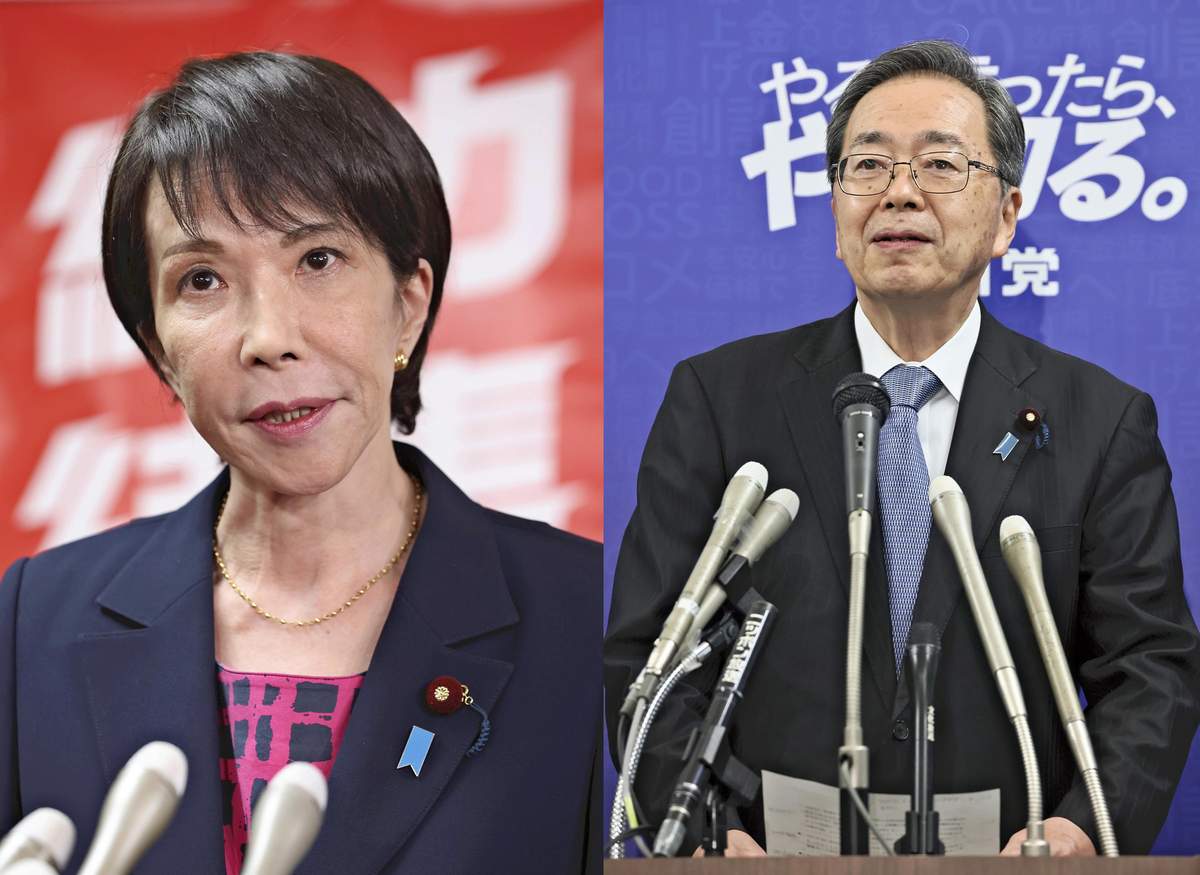
LDP President Sanae Takaichi, left, and Komeito leader Tetsuo Saito answer reporters’ questions on separate occasions in Chiyoda Ward, Tokyo, on Friday following talks between the two party leaders.
17:59 JST, October 11, 2025
The Liberal Democratic Party and Komeito have failed to bridge the rift that was exposed with the election of LDP President Sanae Takaichi, resulting in the end of their quarter-century coalition and leaving the political outlook even more uncertain.
The latest development was a consequence brought on by LDP executives themselves. They misjudged and downplayed Komeito’s deep concerns and strong backlash, particularly on the issues of politics and money, resulting in their failure to respond swiftly.
Response
The talks between Takaichi and Komeito leader Tetsuo Saito took place in the Diet Building on Friday afternoon.
The meeting, which later turned out to be a turning point for the LDP-Komeito alliance, lasted about 90 minutes, but it was notable as the parties disagreed over their fundamental stances.
Komeito thought that in Friday’s meeting, the LDP would provide its answer to strengthening regulations on donations by corporations and organizations — a condition presented by Komeito for maintaining the coalition government.
However, Takaichi repeatedly requested to continue negotiations, saying, “I want to take this matter back for more discussions within the party” and “I need three more days.”
Unlike Takaichi, Saito was given full authority by his party to handle coalition negotiations and said, “We want an answer right here and right now,” leaving no room for compromise.
Although LDP executives already believed it was impossible to accept Komeito’s proposal, their negotiation method was to just buy time and did not come in with any clear plan. On the other hand, the Komeito side believed it had given the LDP enough time to come to a decision.
Conservative-centrist stance
Komeito has taken a more hardline stance toward the LDP because its supporters’ frustrations over the issues of politics and money involving LDP factions has “reached the brink of explosion,” according to a senior Komeito member.
Like the LDP, Komeito suffered heavy losses in last October’s House of Representatives election and July’s House of Councillors election, leading more Komeito supporters to believe the poor performance was caused by politics and money issues.
After the meeting, Saito told reporters, “We’ve reached our limit in giving explanations to the public about the LDP’s scandals and supporting its candidates [in elections].”
To begin with, Komeito never anticipated that Takaichi, one of the most conservative figures within the LDP, would be elected as the party’s president.
Before the race, Saito said, “We cannot form a coalition government unless it is with someone who aligns with our conservative-centrist policies and principles.”
Komeito hardened its stance further when Takaichi made LDP executive appointments.
She picked Koichi Hagiuda as acting secretary general despite the fact that the former LDP policy research council chairperson was among those who failed to report funds in their political funds reports. In August, a policy secretary of Hagiuda received a summary order to pay a ¥300,000 fine for violating the Political Funds Control Law.
Hardliners against Komeito
Former Prime Minister Taro Aso, who recently assumed the post of LDP vice president under Takaichi’s leadership, criticized former Komeito leader Natsuo Yamaguchi and other Komeito executives in 2023, calling them “a cancer.”
The new LDP executives include other hardliners against Komeito, such as Election Strategy Committee Chairperson Keiji Furuya.
Former Prime Minister Yoshihide Suga, who has strong ties to Komeito’s supporting organization Soka Gakkai, was removed from his position as vice president. Komeito felt as if it was being “provoked.”
The fact that Takaichi secretly met with Democratic Party for the People leader Yuichiro Tamaki on Oct. 5 evening also fueled Komeito’s distrust of the LDP.
Lacking direct connections with Komeito, the new LDP executives under Takaichi failed to understand what Komeito was truly thinking. Until only a few days ago, they were overconfident, with one of the four main LDP leaders saying, “They’ll end up coming around anyway.”
According to sources, the LDP had proposed removing Hagiuda from his post during preliminary behind-the-scenes negotiations before Friday’s meeting but was met with a cold response from Komeito.
Impact on elections
The LDP is growing increasingly uneasy about the electoral repercussions following Komeito’s withdrawal from the ruling coalition. The uneasiness stems from years of mutual support in national elections, and now, there are fewer LDP lawmakers who can “secure a win without Komeito votes,” according to a former cabinet minister.
Especially in the lower house election, a framework has been established in which Soka Gakkai backs LDP candidates in single-seat constituencies. At the same time, the LDP calls for its supporters to vote for Komeito in the proportional representation segment of an election.
LDP candidates who secured Komeito’s endorsement could typically count on receiving an estimated 10,000 to 20,000 Komeito votes in each single-seat constituency. Losing this support could result in a wave of defeated LDP candidates in closely contested seats.
In Saitama Constituency No. 16, where more than 170,000 people voted in last year’s lower house election, an exit poll jointly conducted by The Yomiuri Shimbun and NTV affiliates found that 7% of respondents were Komeito supporters, roughly equating to 12,000 people.
Assuming they all voted for the LDP candidate, the loss of these votes would be enough to overturn the result. Shinako Tsuchiya, who won by a margin of 2,665 votes, would lose the seat.
By applying the same calculation to Hyogo Constituency No. 7, the LDP’s Kenji Yamada would also lose the seat.
“Without support from Komeito, 40 to 50 LDP lower house members could potentially lose their seats,” an LDP executive said.
For Komeito, too, winning in single-member constituencies would become difficult without LDP backing, and a reduction in proportional representation votes is inevitable.
“We should withdraw from single-seat constituencies and focus only on the proportional representation segment of the election and the upper house election,” a senior Komeito member said.
Saito, speaking about electoral cooperation on Friday, indicated that Komeito may continue supporting the LDP in some areas, noting there are “many regions where we can back [LDP members] based on their personal merits or policies.”
In the future, the LDP and Komeito will likely make moves to seek “mutual support,” particularly focusing on LDP lawmakers who maintain good relationships with Komeito.





Most Read
Popular articles in the past 24 hours
-
Business Hotels Expanding into Regional Areas in Japan, Aiming to...
-
6 Injured at Naked Festival in Japan’s Okayama Prefecture; Police...
-

Fiji Defense Minister Hopes Japan Will Support Stabilization of P...
-

Space One Delays Launch of No. 3 Kairos Rocket; Company to Announ...
-

Milano Cortina 2026: Malinin Highlights Dangers of Social Media i...
-

Reciprocal Tariffs Ruled Illegal: Judiciary Would Not Tolerate Pr...
-
Japanese Film, Anymart, Wins Critics’ Award at International Film...
-

3rd Japan Pacific Islands Defense Dialogue to Begin in Tokyo on S...
Popular articles in the past week
-

Japan PM Takaichi’s Cabinet Resigns en Masse
-

Man Infected with Measles Reportedly Dined at Restaurant in Tokyo...
-

Sanae Takaichi Elected Prime Minister of Japan; Keeps All Cabinet...
-

Japan's Govt to Submit Road Map for Growth Strategy in March, PM ...
-

Bus Carrying 40 Passengers Catches Fire on Chuo Expressway; All E...
-

Milano Cortina 2026: Figure Skaters Riku Miura, Ryuichi Kihara Pa...
-

Japan, U.S. Name 3 Inaugural Investment Projects; Reached Agreeme...
-
U.S. Firm to Build Training Hub in Fukushima N-plant for Debris R...
Popular articles in the past month
-
Japan PM Takaichi’s Cabinet Resigns en Masse
-

Japan Institute to Use Domestic Commercial Optical Lattice Clock ...
-

Israeli Ambassador to Japan Speaks about Japan’s Role in the Reco...
-
Man Infected with Measles Reportedly Dined at Restaurant in Tokyo...
-

Videos Plagiarized, Reposted with False Subtitles Claiming ‘Ryuky...
-

Man Infected with Measles May Have Come in Contact with Many Peop...
-

Prudential Life Insurance Plans to Fully Compensate for Damages C...
-

Woman with Measles Visited Hospital in Tokyo Multiple Times Befor...
Top Articles in Politics
-
Japan PM Takaichi’s Cabinet Resigns en Masse
-
Sanae Takaichi Elected Prime Minister of Japan; Keeps All Cabinet Appointees from Previous Term
-
Japan’s Govt to Submit Road Map for Growth Strategy in March, PM Takaichi to Announce in Upcoming Policy Speech
-

LDP Wins Historic Landslide Victory
-

LDP Wins Landslide Victory, Secures Single-party Majority; Ruling Coalition with JIP Poised to Secure Over 300 seats (UPDATE 1)
JN ACCESS RANKING
-
Japan PM Takaichi’s Cabinet Resigns en Masse
-
Japan Institute to Use Domestic Commercial Optical Lattice Clock to Set Japan Standard Time
-
Israeli Ambassador to Japan Speaks about Japan’s Role in the Reconstruction of Gaza
-
Man Infected with Measles Reportedly Dined at Restaurant in Tokyo Station
-
Videos Plagiarized, Reposted with False Subtitles Claiming ‘Ryukyu Belongs to China’; Anti-China False Information Also Posted in Japan