
Often Rocky 26-Year Political Partnership Ends as Komeito Leaves Coalition with LDP
20:00 JST, October 11, 2025
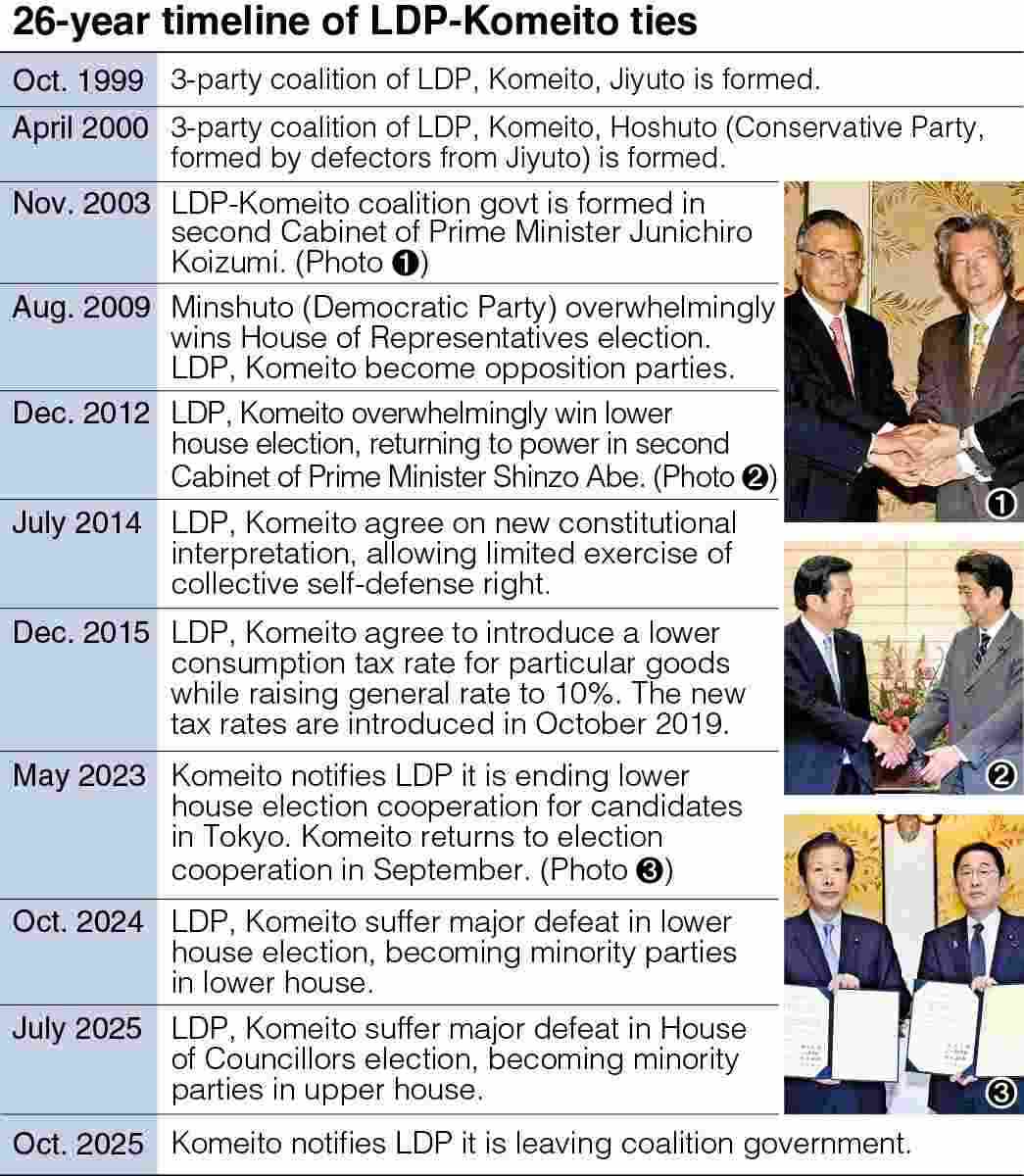
A sudden end was brought on Friday to the 26-year history of cooperation between the Liberal Democratic Party and Komeito. Though the two parties maintained their cooperative relationship even when the LDP fell into opposition, enduring tough times, Komeito’s dissatisfaction reached its peak over the LDP’s “politics and money” issues, driving Komeito to dissolve the coalition.
Three-party roots
“Based on our 26 years of trusting relations, while our relationship as coalition partners ends, let’s continue working together,” Komeito leader Tetsuo Saito said at the conclusion of his meeting with LDP President Sanae Takaichi on Friday. The two leaders shook hands.
The relationship between the two parties began with the formation of a coalition among the LDP, Komeito and now defunct Jiyuto (Liberal Party) in October 1999.
The LDP, whose then president was Prime Minister Keizo Obuchi, was a minority party in the House of Councillors at that time.
Komeito had bitter memories from 1993, when the party joined a coalition government led by Prime Minister Morihiro Hosokawa with the aim of uniting forces excluding the LDP.
At that time, the then opposition LDP criticized Komeito’s move as amounting to “mixing religion and politics” and made demands that the late Daisaku Ikeda, then honorary president of lay Buddhist organization Soka Gakkai, a key supporter of Komeito, appear before the Diet as sworn witness. It has been said that Komeito later agreed to join the coalition with the LDP partly to avoid repeating a such a situation.
Occasional friction
After the LDP and Komeito became a two-party coalition in November 2003, policy differences between the two parties — particularly on security — sometimes caused friction. However, leaders of both parties at the time repeatedly negotiated and found compromises.
Regarding the dispatch of Self-Defense Forces to Iraq in 2004, then Komeito leader Takenori Kanzaki, who initially held a cautious stance on the dispatch, visited Iraq to personally inspect the local security situation and changed his mind, shifting to approval.
In 2014, regarding the issue of the exercise of collective self-defense rights, then Komeito leader Natsuo Yamaguchi expressed “firm opposition.” However, Komeito agreed to a constitutional interpretation that strictly defined the conditions for exercising such rights and permitted them only under limited circumstances.
Regarding the consumption tax rate hike to 10%, Komeito strongly called for a lowered tax rate on items like foods. Threatening to leave the coalition with the LDP, Komeito succeeded in securing the introduction of the lowered tax rate despite the fact that many LDP lawmakers were opposed to the measure.
Even during their over three years in opposition starting in 2009, the two parties maintained their relationship. Then LDP Secretary General Tadamori Oshima and Komeito Diet affairs chief Yoshio Urushibara met daily, and their close ties were often described as if they were “the corrupt magistrate and the villain merchant” in a samurai drama. After their coalition returned to power in the second Cabinet of Prime Minister Shinzo Abe in December 2012, Abe and then Komeito leader Akihiro Ota built a good relationship.
‘Snow on geta’
In recent years, however, the bonds between the two parties were seen as thinning, and conflicts over election cooperation surfaced.
In May 2023, the two parties’ candidate coordination for the House of Representatives election stalled, and Komeito notified the LDP it would withhold endorsements for all LDP candidates in Tokyo. While an agreement to revive election cooperation was reached in September, then Komeito Secretary General Keiichi Ishii’s remark that “trust between the LDP and Komeito has hit rock bottom” caused wide repercussions.
Komeito’s relationship with the LDP was sometimes derided as “snow on geta wooden sandals that sticks no matter how one tries to stamp it off,” implying Komeito would never leave the LDP. After the meeting on Friday, Saito reflected on the past 26 years, saying: “We were a small presence, and it was difficult to voice our opinions. There were many times we had to endure.”





Most Read
Popular articles in the past 24 hours
-
Business Hotels Expanding into Regional Areas in Japan, Aiming to...
-

6 Injured at Naked Festival in Japan’s Okayama Prefecture; Police...
-

Fiji Defense Minister Hopes Japan Will Support Stabilization of P...
-

Space One Delays Launch of No. 3 Kairos Rocket; Company to Announ...
-

Milano Cortina 2026: Malinin Highlights Dangers of Social Media i...
-

Reciprocal Tariffs Ruled Illegal: Judiciary Would Not Tolerate Pr...
-
Japanese Film, Anymart, Wins Critics’ Award at International Film...
-

3rd Japan Pacific Islands Defense Dialogue to Begin in Tokyo on S...
Popular articles in the past week
-

Japan PM Takaichi’s Cabinet Resigns en Masse
-

Man Infected with Measles Reportedly Dined at Restaurant in Tokyo...
-

Sanae Takaichi Elected Prime Minister of Japan; Keeps All Cabinet...
-

Japan's Govt to Submit Road Map for Growth Strategy in March, PM ...
-

Bus Carrying 40 Passengers Catches Fire on Chuo Expressway; All E...
-

Milano Cortina 2026: Figure Skaters Riku Miura, Ryuichi Kihara Pa...
-

Japan, U.S. Name 3 Inaugural Investment Projects; Reached Agreeme...
-

U.S. Firm to Build Training Hub in Fukushima N-plant for Debris R...
Popular articles in the past month
-
Japan PM Takaichi’s Cabinet Resigns en Masse
-

Japan Institute to Use Domestic Commercial Optical Lattice Clock ...
-

Israeli Ambassador to Japan Speaks about Japan’s Role in the Reco...
-
Man Infected with Measles Reportedly Dined at Restaurant in Tokyo...
-

Videos Plagiarized, Reposted with False Subtitles Claiming ‘Ryuky...
-

Man Infected with Measles May Have Come in Contact with Many Peop...
-

Prudential Life Insurance Plans to Fully Compensate for Damages C...
-

Woman with Measles Visited Hospital in Tokyo Multiple Times Befor...
Top Articles in Politics
-
Japan PM Takaichi’s Cabinet Resigns en Masse
-
Sanae Takaichi Elected Prime Minister of Japan; Keeps All Cabinet Appointees from Previous Term
-
Japan’s Govt to Submit Road Map for Growth Strategy in March, PM Takaichi to Announce in Upcoming Policy Speech
-

LDP Wins Historic Landslide Victory
-

LDP Wins Landslide Victory, Secures Single-party Majority; Ruling Coalition with JIP Poised to Secure Over 300 seats (UPDATE 1)
JN ACCESS RANKING
-
Japan PM Takaichi’s Cabinet Resigns en Masse
-
Japan Institute to Use Domestic Commercial Optical Lattice Clock to Set Japan Standard Time
-
Israeli Ambassador to Japan Speaks about Japan’s Role in the Reconstruction of Gaza
-
Man Infected with Measles Reportedly Dined at Restaurant in Tokyo Station
-
Videos Plagiarized, Reposted with False Subtitles Claiming ‘Ryukyu Belongs to China’; Anti-China False Information Also Posted in Japan