
After Japan’s LDP Leader Election, New Prime Minister Expected Not to Be Chosen for 12 Days
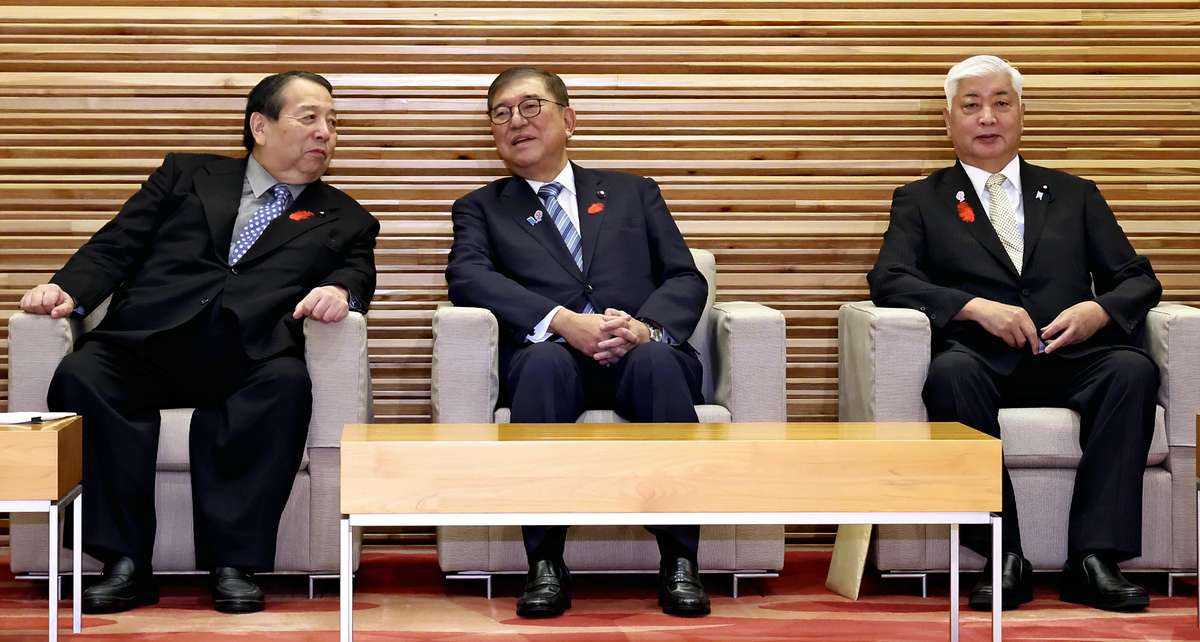
Prime Minister Shigeru Ishiba, center, attends a cabinet meeting, along with other cabinet members, at the Prime Minister’s Office on Friday.
20:00 JST, October 4, 2025
Former economic security minister Sanae Takaichi was elected the new president of the Liberal Democratic Party on Saturday, beginning an unprecedented 12-day period where the ruling party leader and prime minister differ.
The prime minister election is expected to take place on Oct. 15.
During this period, outgoing Prime Minister Ishiba plans to release a message to mark the 80th anniversary of the end of World War II. His decision had been met with a cool response both inside and outside the party.
Generally, the prime minister election is held very soon after the leadership election of the ruling party, followed by the formation of a new cabinet and its inauguration. When Ishiba won the LDP leadership race in September last year, for example, he was elected prime minister just four days later.
However, the government and ruling coalition intend to allow a longer wait. The decision took into consideration assertions made by candidates in the presidential race candidates. One is that time is necessary to hold talks with opposition parties, as the ruling coalition of the LDP and Komeito are currently a minority in both houses of the Diet.
An outgoing prime minister typically refrains from overt activities.
However, Ishiba plans to issue a message where he examines the circumstances that led to the war. He is preparing to convey his thoughts to the new president next week, then hold a press conference by Friday to deliver the message.
In the message, Ishiba is not expected to address historical perceptions. Depending on its content, however, it could cause ripples at home and abroad.
Ishiba also plans to attend the closing ceremony of the 2025 Osaka-Kansai Expo on Oct. 13, an event he is said to have a “strong attachment to,” as those around him have put it.
Within the government and ruling parties, there is resistance to a “lame-duck” prime minister issuing any important announcement following the election of the new party president.
Some candidates in the presidential race have made their negative stance clear. A high-ranking government official also questioned, “Why does [Ishiba] insist on issuing [the message] as prime minister?”
Kazuya Shinba, secretary general of the Democratic Party For the People, said at a press conference on Friday, “I understand the outgoing prime minister wants to leave some mark, but I hope he will discuss it thoroughly with the next cabinet.”





Most Read
Popular articles in the past 24 hours
-
6 Injured at Naked Festival in Japan’s Okayama Prefecture; Police...
-

Fiji Defense Minister Hopes Japan Will Support Stabilization of P...
-

Space One Delays Launch of No. 3 Kairos Rocket; Company to Announ...
-

Milano Cortina 2026: Malinin Highlights Dangers of Social Media i...
-

Reciprocal Tariffs Ruled Illegal: Judiciary Would Not Tolerate Pr...
-

Japanese Film, Anymart, Wins Critics’ Award at International Film...
-
3rd Japan Pacific Islands Defense Dialogue to Begin in Tokyo on S...
-

India, Brazil Sign Mining Pact As Modi Targets $20 Billion Trade ...
Popular articles in the past week
-

Japan PM Takaichi’s Cabinet Resigns en Masse
-

Man Infected with Measles Reportedly Dined at Restaurant in Tokyo...
-

Sanae Takaichi Elected Prime Minister of Japan; Keeps All Cabinet...
-

Japan's Govt to Submit Road Map for Growth Strategy in March, PM ...
-

Bus Carrying 40 Passengers Catches Fire on Chuo Expressway; All E...
-

Milano Cortina 2026: Figure Skaters Riku Miura, Ryuichi Kihara Pa...
-
Japan, U.S. Name 3 Inaugural Investment Projects; Reached Agreeme...
-

U.S. Firm to Build Training Hub in Fukushima N-plant for Debris R...
Popular articles in the past month
-
Japan PM Takaichi’s Cabinet Resigns en Masse
-

Japan Institute to Use Domestic Commercial Optical Lattice Clock ...
-

Israeli Ambassador to Japan Speaks about Japan’s Role in the Reco...
-
Man Infected with Measles Reportedly Dined at Restaurant in Tokyo...
-

Videos Plagiarized, Reposted with False Subtitles Claiming ‘Ryuky...
-

Man Infected with Measles May Have Come in Contact with Many Peop...
-

Prudential Life Insurance Plans to Fully Compensate for Damages C...
-

Woman with Measles Visited Hospital in Tokyo Multiple Times Befor...
Top Articles in Politics
-
Japan PM Takaichi’s Cabinet Resigns en Masse
-
Sanae Takaichi Elected Prime Minister of Japan; Keeps All Cabinet Appointees from Previous Term
-
Japan’s Govt to Submit Road Map for Growth Strategy in March, PM Takaichi to Announce in Upcoming Policy Speech
-

LDP Wins Historic Landslide Victory
-

LDP Wins Landslide Victory, Secures Single-party Majority; Ruling Coalition with JIP Poised to Secure Over 300 seats (UPDATE 1)
JN ACCESS RANKING
-
Japan PM Takaichi’s Cabinet Resigns en Masse
-
Japan Institute to Use Domestic Commercial Optical Lattice Clock to Set Japan Standard Time
-
Israeli Ambassador to Japan Speaks about Japan’s Role in the Reconstruction of Gaza
-
Man Infected with Measles Reportedly Dined at Restaurant in Tokyo Station
-
Videos Plagiarized, Reposted with False Subtitles Claiming ‘Ryukyu Belongs to China’; Anti-China False Information Also Posted in Japan