
14:46 JST, March 9, 2022
The Japanese government has been struggling to deal with mounting sanctions imposed on Russia by the United States and European countries that ban Russian aircraft from flying in their airspace.
This is because if Japan pushes ahead with such sanctions, it is expected that Russia will take retaliatory steps that would deal a blow to Japanese aviation.
The Japanese government has been cautious about a flight ban, unlike economic sanctions on which Japan has been in line with measures imposed by the United States and European nations.
“There are still a number of possibilities for Japan to impose sanctions [on Russia]. I want to make a good decision about what is effective and when is appropriate.”
Prime Minister Fumio Kishida said nothing more than that at the House of Councillors Budget Committee meeting on Monday when asked whether Japan would impose a flight ban on Russia.
Regarding sanctions against Russia, Japan has placed priority on taking concerted action with the United States and European countries through such measures as restricting exports of semiconductors and other products and freezing assets held by financial institutions.
According to the Japanese Foreign Ministry, more than 30 countries, including the United States, Britain and the member nations of the European Union, have already imposed flight bans in their territorial airspace.
There have been voices in the Japanese government calling for Japan to likewise impose a flight ban on Russia. For example, Masahisa Sato, director of the ruling Liberal Democratic Party’s Foreign Affairs Division, said, “It’s extremely effective to ban Russia from free airspace.”
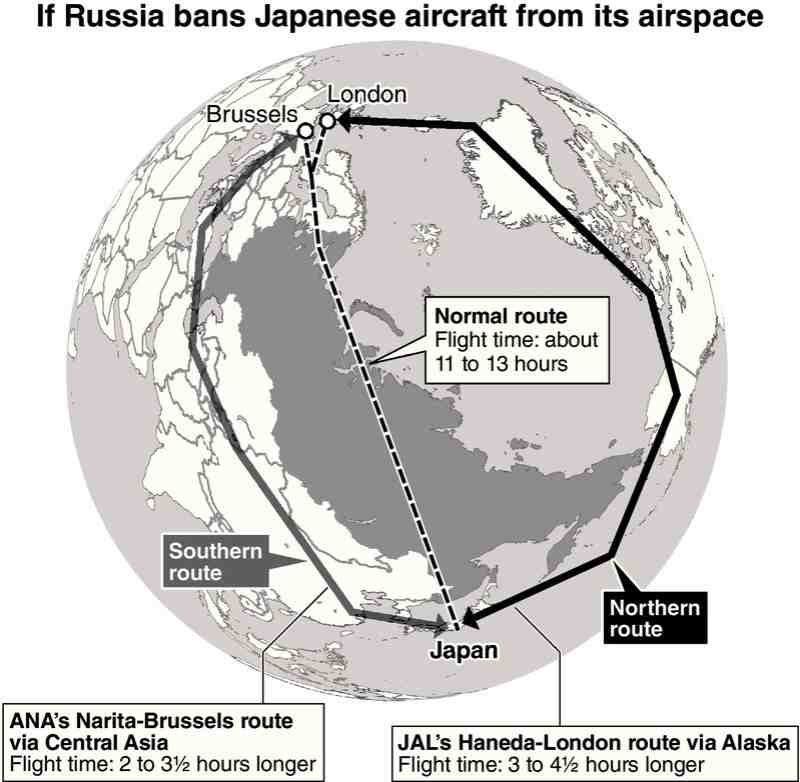
However, the government has not shown a positive attitude toward such sanctions. If Japan goes ahead with them, Russia could ban Japanese airlines from Russian territorial airspace as a countermeasure. Flying the shortest routes from Japan to Europe means flying over the vast Russian landmass.
Foreign Minister Yoshimasa Hayashi said, “It is necessary to consider the geographical differences between Europe and Japan and the impact on logistics.”
For security reasons, All Nippon Airways Co. and Japan Airlines Co. since March 3 have either canceled flights to Europe or changed their routes to avoid flying over Russia.
JAL changed its route between Haneda Airport and London to one via the U.S. state of Alaska, increasing its outbound flight time by three hours and its inbound flight time by 4½ hours.
ANA said that the flight time on its Narita Airport-Brussels route, now via Central Asia, has increased by two to 3½ hours. The burden of fuel and labor costs also increases with the longer flying time.
On the other hand, Russia’s largest airline, Aeroflot, has suspended all international flights except those to neighboring Belarus since Tuesday.
Even if Japan bans flights of Russian aircraft over its territorial airspace, Russia would not suffer much damage. But if Russia bans Japanese aircraft from flying over its territorial airspace, that measure could continue for a prolonged period.
A senior Japanese government official said, “If Japan suffers more damage than Russia, the sanctions cannot be said to be effective.”
The government has avoided explicitly refusing to impose airspace restrictions, apparently to make it less obvious that Japan’s sanctions on Russia are out of step with those of other countries.








Most Read
Popular articles in the past 24 hours
-
Japan's Budget on Track for Quick Passage, but Ruling Parties to ...
-
Japan-Based USS Tripoli, Marine Unit to Be Sent to Middle East, U...
-

Ransomware Attacks Hitting Japan's Small, Midsize Firms
-

7 Men Arrested Over Robbery of ¥423 Mil. on Tokyo Street; Members...
-

National Intelligence Council: Proposed Body Must Be Utilized To ...
-

‘Kokuho’ Wins Record 10 Awards at Japan Academy Film Prize; Demon...
-
North Korea Fires about 10 Missiles toward Sea in Show of Force, ...
-

Milano Cortina 2026: Japan’s Daichi Oguri Wins Silver in Pa...
Popular articles in the past week
-

Japan Figure Skating Legend Yuzuru Hanyu Is Proud Disaster Surviv...
-

Govt to Utilize ODA for Ensuring Economic Security; Securing Ener...
-
15 Measles Patients Confirmed in Tokyo in Past 6 Days; 1 May Have...
-
Massive Sewer Pipe Found Jutting Out of Highway in Osaka
-
Japan Govt to Tighten Requirements to Receive Permanent Residency...
-
Power Outage Forces About 980 Passengers in Yokohama to Walk to T...
-
JR Tokai Breaks Ground on Yamanashi Maglev Station; Will Be Part ...
-

Beckoning Cats Get Makeover to Fit Modern Lifestyles with Sleek D...
Popular articles in the past month
-

Producer Behind Pop Group XG Arrested for Cocaine Possession
-

Japan PM Takaichi’s Cabinet Resigns en Masse
-

Man Infected with Measles Reportedly Dined at Restaurant in Tokyo...
-
Japan Figure Skating Legend Yuzuru Hanyu Is Proud Disaster Surviv...
-

iPS Treatments Pass Key Milestone, but Broader Applications Far f...
-

Sanae Takaichi Elected Prime Minister of Japan; Keeps All Cabinet...
-

South Korea Tightens Rules on Foreigners Buying Homes in Seoul Me...
-

Nepal Bus Crash Kills 19 People, Injures 25 Including One Japanes...
Top Articles in Politics
-
Japan PM Takaichi’s Cabinet Resigns en Masse
-
Sanae Takaichi Elected Prime Minister of Japan; Keeps All Cabinet Appointees from Previous Term
-

Japan’s Govt to Submit Road Map for Growth Strategy in March, PM Takaichi to Announce in Upcoming Policy Speech
-
LDP Begins Training New Lawmakers to Avoid Scandal, Gaffes; Historic Victory in Latest Election Heightens Focus on Party
-

Japan PM Sanae Takaichi Welcomes Peach Ambassadors Koga Momo Musume to Official Residence
JN ACCESS RANKING
-
Producer Behind Pop Group XG Arrested for Cocaine Possession
-
Japan PM Takaichi’s Cabinet Resigns en Masse
-
Man Infected with Measles Reportedly Dined at Restaurant in Tokyo Station
-
Japan Figure Skating Legend Yuzuru Hanyu Is Proud Disaster Survivor and Gold Medalist, Vows to Continue Support Efforts
-
iPS Treatments Pass Key Milestone, but Broader Applications Far from Guaranteed