
DPFP Has Mediocre Results in Japan’s Polls on Sunday, But Party Still Gains More Seats Than Before
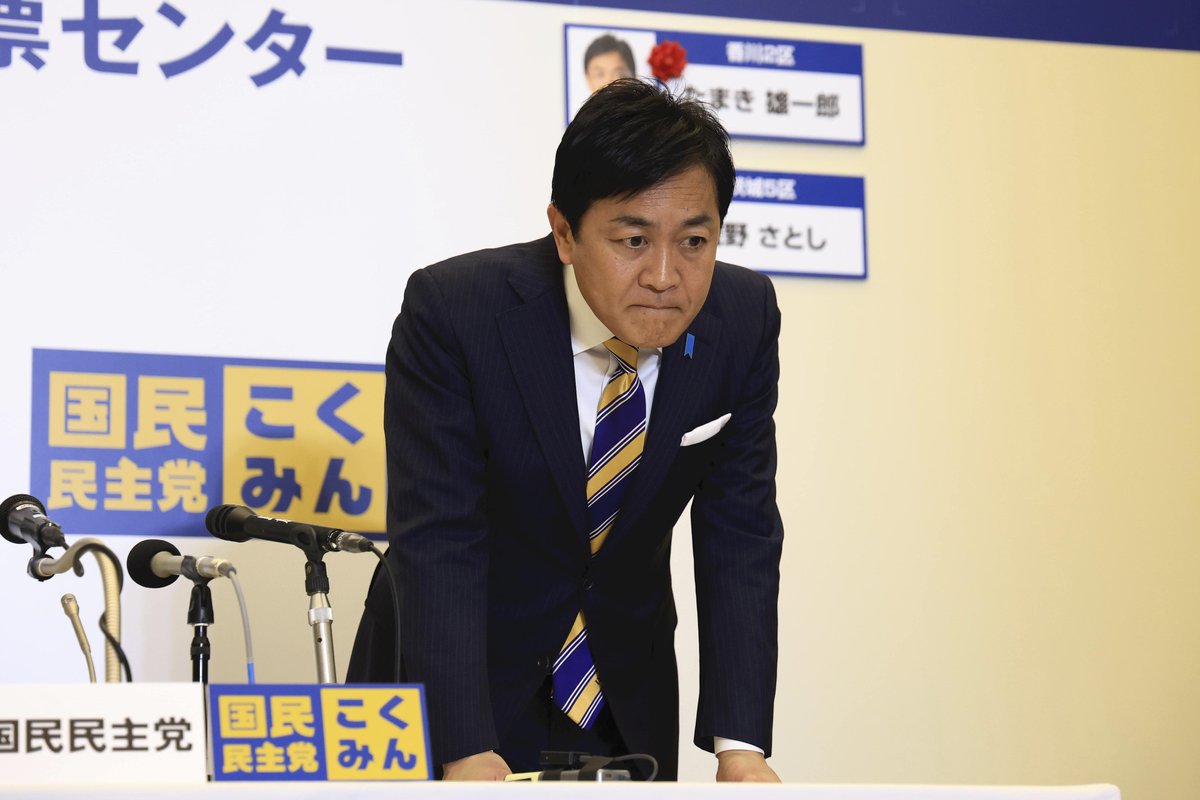
Democratic Party for the People leader Yuichiro Tamaki looks at a monitor showing an early report of House of Representatives election results in Shinjuku Ward, Tokyo, on Sunday night.
2:00 JST, February 10, 2026
The Democratic Party for the People had a mediocre showing in the House of Representatives election on Sunday, although DPFP executives won single-seat constituencies and the party won more seats than it had before the election.
DPFP leader Yuichiro Tamaki was elected in Kagawa Constituency No. 2, and acting representative Motohisa Furukawa won in Aichi Constituency No. 2.
In the 2024 lower house election, the DPFP won 28 seats, four times the number it held prior to the race.
Tamaki had set two goals in the latest election: securing 51 seats, enough to make the party submit bills on its own in the lower house, and 9 million votes in the proportional representation segment.
However, the presence of the DPFP was somewhat overshadowed because a showdown between the Liberal Democratic Party and the Centrist Reform Alliance became the main focus of the election. The CRA was formed by the Constitutional Democratic Party of Japan and Komeito before the election.
In the 2024 election, the DPFP refrained from fielding candidates, in principle, in districts where former legislators of the CDPJ ran, out of consideration for the CDPJ which was supported by the Japanese Trade Union Confederation (Rengo), like the DPFP.
In the latest poll, however, the DPFP actively fielded candidates even in districts where CRA candidates ran, believing that there was no longer a need to show such consideration.
Consequently, the DPFP and the CRA competed in 46 constituencies, vying for votes critical of the ruling parties
During the campaign, Tamaki stressed that his party succeeded in realizing its flagship policies, including those to end provisional surcharges on the gasoline tax and raise the “annual income barrier,” or the threshold at which income tax is levied, to ¥1.78 million. “What we must consider is not the stability of the ruling parties, but that of people’s lives,” Tamaki said.
The DPFP pledged in the campaign that it would cut residential taxes and establish a system to refund social insurance contributions to reduce the burden on the working generation, among other things, but the message did not fully reach voters.
At a press conference in the early hours of Monday, Tamaki denied the possibility that his party would join the ruling coalition. “We will cooperate on policies that should be advanced,” Tamaki said.


Related Tags




Most Read
Popular articles in the past 24 hours
-
Seeking Nuclear Waste Site, Japan Eyes Remote Island of Minami-To...
-

Total Lunar Eclipse Visible for Some in Japan, While Clouds Block...
-

Japan Ministry Asks to Conduct Nuclear Waste Disposal-related Sur...
-

WBC to Begin: All the Pieces are in Place for Japan’s Second Stra...
-

Milano Cortina 2026: Ceremony for Winter Paralympic Torch Relay T...
-

Tokyo High Court Upholds Unification Church Dissolution Order; Li...
-

How Trump Assassination Attempts Played into His Decision to Atta...
-

CARTOON OF THE DAY (March 4)
Popular articles in the past week
-
Tokyo Spends Big on Children, Wins Over Parents
-

Japan’s Miura, Kihara Announce Withdrawal from Figure Skating Wor...
-

South Korea Tightens Rules on Foreigners Buying Homes in Seoul Me...
-

BOJ Keeping Eye on Economy and Takaichi's ‘Proactive Fiscal Polic...
-
Tokyo Measles Patient Traveled to Fukuoka Aboard JAL Planes; Susp...
-
Nidec Chairman Resigns Amid Accounting Scandal at Major Japanese ...
-

Strait of Hormuz Closure Shakes Markets; Prolonged Closure Could ...
-

Tourists Ignore Safety Barriers Near Famous Zao ‘Snow Monsters’ i...
Popular articles in the past month
-

Producer Behind Pop Group XG Arrested for Cocaine Possession
-

Japan PM Takaichi’s Cabinet Resigns en Masse
-

Man Infected with Measles Reportedly Dined at Restaurant in Tokyo...
-

Israeli Ambassador to Japan Speaks about Japan’s Role in the Reco...
-

Videos Plagiarized, Reposted with False Subtitles Claiming ‘Ryuky...
-

Prudential Life Insurance Plans to Fully Compensate for Damages C...
-

Woman with Measles Visited Hospital in Tokyo Multiple Times Befor...
-

iPS Treatments Pass Key Milestone, but Broader Applications Far f...
Top Articles in Politics
-
Japan PM Takaichi’s Cabinet Resigns en Masse
-

Sanae Takaichi Elected Prime Minister of Japan; Keeps All Cabinet Appointees from Previous Term
-
Japan’s Govt to Submit Road Map for Growth Strategy in March, PM Takaichi to Announce in Upcoming Policy Speech
-

LDP Wins Landslide Victory, Secures Single-party Majority; Ruling Coalition with JIP Poised to Secure Over 300 seats (UPDATE 1)
-

LDP Wins Historic Landslide Victory
JN ACCESS RANKING
-
Producer Behind Pop Group XG Arrested for Cocaine Possession
-
Japan PM Takaichi’s Cabinet Resigns en Masse
-
Man Infected with Measles Reportedly Dined at Restaurant in Tokyo Station
-
Israeli Ambassador to Japan Speaks about Japan’s Role in the Reconstruction of Gaza
-
Videos Plagiarized, Reposted with False Subtitles Claiming ‘Ryukyu Belongs to China’; Anti-China False Information Also Posted in Japan