
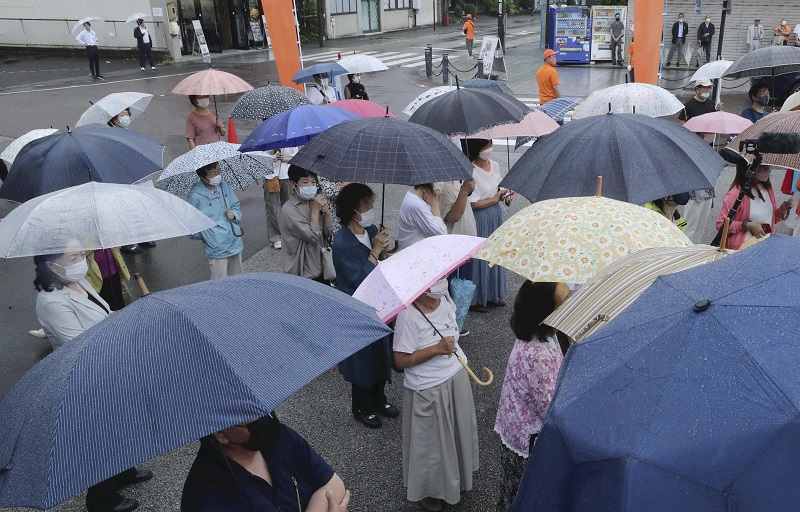
People listen to a House of Councillors election candidate’s speech in Inuyama, Aichi Prefecture, on Wednesday.
15:54 JST, June 23, 2022
A record 181 women are running in the House of Councillors election, for which campaigning officially kicked off Wednesday.
The last record was set in 1989, when 146 female candidates ran in the upper house poll.
Of the 545 candidates in the upcoming election, 33.2% are women, marking the first time the rate has exceeded 30%.
While stumping in Aomori on Wednesday, Constitutional Democratic Party of Japan leader Kenta Izumi emphasized the fact that more than half of his party’s candidates are women.
“We want women’s voices to be reflected in Diet deliberations to create a society in which both men and women can live comfortably,” he said.
The CDPJ has fielded 26 women, including an incumbent in the Aomori electoral district, and 25 men. Meanwhile, the Japanese Communist Party has fielded 32 women, accounting for 55.2% of its candidates.
The percentage of female candidates is high among opposition parties, with more than 40% for the Democratic Party for the People and more than 30% for Nippon Ishin no Kai.
While the ruling parties also increased the percentage of female candidates compared to the 2019 upper house election, the rates stand at 23.2% for the Liberal Democratic Party and 20.8% for Komeito, which have many male incumbents running for re-election. Of the 82 LDP candidates running, 19 are women.
A phenomenon dubbed the “madonna boom” led to 146 women running in the upper house election in 1989, triggered by the huge popularity of Takako Doi, the leader of the now-defunct Japan Socialist Party.
In the 2019 upper house election, 28.1% of candidates were women, a record topped by the 33.2% running in the upcoming poll.
Opposition and ruling parties are believed to have put an emphasis on fielding female candidates as part of efforts to broaden support and show voters that they are in favor of women’s advancement in politics.
In late May, the LDP announced the fielding of four additional female candidates in the proportional representation section, achieving its target of raising the percentage of female candidates in the section to 30%.
The government set a goal of raising the rate of female candidates running in national elections to 35% by 2025 in the Fifth Basic Plan for Gender Equality.
However, a senior Komeito official said: “It’s easy to increase the number of female candidates, but it’s not easy to increase the number of [female] election winners.”







Most Read
Popular articles in the past 24 hours
-
JR Tokai Breaks Ground on Yamanashi Maglev Station; Will Be Part ...
-

Milano Cortina 2026: Japan’s Alpine Skier Muraoka Extends P...
-
Rising Kabuki Star Works to Ensure Deaf Audience's Enjoyment of P...
-

Japan Considering Taking Part in U.S. ‘Golden Dome’ Defense Syste...
-

Lady Bess: Iroha Okuda, Mayuko Kominami Discuss Performing Elizab...
-

46 Evacuated from UAE, Oman on Japanese Govt-chartered Flight
-

Japan's TEPCO Releases Footage from Fukushima N-Plant Reactor
-

Driver Dies in Collision with Express Train at Crossing in Mito; ...
Popular articles in the past week
-

Japan Figure Skating Legend Yuzuru Hanyu Is Proud Disaster Surviv...
-

Nippon Life Insurance's U.S. Arm Sues OpenAI Over Legal Assistanc...
-

Govt to Utilize ODA for Ensuring Economic Security; Securing Ener...
-

Massive Sewer Pipe Found Jutting Out of Highway in Osaka
-
15 Measles Patients Confirmed in Tokyo in Past 6 Days; 1 May Have...
-

Japan Govt to Tighten Requirements to Receive Permanent Residency...
-

Beckoning Cats Get Makeover to Fit Modern Lifestyles with Sleek D...
-
Japan Govt Survey Finds Just 10% of Workers Want Working Hours to...
Popular articles in the past month
-

Producer Behind Pop Group XG Arrested for Cocaine Possession
-

Japan PM Takaichi’s Cabinet Resigns en Masse
-

Man Infected with Measles Reportedly Dined at Restaurant in Tokyo...
-

Videos Plagiarized, Reposted with False Subtitles Claiming ‘Ryuky...
-
Japan Figure Skating Legend Yuzuru Hanyu Is Proud Disaster Surviv...
-

iPS Treatments Pass Key Milestone, but Broader Applications Far f...
-

Sanae Takaichi Elected Prime Minister of Japan; Keeps All Cabinet...
-

Nepal Bus Crash Kills 19 People, Injures 25 Including One Japanes...
Top Articles in Politics
-
Japan PM Takaichi’s Cabinet Resigns en Masse
-
Sanae Takaichi Elected Prime Minister of Japan; Keeps All Cabinet Appointees from Previous Term
-

Japan’s Govt to Submit Road Map for Growth Strategy in March, PM Takaichi to Announce in Upcoming Policy Speech
-

LDP Begins Training New Lawmakers to Avoid Scandal, Gaffes; Historic Victory in Latest Election Heightens Focus on Party
-

Japan PM Sanae Takaichi Welcomes Peach Ambassadors Koga Momo Musume to Official Residence
JN ACCESS RANKING
-
Producer Behind Pop Group XG Arrested for Cocaine Possession
-
Japan PM Takaichi’s Cabinet Resigns en Masse
-
Man Infected with Measles Reportedly Dined at Restaurant in Tokyo Station
-
Videos Plagiarized, Reposted with False Subtitles Claiming ‘Ryukyu Belongs to China’; Anti-China False Information Also Posted in Japan
-
Japan Figure Skating Legend Yuzuru Hanyu Is Proud Disaster Survivor and Gold Medalist, Vows to Continue Support Efforts