
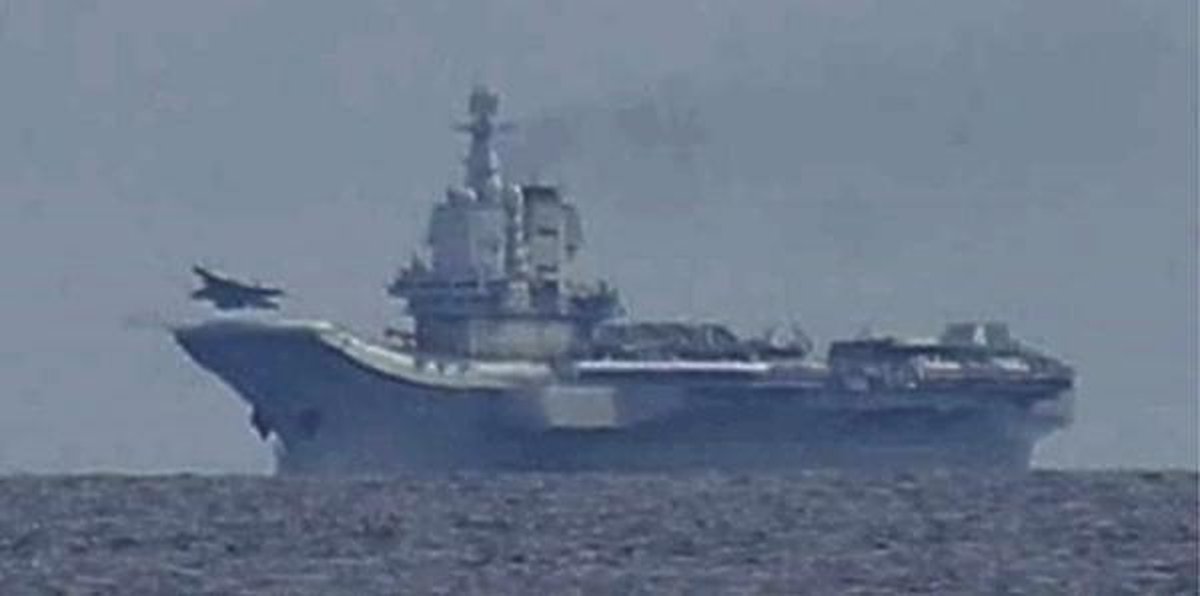
The Chinese Navy aircraft carrier Shandong
16:09 JST, July 18, 2025
Two Chinese Navy aircraft carriers deployed to the Pacific Ocean around Japan and other areas in June had been conducting drills to intercept a U.S. carrier strike group, it has been learned.
Several Japanese government officials revealed this information. Chinese military forces apparently divided themselves into U.S. and Chinese military roles during the drills to mimic the navigational methods employed by U.S. aircraft carriers. The Chinese military is enhancing its capacity to prevent U.S. military intervention in the event of a conflict in Taiwan, according to a Japanese government analysis.
According to the Defense Ministry’s Joint Staff Office, the Chinese aircraft carriers Liaoning and Shandong have been deployed simultaneously in the Pacific Ocean around Japan since late May. From May 25 to June 19, fighter jets and helicopters aboard the Liaoning and the Shandong made a total of about 1,050 landings and takeoffs while the two naval vessels were sailing in the waters near islands including Okinawa, Okinotorishima and Minami-Torishima.
Drills simulating carrier interceptions were conducted for about a week starting around June 7. The Liaoning departed westward from within Japan’s exclusive economic zone (EEZ) off Minami-Torishima Island around June 7. Over the course of several days, it crossed the so-called second island chain — China’s defense line connecting the Ogasawara Islands to Guam, where U.S. military bases are located — and then proceeded toward China.
Meanwhile, the Shandong moved eastward from the south of Okinawa Island to intercept the Liaoning. The analysis concluded that the Liaoning was acting as a U.S. aircraft carrier.
It is believed that U.S. aircraft carriers have a rule to maintain a certain distance from Chinese aircraft carriers to prevent skirmishes. According to a source close to the matter, the Liaoning moved to maintain a distance of about 500 nautical miles (about 930 kilometers) when approaching the Shandong. It is highly likely that the Chinese military was acting in accordance with U.S. regulations and imitating the movements of a U.S. aircraft carrier before entering a state of war.
At the end of June, China’s national defense ministry announced that the Liaoning and the Shandong had conducted drills in the western Pacific Ocean, training to engage with each other in realistic countermeasures. The statement is consistent with the Japanese government’s analysis.
On June 7 and 8, a Chinese vessel-based fighter jet abnormally approached a Maritime Self-Defense Force P-3C patrol aircraft while it was monitoring a Chinese aircraft carrier. This was likely an attempt to pressure the Japanese side to abandon surveillance and prevent them from obtaining information about the drills.
The Chinese military is developing the so-called A2/AD (Anti-Access/Area Denial) strategy to prevent U.S. military operations inside the second island chain and prevent U.S. forces from entering the so-called first island chain, connecting the Nansei Islands and the Philippines. A Self-Defense Forces source noted that the deployment of the two Chinese aircraft carriers may have been part of a move to materialize this strategy.





Most Read
Popular articles in the past 24 hours
-

Japan Defense Agency to Develop AI Intelligence Analysis System f...
-

Moai Statue Shows Lasting Bond Between Miyagi Pref. Town, Easter ...
-

Milano Cortina 2026: Japan’s Oguri Wins Para Snowboard Silver at ...
-
Japan's Defense Ministry: North Korea Appears to Have Fired Balli...
-
Aichi Fisheries Cooperatives Use Smart Tech to Farm Triploid Oyst...
-
Teachers Support Students’ Inquiry Learning behind the Scenes
-
Japan's Lower House Passes Budget Proposal; Could Be Delayed in U...
-

National Intelligence Council: Proposed Body Must Be Utilized To ...
Popular articles in the past week
-

Japan Figure Skating Legend Yuzuru Hanyu Is Proud Disaster Surviv...
-
Govt to Utilize ODA for Ensuring Economic Security; Securing Ener...
-
15 Measles Patients Confirmed in Tokyo in Past 6 Days; 1 May Have...
-
Massive Sewer Pipe Found Jutting Out of Highway in Osaka
-
Japan Govt to Tighten Requirements to Receive Permanent Residency...
-
JR Tokai Breaks Ground on Yamanashi Maglev Station; Will Be Part ...
-

Beckoning Cats Get Makeover to Fit Modern Lifestyles with Sleek D...
-
Power Outage Forces About 980 Passengers in Yokohama to Walk to T...
Popular articles in the past month
-

Producer Behind Pop Group XG Arrested for Cocaine Possession
-

Japan PM Takaichi’s Cabinet Resigns en Masse
-

Man Infected with Measles Reportedly Dined at Restaurant in Tokyo...
-

Videos Plagiarized, Reposted with False Subtitles Claiming ‘Ryuky...
-
Japan Figure Skating Legend Yuzuru Hanyu Is Proud Disaster Surviv...
-

iPS Treatments Pass Key Milestone, but Broader Applications Far f...
-

Sanae Takaichi Elected Prime Minister of Japan; Keeps All Cabinet...
-

Nepal Bus Crash Kills 19 People, Injures 25 Including One Japanes...
Top Articles in Politics
-
Japan PM Takaichi’s Cabinet Resigns en Masse
-
Sanae Takaichi Elected Prime Minister of Japan; Keeps All Cabinet Appointees from Previous Term
-
Japan’s Govt to Submit Road Map for Growth Strategy in March, PM Takaichi to Announce in Upcoming Policy Speech
-
LDP Begins Training New Lawmakers to Avoid Scandal, Gaffes; Historic Victory in Latest Election Heightens Focus on Party
-

Japan PM Sanae Takaichi Welcomes Peach Ambassadors Koga Momo Musume to Official Residence
JN ACCESS RANKING
-
Producer Behind Pop Group XG Arrested for Cocaine Possession
-
Japan PM Takaichi’s Cabinet Resigns en Masse
-
Man Infected with Measles Reportedly Dined at Restaurant in Tokyo Station
-
Videos Plagiarized, Reposted with False Subtitles Claiming ‘Ryukyu Belongs to China’; Anti-China False Information Also Posted in Japan
-
Japan Figure Skating Legend Yuzuru Hanyu Is Proud Disaster Survivor and Gold Medalist, Vows to Continue Support Efforts