
Japan, U.S. fleet Commanders Prepare for Taiwan Contingency; Quick Response System a ‘Maximum Necessity’
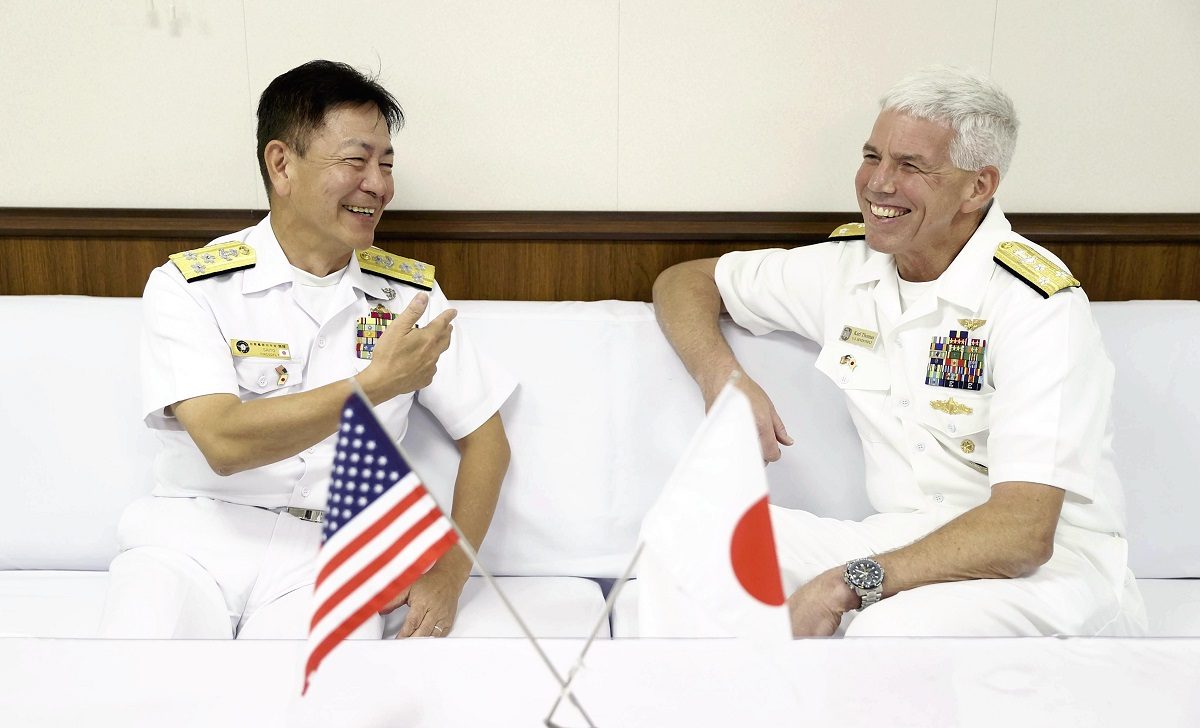
Maritime Self-Defense Force Vice Adm. Akira Saito, left and U.S. Navy Vice Adm. Karl Thomas talk on Wednesday in Yokosuka, Kanagawa Prefecture.
1:00 JST, September 22, 2023
Japanese Maritime Self-Defense Force Vice Adm. Akira Saito and U.S. Navy Vice Adm. Karl Thomas stressed the importance of strengthening their readiness for a Taiwan contingency, during an exclusive interview with The Yomiuri Shimbun, conducted Wednesday aboard the MSDF destroyer Izumo anchored in Yokosuka, Kanagawa Prefecture.
In their first joint interview, Saito, commander in chief of the Self-Defense Fleet, and Thomas, commander of the U.S. 7th Fleet, expressed concern over the Chinese military, which is increasing military pressure on Taiwan.
In fact, the Chinese aircraft carrier Shandong has continued aircraft launching and landing activities in the waters around Taiwan.
“I think it’s very clear that they’re pressurizing Taiwan more than they have in the past,” Thomas said.
Saito said he was aware that the Chinese military has been training and “considerably improving its skills.”
As for a Taiwan contingency, “I would tell you that our job is to be ready,” Thomas said. “And so we train and we operate together so that we’re ready if our political leadership decides that they need to call upon us.
“That goal is to be so ready, that we never get into a hypothetical … Taiwan situation. So that’s what he and I focus on, is being prepared to work as a team such that if called upon we can operate as a team.”
Saito agreed with Thomas by saying that the development of an immediate response system “is a maximum necessity.”
“We are training every day, exchanging views every day and improving our defense capabilities every day for all phases from peacetime to contingency,” said Saito, citing cyber-attacks and information warfare as areas in which the MSDF would strengthen its readiness.
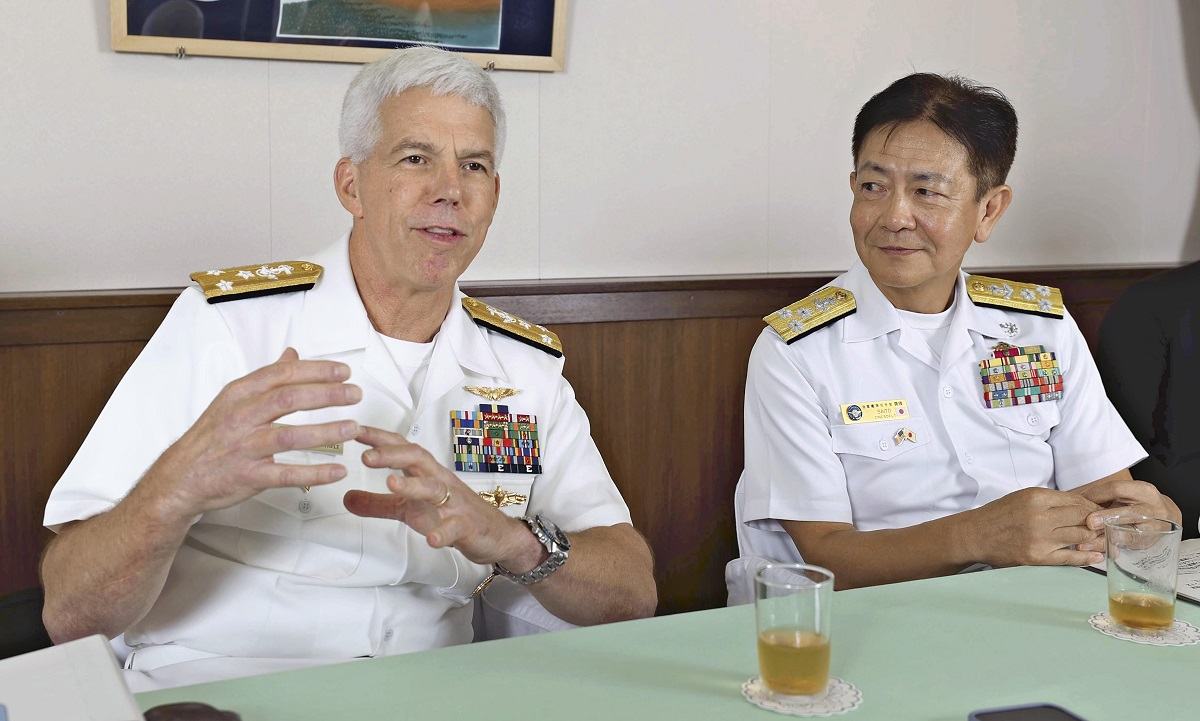
U.S. Navy Vice Adm. Karl Thomas, left, sits beside Maritime Self-Defense Force Vice Adm. Akira Saito during a joint interview on Wednesday in Yokosuka, Kanagawa Prefecture.
U.S. warships have conducted freedom of navigation operations in the South China Sea in response to the Chinese military’s hegemonic actions there, and Thomas said that the U.S. Navy would do likewise in the Taiwan Strait. “That’s an international strait, and so we sail through as a team,” he said.
Regarding efforts by Japan, the United States and South Korea to immediately share information related to North Korean ballistic missiles, Saito said, “I believe it is very meaningful as it will immediately lead to the improvement of our ability to deal with them.”
The Self-Defense Fleet is the MSDF’s core force. It includes escort vessels, submarines and other assets. The U.S. 7th Fleet is the main fleet of the U.S. Indo-Pacific Command, which covers the Asia-Pacific region.




Most Read
Popular articles in the past 24 hours
-
Tokyo Skytree's Elevator Stops, Trapping 20 People; All Rescued (...
-
China, India Tapping into Promising African Market; Beijing Annou...
-

Milano Cortina 2026: Miura-Kihara Duo, Other Japanese Figure Skat...
-

Japan’s Major Real Estate Firms Expanding Overseas Businesses to ...
-
‘Storytellers’ Being Dispatched Overseas to Promote Japan; Events...
-
Japan, Pacific Island Nations to Work on Deepening Cooperation
-
Space One Delays Launch of No. 3 Kairos Rocket; Company to Announ...
-
Ukrainian Ambassador Closely Watching Japan’s Revision of Defense...
Popular articles in the past week
-

Japan PM Takaichi’s Cabinet Resigns en Masse
-

Man Infected with Measles Reportedly Dined at Restaurant in Tokyo...
-

Sanae Takaichi Elected Prime Minister of Japan; Keeps All Cabinet...
-

Japan's Govt to Submit Road Map for Growth Strategy in March, PM ...
-

Bus Carrying 40 Passengers Catches Fire on Chuo Expressway; All E...
-

Milano Cortina 2026: Figure Skaters Riku Miura, Ryuichi Kihara Pa...
-

Japan, U.S. Name 3 Inaugural Investment Projects; Reached Agreeme...
-
U.S. Firm to Build Training Hub in Fukushima N-plant for Debris R...
Popular articles in the past month
-
Japan PM Takaichi’s Cabinet Resigns en Masse
-

Japan Institute to Use Domestic Commercial Optical Lattice Clock ...
-

Israeli Ambassador to Japan Speaks about Japan’s Role in the Reco...
-
Man Infected with Measles Reportedly Dined at Restaurant in Tokyo...
-

Videos Plagiarized, Reposted with False Subtitles Claiming ‘Ryuky...
-

Man Infected with Measles May Have Come in Contact with Many Peop...
-

Prudential Life Insurance Plans to Fully Compensate for Damages C...
-

Woman with Measles Visited Hospital in Tokyo Multiple Times Befor...
Top Articles in Politics
-
Japan PM Takaichi’s Cabinet Resigns en Masse
-
Sanae Takaichi Elected Prime Minister of Japan; Keeps All Cabinet Appointees from Previous Term
-
Japan’s Govt to Submit Road Map for Growth Strategy in March, PM Takaichi to Announce in Upcoming Policy Speech
-

LDP Wins Historic Landslide Victory
-

LDP Wins Landslide Victory, Secures Single-party Majority; Ruling Coalition with JIP Poised to Secure Over 300 seats (UPDATE 1)
JN ACCESS RANKING
-
Japan PM Takaichi’s Cabinet Resigns en Masse
-
Japan Institute to Use Domestic Commercial Optical Lattice Clock to Set Japan Standard Time
-
Israeli Ambassador to Japan Speaks about Japan’s Role in the Reconstruction of Gaza
-
Man Infected with Measles Reportedly Dined at Restaurant in Tokyo Station
-
Videos Plagiarized, Reposted with False Subtitles Claiming ‘Ryukyu Belongs to China’; Anti-China False Information Also Posted in Japan