
Japan, U.S. Defense Ministers Reaffirm Cooperation Against Possible 2nd Launch by North Korea
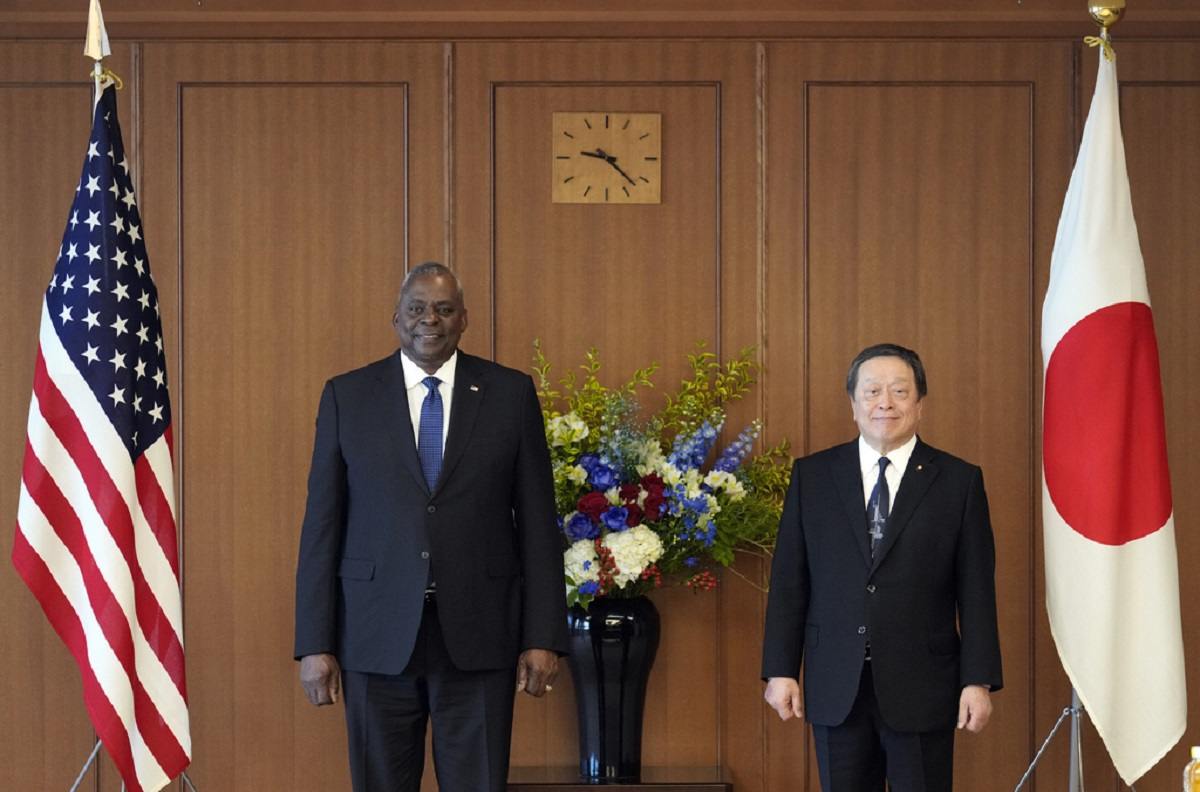
Defense Minister Yasukazu Hamada, right, and U.S. Defense Secretary Lloyd Austin pose at the start of their meeting at the Defense Ministry in Tokyo on Thursday.
17:19 JST, June 1, 2023
Japan’s Defense Minister Yasukazu Hamada and U.S. Secretary of Defense Lloyd Austin confirmed Thursday that their two countries and South Korea would cooperate against the next launch of a purported military reconnaissance satellite, which North Korea has preannounced.
During their meeting at the Defense Ministry in Tokyo, the two leaders also agreed to strengthen the deterrence and response capabilities of the Japan-U.S. alliance with China in mind.
At the beginning of their meeting, Hamada said he “strongly condemns” Wednesday’s “satellite” launch, which ended in failure.
North Korea vowed to conduct a second launch soon.
Hamada said at a press conference after the meeting, “We confirmed to further work closely between Japan and the United States, and Japan, the United States and the Republic of Korea, so that we can rapidly act in a concerted manner against North Korea’s provocative actions.”
He also pointed out the importance of extended deterrence, including the U.S. nuclear umbrella.
Austin said, “As we face these shared challenges, I am here to reaffirm America’s unwavering commitment to Japan.”
North Korea’s “satellite” launches utilize technology that is applicable to ballistic missile development, and Tokyo and Washington are wary of Pyongyang’s growing nuclear and missile capabilities.
In preparation for missile launches, radar systems of Japan and South Korea are expected to be linked via the United States to quickly share missile-related information. Japan, the United States and South Korea plan to hold a trilateral defense ministerial meeting in conjunction with the Asia Security Summit, or the IISS Shangri-La Dialogue, in Singapore from Friday to Sunday. Austin said that there has been important progress in cooperation among the three countries.
Hamada and Austin also discussed measures against China’s growing military power.
“We are deeply concerned by [China’s] coercive behavior and its attempts to undermine the rules-based international order,” Austin told reporters.
As for Japan’s decision to acquire self-defense capabilities to attack missile launching bases and other targets, the U.S. secretary of defense said, “I strongly support Japan’s updated national security policies, including your decision to increase defense spending and to acquire counterstrike capabilities.”
During Thursday’s meeting, they also exchanged views on the division of their roles in a contingency.
Austin said, “We continue to strengthen our interoperability through training and exercises.”







Most Read
Popular articles in the past 24 hours
-

Tokyo Skytree's Elevator Stops, Trapping 20 People; All Rescued (...
-

China, India Tapping into Promising African Market; Beijing Annou...
-

Milano Cortina 2026: Miura-Kihara Duo, Other Japanese Figure Skat...
-

Japan’s Major Real Estate Firms Expanding Overseas Businesses to ...
-

‘Storytellers’ Being Dispatched Overseas to Promote Japan; Events...
-
Japan, Pacific Island Nations to Work on Deepening Cooperation
-

Space One Delays Launch of No. 3 Kairos Rocket; Company to Announ...
-

Ukrainian Ambassador Closely Watching Japan’s Revision of Defense...
Popular articles in the past week
-

Japan PM Takaichi’s Cabinet Resigns en Masse
-

Man Infected with Measles Reportedly Dined at Restaurant in Tokyo...
-

Sanae Takaichi Elected Prime Minister of Japan; Keeps All Cabinet...
-

Japan's Govt to Submit Road Map for Growth Strategy in March, PM ...
-

Bus Carrying 40 Passengers Catches Fire on Chuo Expressway; All E...
-

Milano Cortina 2026: Figure Skaters Riku Miura, Ryuichi Kihara Pa...
-

Japan, U.S. Name 3 Inaugural Investment Projects; Reached Agreeme...
-

U.S. Firm to Build Training Hub in Fukushima N-plant for Debris R...
Popular articles in the past month
-
Japan PM Takaichi’s Cabinet Resigns en Masse
-

Japan Institute to Use Domestic Commercial Optical Lattice Clock ...
-

Israeli Ambassador to Japan Speaks about Japan’s Role in the Reco...
-
Man Infected with Measles Reportedly Dined at Restaurant in Tokyo...
-

Videos Plagiarized, Reposted with False Subtitles Claiming ‘Ryuky...
-

Man Infected with Measles May Have Come in Contact with Many Peop...
-

Prudential Life Insurance Plans to Fully Compensate for Damages C...
-

Woman with Measles Visited Hospital in Tokyo Multiple Times Befor...
Top Articles in Politics
-
Japan PM Takaichi’s Cabinet Resigns en Masse
-
Sanae Takaichi Elected Prime Minister of Japan; Keeps All Cabinet Appointees from Previous Term
-
Japan’s Govt to Submit Road Map for Growth Strategy in March, PM Takaichi to Announce in Upcoming Policy Speech
-

LDP Wins Historic Landslide Victory
-

LDP Wins Landslide Victory, Secures Single-party Majority; Ruling Coalition with JIP Poised to Secure Over 300 seats (UPDATE 1)
JN ACCESS RANKING
-
Japan PM Takaichi’s Cabinet Resigns en Masse
-
Japan Institute to Use Domestic Commercial Optical Lattice Clock to Set Japan Standard Time
-
Israeli Ambassador to Japan Speaks about Japan’s Role in the Reconstruction of Gaza
-
Man Infected with Measles Reportedly Dined at Restaurant in Tokyo Station
-
Videos Plagiarized, Reposted with False Subtitles Claiming ‘Ryukyu Belongs to China’; Anti-China False Information Also Posted in Japan