
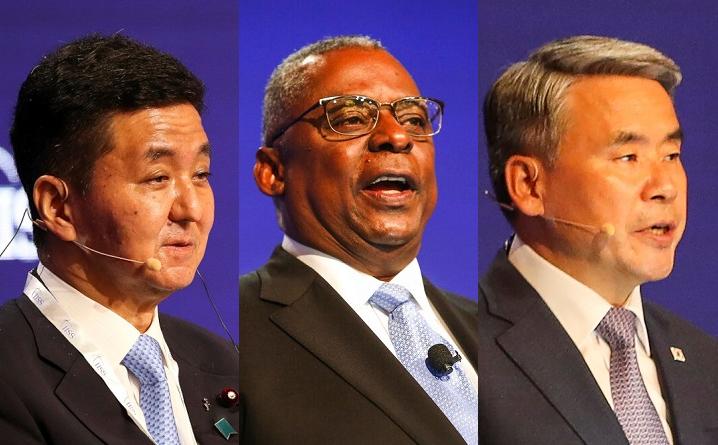
From left: Japanese Defense Minister Nobuo Kishi, U.S. Secretary of Defense Lloyd Austin, South Korean Defense Minister Lee Jong-sup. In the Asia’s annual defense and security forum, in Singapore, Saturday, June 11, 2022.
15:03 JST, June 12, 2022
Tokyo, June 11 (Jiji Press)—Defense chiefs from Japan, the United States and South Korea on Saturday agreed to conduct trilateral missile warning, search and tracking exercises, in response to progress in North Korea’s missile development programs.
Japanese Defense Minister Nobuo Kishi, U.S. Secretary of Defense Lloyd Austin and South Korean Defense Minister Lee Jong-sup also agreed at their meeting in Singapore to make efforts to rebuild relations of trust between Japanese and South Korean defense authorities. The meeting was held on the sidelines of the Asia Security Summit, also known as the Shangri-La Dialogue, which started in Singapore Friday.
In a joint statement released after their meeting, the three defense chiefs “strongly condemned” North Korea’s “repeated unlawful ballistic missile launches.”
They also “emphasized the importance of peace and stability in the Taiwan Strait,” apparently mindful of China’s growing military threat, expressing “strong opposition to any unilateral actions that seek to alter the status quo and increase tensions in the region.”
The last time Japan, the United States and South Korea announced their plan to conduct joint exercises was in December 2017.
Since the beginning of this year, North Korea has repeatedly fired missiles, including intercontinental ballistic missiles. Some observers say that the country may conduct a nuclear test soon.
Japan, the United States and South Korea apparently tried to highlight their resolve to cope with such circumstances through trilateral cooperation.
Saturday’s meeting was the first in-person meeting of defense chiefs of Japan, the United States and South Korea since November 2019.
Relations deteriorated between Japanese and South Korean defense authorities after a South Korean warship directed its radar at a Japanese Maritime Self-Defense Force plane in December 2018.
On Saturday, the defense chiefs “shared the recognition that defense-related confidence building among countries in the region is important” and agreed to continue related efforts.
Meanwhile, the SDF remains deeply distrustful of the South Korean military, according to sources familiar with the situation. This is because the South Korean side has flatly denied the radar lock-on and the issue has yet to be resolved.
“We don’t want to conduct bilateral drills” with the South Korean military, a senior SDF official said, expressing concerns over similar incidents.
Speaking at a press conference, Kishi said that the radar lock-on incident was not taken up at the latest trilateral meeting.
“The importance (for Japan and South Korea as well as the two plus the United States) to jointly deal with the situation in North Korea has increased more than ever,” the Japanese defense minister said, suggesting his intention to prioritize the resumption of bilateral or trilateral exchanges of troops.




Most Read
Popular articles in the past 24 hours
-

National Intelligence Council: Proposed Body Must Be Utilized To ...
-
Japan's Defense Ministry: North Korea Appears to Have Fired Balli...
-

Aichi Fisheries Cooperatives Use Smart Tech to Farm Triploid Oyst...
-

CARTOON OF THE DAY (March 14)
-
Japan's Lower House Passes Budget Proposal; Could Be Delayed in U...
-

Fukuoka: American Beavers at Japan's Zoo Create Sculptures; Visit...
-

Hyogo: Family in Japan Produces Traditional Charcoal to Help Pres...
-

Election Fraud in Tokyo’s Ota Ward: Use Incident As Catalyst for ...
Popular articles in the past week
-

Japan Figure Skating Legend Yuzuru Hanyu Is Proud Disaster Surviv...
-
Govt to Utilize ODA for Ensuring Economic Security; Securing Ener...
-
15 Measles Patients Confirmed in Tokyo in Past 6 Days; 1 May Have...
-
Massive Sewer Pipe Found Jutting Out of Highway in Osaka
-
Japan Govt to Tighten Requirements to Receive Permanent Residency...
-
JR Tokai Breaks Ground on Yamanashi Maglev Station; Will Be Part ...
-
Power Outage Forces About 980 Passengers in Yokohama to Walk to T...
-

Beckoning Cats Get Makeover to Fit Modern Lifestyles with Sleek D...
Popular articles in the past month
-

Producer Behind Pop Group XG Arrested for Cocaine Possession
-

Japan PM Takaichi’s Cabinet Resigns en Masse
-

Man Infected with Measles Reportedly Dined at Restaurant in Tokyo...
-
Japan Figure Skating Legend Yuzuru Hanyu Is Proud Disaster Surviv...
-

iPS Treatments Pass Key Milestone, but Broader Applications Far f...
-

Sanae Takaichi Elected Prime Minister of Japan; Keeps All Cabinet...
-

South Korea Tightens Rules on Foreigners Buying Homes in Seoul Me...
-

Nepal Bus Crash Kills 19 People, Injures 25 Including One Japanes...
Top Articles in Politics
-
Japan PM Takaichi’s Cabinet Resigns en Masse
-
Sanae Takaichi Elected Prime Minister of Japan; Keeps All Cabinet Appointees from Previous Term
-

Japan’s Govt to Submit Road Map for Growth Strategy in March, PM Takaichi to Announce in Upcoming Policy Speech
-
LDP Begins Training New Lawmakers to Avoid Scandal, Gaffes; Historic Victory in Latest Election Heightens Focus on Party
-

Japan PM Sanae Takaichi Welcomes Peach Ambassadors Koga Momo Musume to Official Residence
JN ACCESS RANKING
-
Producer Behind Pop Group XG Arrested for Cocaine Possession
-
Japan PM Takaichi’s Cabinet Resigns en Masse
-
Man Infected with Measles Reportedly Dined at Restaurant in Tokyo Station
-
Japan Figure Skating Legend Yuzuru Hanyu Is Proud Disaster Survivor and Gold Medalist, Vows to Continue Support Efforts
-
iPS Treatments Pass Key Milestone, but Broader Applications Far from Guaranteed