
Japanese prime minister eyes action plan to promote rule-based international order in Indo-Pacific region
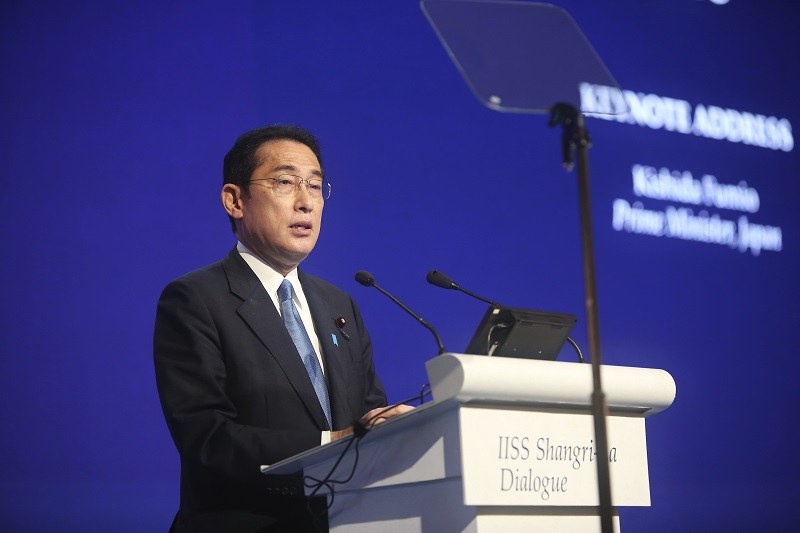
Prime Minister Fumio Kishida delivers the keynote speech at the Shangri-La Dialogue in Singapore on Friday.
17:13 JST, June 11, 2022
SINGAPORE — Prime Minister Fumio Kishida emphasized the importance of enhancing rule-based international order during a keynote speech Friday that opened the three-day Shangri-La Dialogue security summit in Singapore.
In the address, Kishida expressed his intention to develop by next spring an action plan to promote a Japan-led “free and open Indo-Pacific.”
He also outlined steps to provide in the next three years a minimum of about $2 billion in aid to Indo-Pacific countries — including those of the Association of Southeast Asian Nations — for maritime security equipment such as patrol vessels, and the development of maritime transportation infrastructure.
Kishida’s speech was the first keynote address by a Japanese prime minister in eight years.
Referring to Russia’s invasion of Ukraine, Kishida said, “No country or region in the world can shrug this off as ‘someone else’s problem.’”
With China in mind, the prime minister touched on ongoing attempts to change by force the status quo in the South China Sea and East China Sea, saying, “Confidence in the universal rules that govern international relations is being shaken.”
The prime minister also announced the “Kishida Vison for Peace” and the role that Japan should play. The five-pillar vision calls for: maintaining and strengthening the rule-based international order; enhancing Japan’s defense capabilities in tandem with reinforcing the Japan-U.S. alliance and strengthening security cooperation with other like-minded countries; promoting realistic efforts to bring about a world without nuclear weapons; strengthening the functions of the United Nations; and strengthening international cooperation in new policy areas such as economic security.
Kishida also spoke on the issue of peace and stability in the Taiwan Strait, expressing his determination to fundamentally reinforce Japan’s defense capabilities within the next five years and secure a “substantial increase” in the nation’s defense budget.
On the issue of denuclearization, he said, “Mindful of the non-transparent manner in which some countries have been increasing their nuclear capabilities, we call for all nuclear-weapon states to disclose information regarding their nuclear forces.”
Kishida also said he intended to encourage the United States and China to engage in bilateral dialogue on nuclear disarmament and arms control.
The Shangri-La Dialogue summit — also known as the IISS Asia Security Summit — allows Asian and Western officials involved in national defense to discuss regional security. The event is organized by the International Institute for Strategic Studies in the United Kingdom. This is the first summit to be held in three years due to the novel coronavirus pandemic.





Most Read
Popular articles in the past 24 hours
-

National Intelligence Council: Proposed Body Must Be Utilized To ...
-
Japan's Defense Ministry: North Korea Appears to Have Fired Balli...
-

Aichi Fisheries Cooperatives Use Smart Tech to Farm Triploid Oyst...
-

CARTOON OF THE DAY (March 14)
-
Japan's Lower House Passes Budget Proposal; Could Be Delayed in U...
-

Fukuoka: American Beavers at Japan's Zoo Create Sculptures; Visit...
-

Hyogo: Family in Japan Produces Traditional Charcoal to Help Pres...
-

Election Fraud in Tokyo’s Ota Ward: Use Incident As Catalyst for ...
Popular articles in the past week
-

Japan Figure Skating Legend Yuzuru Hanyu Is Proud Disaster Surviv...
-
Govt to Utilize ODA for Ensuring Economic Security; Securing Ener...
-
15 Measles Patients Confirmed in Tokyo in Past 6 Days; 1 May Have...
-

Massive Sewer Pipe Found Jutting Out of Highway in Osaka
-
Japan Govt to Tighten Requirements to Receive Permanent Residency...
-
JR Tokai Breaks Ground on Yamanashi Maglev Station; Will Be Part ...
-

Power Outage Forces About 980 Passengers in Yokohama to Walk to T...
-

Beckoning Cats Get Makeover to Fit Modern Lifestyles with Sleek D...
Popular articles in the past month
-

Producer Behind Pop Group XG Arrested for Cocaine Possession
-

Japan PM Takaichi’s Cabinet Resigns en Masse
-

Man Infected with Measles Reportedly Dined at Restaurant in Tokyo...
-
Japan Figure Skating Legend Yuzuru Hanyu Is Proud Disaster Surviv...
-

iPS Treatments Pass Key Milestone, but Broader Applications Far f...
-

Sanae Takaichi Elected Prime Minister of Japan; Keeps All Cabinet...
-

South Korea Tightens Rules on Foreigners Buying Homes in Seoul Me...
-

Nepal Bus Crash Kills 19 People, Injures 25 Including One Japanes...
Top Articles in Politics
-
Japan PM Takaichi’s Cabinet Resigns en Masse
-
Sanae Takaichi Elected Prime Minister of Japan; Keeps All Cabinet Appointees from Previous Term
-

Japan’s Govt to Submit Road Map for Growth Strategy in March, PM Takaichi to Announce in Upcoming Policy Speech
-
LDP Begins Training New Lawmakers to Avoid Scandal, Gaffes; Historic Victory in Latest Election Heightens Focus on Party
-
Japan PM Sanae Takaichi Welcomes Peach Ambassadors Koga Momo Musume to Official Residence
JN ACCESS RANKING
-
Producer Behind Pop Group XG Arrested for Cocaine Possession
-
Japan PM Takaichi’s Cabinet Resigns en Masse
-
Man Infected with Measles Reportedly Dined at Restaurant in Tokyo Station
-
Japan Figure Skating Legend Yuzuru Hanyu Is Proud Disaster Survivor and Gold Medalist, Vows to Continue Support Efforts
-
iPS Treatments Pass Key Milestone, but Broader Applications Far from Guaranteed