
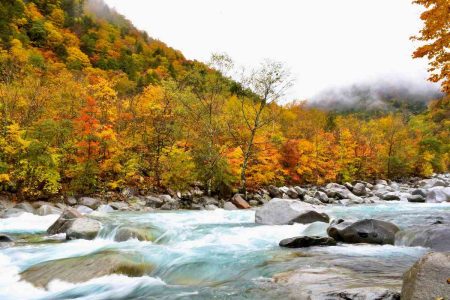
Autumn foliage by the river at the foot of the mountain
15:46 JST, January 20, 2026
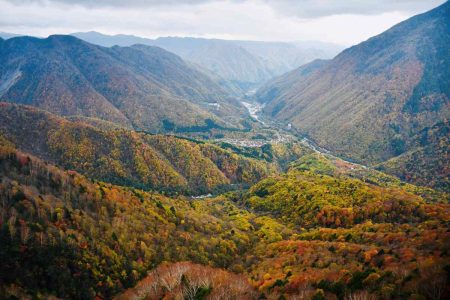
The view from the ropeway car shows the gradation of autumn foliage colors.
At the beginning of November, autumn foliage had just entered the peak of its season in the Okuhida area of Takayama, Gifu Prefecture. Located at the foot of the Northern Japanese Alps, this is one of few places where autumn foliage and snowy winter scenes can be enjoyed at the same time, attracting many hikers and tourists.
From the foot of the mountains, the Shinhotaka Ropeway operates year-round, bringing visitors to an altitude of 2,156 meters. Starting at the Shinhotaka Onsen station at the mountains’ base, the ropeway offers a panoramic view of precipitous rocky walls and the peaks of the Alps. As the ropeway ascended, the color of the autumn leaves changed. The transition from greenish yellows, which possibly indicated the early stage of the foliage season, to the reds and oranges during its peak was stunning, giving a sense of the changing of the seasons.
Transitioning seasons
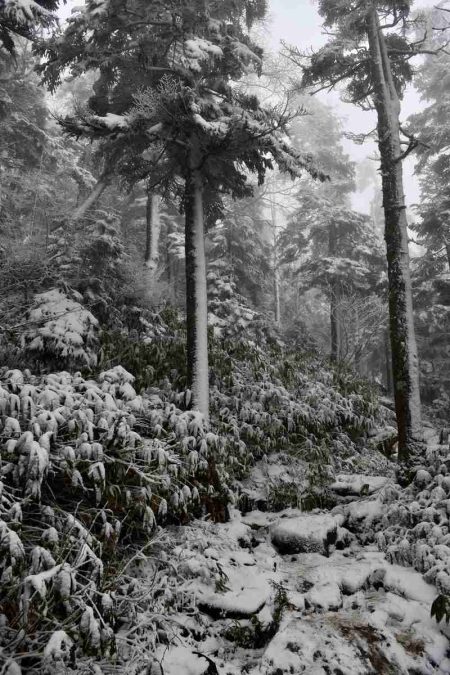
A snow-covered mountain path
At the end of the ropeway, the season already shifted to winter. The snow-capped conifer trees were seen with the Alps behind them in the grayish winter sky. From the ropeway station, a 90-minute trek led to the ridge of the mountain ranges. Stepping onto the soft, fresh snow in the quiet forest brought excitement as if stepping into an unknown world. Many trees had snow on their branches, evoking festive Christmas trees.
The temperature started to fall as hikers ascended, and the path got steep and rocky, becoming slippery with the snow. Wearing chain spikes on hiking boots gave stability in taking steps. Between the trees, the intimidating rough, rocky Hotaka mountain range of the Alps emerged in the distance, giving the energy to keep going.
The forest ends at an altitude of around 2,370 meters. A mountain hut was around there and it was enveloped in gusty winds that started to blow since there was little to shield it from the winds. Another 30-minute hike led to a small peak called Nishiho Maruyama, an almost hill-like peak, which rises to 2,452 meters. The weather there was practically like a winter storm. Strong winds almost blew the hikers off the mountain and gray winter clouds surrounded the peak, leaving no visibility of the surrounding area. It was like being completely lost in limbo in a world of black and white.
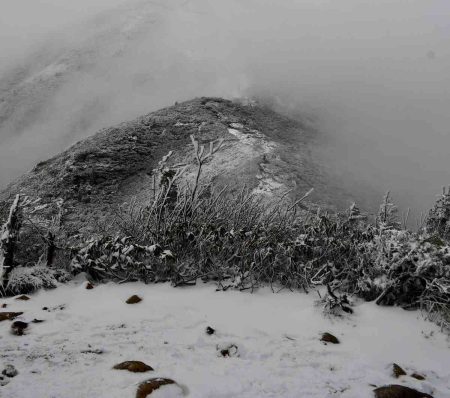
The view from Nishiho Maruyama looks like a world in black and white.
However, in good weather, the view from the peak is striking, with jagged ridge lines of the mountains stretching from north to south, and one can see the Kamikochi area in Nagano Prefecture on the other side of the mountain. The mountain ridges serve as a prefectural border between Gifu and Nagano.
Many hikers go further north beyond Nishiho Maruyama to Nishihotaka-dake (2,909 meters) or Okuhotaka-dake (3,190 meters). However, those peaks and the routes are for experienced and skilled hikers.
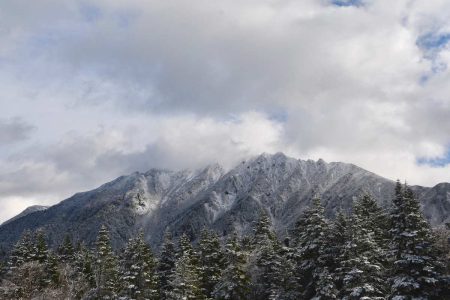
Northen Japanese Alps mountains are seen in the distance behind the snow-covered forest at Nishihotakaguchi ropeway station on Nov. 2, in Takayama, Gifu Prefecture
Back at the mountain hut, a bowl of ramen with soy-based hot soup called Nishiho ramen, which the hut is famous for, gave warmth to hikers’ freezing bodies and the energy to head back.
After getting off at the ropeway station on the way back, colorful and warmer autumn conditions greeted hikers at the foot of the mountains, returning from the world of winter.
Easy access all year round
The Shinhotaka Ropeway offers convenient access close to the summit level of the Northern Japanese Alps, but otherwise, strenuous hiking is required. Since it operates during the winter season, one can get a view of the snow-covered Alps. Visitors can enjoy shopping and snacks at the cafes at the stations.
To get to Nishihotakaguchi ropeway station, the end of the ropeway, it takes about 25 minutes, including transferring from/to the ropeway.
To access the Shinhotaka Ropeway, it takes 3-4 hours by car from Nagoya City. The surrounding area, called Okuhida Onsengo, is famous for numerous hot springs.



Most Read
Popular articles in the past 24 hours
-

Strait of Hormuz Closure Shakes Markets; Prolonged Closure Could ...
-
Measles Patient Visited Hospital in Bunkyo Ward, Tokyo, Metropoli...
-

Iran Situation: Japan Must Exert Diplomatic Efforts without Merel...
-

Milano Cortina 2026: Japanese Figure Skater Miura Returns to Home...
-

2 of Japan's Opposition Parties Submit Bill to Revise Political F...
-

Takayama Among World's Top 10 Most Welcoming Cities for 2026; 2nd...
-
Chiba Police to Arrest Japanese National in Midair; Man Accused o...
-
Former Nomura Securities Employee Given 18-year Prison Sentence f...
Popular articles in the past week
-
Milano Cortina 2026: Japanese Gold Medalist Figure Skater Miura S...
-
Tokyo Spends Big on Children, Wins Over Parents
-

Japan’s Miura, Kihara Announce Withdrawal from Figure Skating Wor...
-

Yokohama to Test Out Renewable-Powered Offshore Floating Data Cen...
-

BOJ Keeping Eye on Economy and Takaichi's ‘Proactive Fiscal Polic...
-
Tokyo Measles Patient Traveled to Fukuoka Aboard JAL Planes; Susp...
-
Japan’s Takaichi Speaks on New U.S. Tariff in Upper House, Says P...
-

Nidec Chairman Resigns Amid Accounting Scandal at Major Japanese ...
Popular articles in the past month
-

Producer Behind Pop Group XG Arrested for Cocaine Possession
-

Japan PM Takaichi’s Cabinet Resigns en Masse
-

Man Infected with Measles Reportedly Dined at Restaurant in Tokyo...
-

Israeli Ambassador to Japan Speaks about Japan’s Role in the Reco...
-

Videos Plagiarized, Reposted with False Subtitles Claiming ‘Ryuky...
-

Prudential Life Insurance Plans to Fully Compensate for Damages C...
-

Woman with Measles Visited Hospital in Tokyo Multiple Times Befor...
-

iPS Treatments Pass Key Milestone, but Broader Applications Far f...
Top Articles in JN Specialities
-
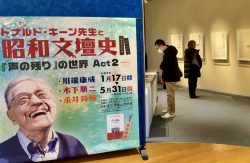
Exhibition Shows Keene’s Interactions with Showa-Era Writers in Tokyo, Features Newspaper Columns, Related Materials
-

Step Back in Time at Historical Estate Renovated into a Commercial Complex in Tokyo
-

The Japan News / Weekly Edition (2/20-2/26)
-
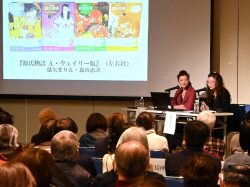
“The Tale of Genji” Back-Translation Project Led to Touching Encounter with Keene; Poet Sisters Recount Memories of Scholar at Packed Talk Event in Tokyo
-

The Japan News / Weekly Edition (2/13-2/19)
JN ACCESS RANKING
-
Producer Behind Pop Group XG Arrested for Cocaine Possession
-
Japan PM Takaichi’s Cabinet Resigns en Masse
-
Man Infected with Measles Reportedly Dined at Restaurant in Tokyo Station
-
Israeli Ambassador to Japan Speaks about Japan’s Role in the Reconstruction of Gaza
-
Videos Plagiarized, Reposted with False Subtitles Claiming ‘Ryukyu Belongs to China’; Anti-China False Information Also Posted in Japan