
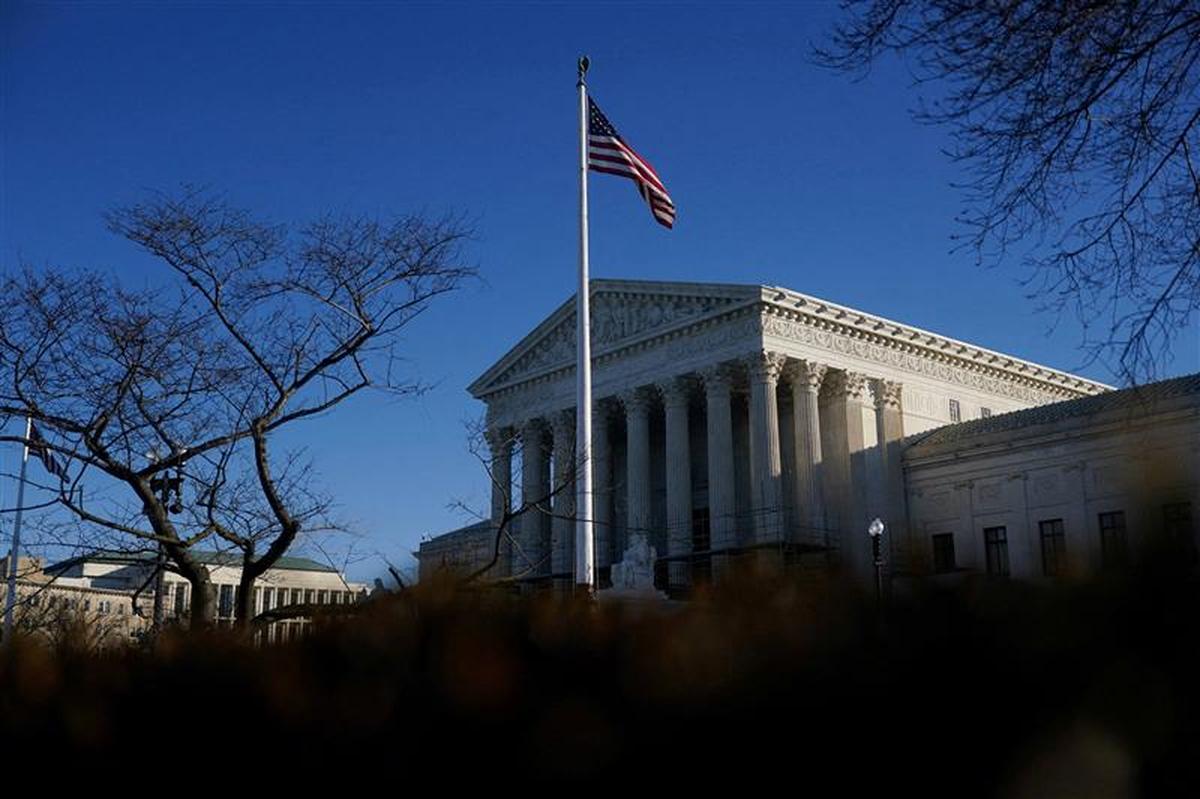
The U.S. Supreme Court is seen in Washington on Jan. 20.
1:09 JST, February 21, 2026
WASHINGTON (Reuters) — The U.S. Supreme Court struck down Donald Trump’s sweeping tariffs that he pursued under a law meant for use in national emergencies, handing a stinging defeat to the Republican president in a landmark opinion on Friday with major implications for the global economy.
The justices, in a 6-3 ruling authored by conservative Chief Justice John Roberts, upheld a lower court’s decision that Trump’s use of this 1977 law exceeded his authority. The justices ruled that the law at issue — the International Emergency Economic Powers Act, or IEEPA – did not grant Trump the power he claimed to impose tariffs.
“Our task today is to decide only whether the power to “regulate … importation,” as granted to the president in IEEPA, embraces the power to impose tariffs. It does not,” Roberts wrote in the ruling, quoting the statute’s text that Trump claimed had justified his sweeping tariffs.
The White House had no immediate comment on the ruling. Democrats and various industry groups hailed the ruling.
Part of the Supreme Court’s majority also declared that such an interpretation would intrude on the powers of Congress and violate a legal principle called the “major questions” doctrine.
The doctrine, embraced by the conservative justices, requires actions by the government’s executive branch of “vast economic and political significance” to be clearly authorized by Congress. The court used the doctrine to stymie some of Democratic former President Joe Biden’s key executive actions.
Roberts, citing a prior Supreme Court ruling, wrote that “the president must ‘point to clear congressional authorization’ to justify his extraordinary assertion of the power to impose tariffs,” adding: “He cannot.”
Roberts wrote that if Congress had intended IEEPA to bestow on the president “the distinct and extraordinary power to impose tariffs, it would have it would have done so expressly — as it consistently has in other tariff statutes.”
Trump has leveraged tariffs – taxes on imported goods — as a key economic and foreign policy tool. They have been central to a global trade war that Trump initiated after he began his second term as president, one that has alienated trading partners, affected financial markets and caused global economic uncertainty.
The Supreme Court reached its conclusion in a legal challenge by businesses affected by the tariffs and 12 U.S. states, most of them Democratic-governed, against Trump’s unprecedented use of this law to unilaterally impose the import taxes.
The three dissenting justices were conservatives Clarence Thomas, Samuel Alito and Brett Kavanaugh. Joining Roberts in the majority were conservative Justices Neil Gorsuch and Amy Coney Barrett, both of whom Trump appointed during his first term in office, along with the three liberal justices, Sonia Sotomayor, Elena Kagan and Ketanji Brown Jackson.
The liberal justices did not join the part of the opinion invoking the major questions doctrine.
The Supreme Court, which has a 6-3 conservative majority, previously had backed Trump in a series of other decisions issued on an emergency basis since he returned to the presidency in January 2025 after his policies were impeded by lower courts.
Trump’s tariffs were forecast to generate over the next decade trillions of dollars in revenue for the United States, which possesses the world’s largest economy.
Trump’s administration has not provided tariffs collection data since December 14. But Penn-Wharton Budget Model economists estimated on Friday that the amount collected in Trump’s tariffs based on IEEPA stood at more than $175 billion. And that amount likely would need to be refunded with a Supreme Court ruling against the IEEPA-based tariffs.
POWERS OF CONGRESS
The U.S. Constitution grants Congress, not the president, the authority to issue taxes and tariffs. But Trump instead turned to a statutory authority by invoking IEEPA to impose the tariffs on nearly every U.S. trading partner without the approval of Congress. Trump has imposed some additional tariffs under other laws that are not at issue in this case. Based on government data from October to mid-December, those represent about third of the revenue from Trump-imposed tariffs.
IEEPA lets a president regulate commerce in a national emergency. Trump became the first president to use IEEPA to impose tariffs, one of the many ways he has aggressively pushed the boundaries of executive authority since he returned to office in areas as varied as his crackdown on immigration, the firing of federal agency officials, domestic military deployments and military operations overseas.
Kavanaugh, who also was appointed by Trump during his first term as president, in a written dissent said that IEEPA’s text, as well as history and prior Supreme Court rulings supported the Trump administration’s position.
“Like quotas and embargoes, tariffs are a traditional and common tool to regulate importation,” wrote Kavanaugh, whose dissenting opinion was joined by Thomas and Alito.
“The tariffs at issue here may or may not be wise policy,” Kavanaugh added. “But as a matter of text, history, and precedent, they are clearly lawful. I respectfully dissent.”
Kavanaugh also said the decision could impact current trade deals.
“Because IEEPA tariffs have helped facilitate trade deals worth trillions of dollars—including with foreign nations from China to the United Kingdom to Japan, the Court’s decision could generate uncertainty regarding various trade agreements,” Kavanaugh wrote.
Trump described the tariffs as vital for U.S. economic security, predicting that the country would be defenseless and ruined without them. Trump in November told reporters that without his tariffs “the rest of the world would laugh at us because they’ve used tariffs against us for years and took advantage of us.” Trump said the United States was abused by other countries including China, the second-largest economy.
Candace Laing, president and CEO of the Canadian Chamber of Commerce, said the decision was a legal ruling, not a reset of U.S. trade policy.
“Canada should prepare for new, blunter mechanisms to be used to reassert trade pressure, potentially with broader and more disruptive effects,” Laing said in a statement.
After the Supreme Court heard arguments in the case in November, Trump said he would consider alternatives if it ruled against him on tariffs, telling reporters that “we’ll have to develop a ‘game two’ plan.”
Treasury Secretary Scott Bessent and other administration officials said the United States would invoke other legal justifications to retain as many of Trump’s tariffs as possible. Among others, these include a statutory provision that permits tariffs on imported goods that threaten U.S. national security and another that allows retaliatory actions including tariffs against trading partners that the Office of the U.S. Trade Representative determines have used unfair trade practices against American exporters.
None of these alternatives offered the flexibility and blunt-force dynamics that IEEPA provided Trump, and may not be able to replicate the full scope of his tariffs in a timely fashion.
Senate Democratic Leader Chuck Schumer called the decision a “victory for the wallets of every American consumer,” adding: Trump’s illegal tariff tax just collapsed. He tried to govern by decree and stuck families with the bill. Enough chaos. End the trade war.”
Democratic Senator Elizabeth Warren said the ruling left many questions unanswered.
“The Court has struck down these destructive tariffs, but there is no legal mechanism for consumers and many small businesses to recoup the money they have already paid. Instead, giant corporations with their armies of lawyers and lobbyists can sue for tariff refunds, then just pocket the money for themselves,” Warren said.
INCREASED LEVERAGE
Trump’s ability to impose tariffs instantaneously on any trading partner’s goods under the aegis of some form of declared national emergency raised his leverage over other countries. It brought world leaders scrambling to Washington to secure trade deals that often included pledges of billions of dollars in investments or other offers of enhanced market access for U.S. companies.
But Trump’s use of tariffs as a cudgel in U.S. foreign policy has succeeded in antagonizing numerous countries, including those long considered among the closest U.S. allies.
IEEPA historically had been used for imposing sanctions on enemies or freezing their assets, not to impose tariffs. The law does not specifically mention the word tariffs. Trump’s Justice Department had argued that IEEPA allows tariffs by authorizing the president to “regulate” imports to address emergencies.
The Congressional Budget Office has estimated that if all current tariffs stay in place, including the IEEPA-based duties, they would generate about $300 billion annually over the next decade.
Total U.S. net customs duty receipts reached a record $195 billion in fiscal 2025, which ended on September 30, according to U.S. Treasury Department data.
On April 2 on a date Trump labeled “Liberation Day,” the president announced what he called “reciprocal” tariffs on goods imported from most U.S. trading partners, invoking IEEPA to address what he called a national emergency related to U.S. trade deficits, though the United States already had run trade deficits for decades.
In February and March of 2025, Trump invoked IEEPA to impose tariffs on China, Canada and Mexico, citing the trafficking of the often-abused painkiller fentanyl and illicit drugs into the United States as a national emergency.
EXTRACTING CONCESSIONS
Trump has wielded his tariffs to extract concessions and renegotiate trade deals, and as a weapon to punish countries that draw his ire on non-trade political matters. These have ranged from Brazil’s prosecution of former president Jair Bolsonaro, India’s purchases of Russian oil that help fund Russia’s war in Ukraine, and an anti-tariffs ad by Canada’s Ontario province.
IEEPA was passed by Congress and signed by Democratic President Jimmy Carter. In passing the measure, Congress placed additional limits on the president’s authority compared to a predecessor law.
The cases on tariffs before the justices involved three lawsuits.
The Washington-based U.S. Court of Appeals for the Federal Circuit sided with five small businesses that import goods in one challenge, and the states of Arizona, Colorado, Connecticut, Delaware, Illinois, Maine, Minnesota, Nevada, New Mexico, New York, Oregon and Vermont in another.
Separately, a Washington-based federal judge sided with a family-owned toy company called Learning Resources.







Most Read
Popular articles in the past 24 hours
-

German Journalist Traces Footsteps of Great-Grandfather Who Was P...
-

10 Foreign Tourists Sustain Injuries After Fire at Capsule Hotel ...
-

World Baseball Classic: Venezuela Beats Japan in Nail-biting Back...
-

Rapid Services Resume on JR Chuo Line; Suspension Caused by Accid...
-

Rapid Services on JR Chuo Line Suspended; Accident at Kokubunji S...
-

World Baseball Classic: Venezuela Beats Japan in Back-and-Forth Q...
-

World Baseball Classic: Red Sox’s Abreu Hits 3-run Homer, Giving ...
-

Zelenskiy Says Ukraine Wants Money, Technology in Return for Midd...
Popular articles in the past week
-

Japan Figure Skating Legend Yuzuru Hanyu Is Proud Disaster Surviv...
-

15 Measles Patients Confirmed in Tokyo in Past 6 Days; 1 May Have...
-
Massive Sewer Pipe Found Jutting Out of Highway in Osaka
-
Japan Govt to Tighten Requirements to Receive Permanent Residency...
-

Power Outage Forces About 980 Passengers in Yokohama to Walk to T...
-
JR Tokai Breaks Ground on Yamanashi Maglev Station; Will Be Part ...
-

Parents in Japan to Get Instagram Notifications When Teens Repeat...
-

'World's Oldest Bio-Business' Is Japan's Seed Koji Retailing, Mol...
Popular articles in the past month
-

Producer Behind Pop Group XG Arrested for Cocaine Possession
-

Japan PM Takaichi’s Cabinet Resigns en Masse
-

Man Infected with Measles Reportedly Dined at Restaurant in Tokyo...
-
Japan Figure Skating Legend Yuzuru Hanyu Is Proud Disaster Surviv...
-

iPS Treatments Pass Key Milestone, but Broader Applications Far f...
-

Sanae Takaichi Elected Prime Minister of Japan; Keeps All Cabinet...
-
South Korea Tightens Rules on Foreigners Buying Homes in Seoul Me...
-

Nepal Bus Crash Kills 19 People, Injures 25 Including One Japanes...
Top Articles in News Services
-
Survey Shows False Election Info Perceived as True
-

Japan’s Nikkei Stock Average Falls as US-Iran Tensions Unsettle Investors (UPDATE 1)
-
Japan’s Nikkei Stock Average Rises on Tech Rally and Takaichi’s Spending Hopes (UPDATE 1)
-

Japan to Ban Use of Power Banks on Airplanes
-

North Korea Unveils Image of Kim Jong Un’s Teenage Daughter Firing Rifle
JN ACCESS RANKING
-
Producer Behind Pop Group XG Arrested for Cocaine Possession
-
Japan PM Takaichi’s Cabinet Resigns en Masse
-
Man Infected with Measles Reportedly Dined at Restaurant in Tokyo Station
-
Japan Figure Skating Legend Yuzuru Hanyu Is Proud Disaster Survivor and Gold Medalist, Vows to Continue Support Efforts
-
iPS Treatments Pass Key Milestone, but Broader Applications Far from Guaranteed