
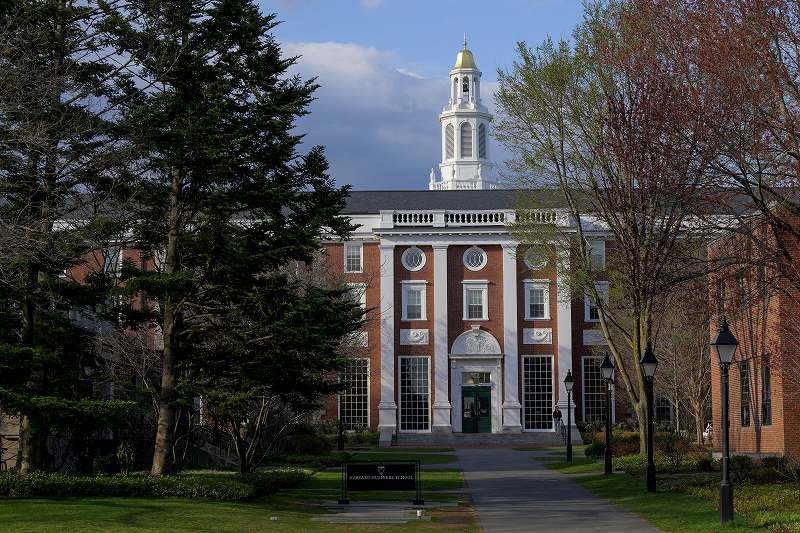
A view of the Business School campus of Harvard University in Cambridge, Mass., U.S., April 15, 2025.
11:21 JST, May 6, 2025
WASHINGTON (Reuters) — The U.S. Department of Education informed Harvard University on Monday that it was freezing billions of dollars in future research grants and other aid until the nation’s oldest and wealthiest college concedes to a number of demands from the Trump administration, a senior department official said.
The move represents the latest salvo from a Trump administration willing to use the power of the federal purse to force institutions, from law firms to universities, to make sweeping policy changes or else lose billions of dollars in federal grants and contracts.
In a letter to Harvard, U.S. Education Department Secretary Linda McMahon said the university must address concerns about antisemitism on campus, school policies that consider a student’s race, and complaints from the administration the university has abandoned its pursuit of “academic excellence” while employing relatively few conservative faculty members.
“This letter is to inform you that Harvard should no longer seek GRANTS from the federal government, since none will be provided,” McMahon wrote.
Harvard said the McMahon letter doubles down on demands that would impose “unprecedented and improper control” over the university and makes new threats to “illegally” withhold funding for lifesaving research.
“Harvard will also continue to defend against illegal government overreach aimed at stifling research and innovation that make Americans safer and more secure,” a university spokesperson said.
The freeze of future funding represents a slightly altered tactic by the Trump administration, whose attempts to freeze top schools of existing funds raised legal eyebrows.
Trump has targeted Harvard over allegations of antisemitism on campus during pro-Palestinian protests. The protests were sparked by U.S. ally Israel’s military assault on Gaza after the October 2023 attack on Israel by Palestinian Hamas militants.
Trump has alleged pro-Palestinian protesters are antisemitic and sympathetic to Hamas. Protesters, including some Jewish groups, say the government wrongly conflate their criticism of Israel’s actions in Gaza with antisemitism and their advocacy for Palestinian rights with support for extremism.
In recent weeks, the administration began a formal review into nearly $9 billion in federal funding for Harvard, demanded the university ban diversity, equity and inclusion practices, and crack down on some pro-Palestinian groups and masks in protests.
Harvard rejected numerous Trump demands last month, calling them an attack on free speech and academic freedom. It sued the Trump administration after it suspended about $2.3 billion in federal funding for the educational institution, while also pledging to tackle discrimination on campus.
In its lawsuit against the Trump administration, Harvard said the government’s funding cuts will have stark “real-life consequences for patients, students, faculty, staff, (and) researchers” while putting in jeopardy crucial medical and scientific research.
Harvard has a $53 billion endowment, the largest of any U.S. university, but the funds are often restricted and used for things like financial aid and scholarships.
The Yemeni group resumed its attacks on Israel and shipping lanes following a brief suspension after the ceasefire between Hamas and Israel in Gaza ended.
The Houthis, who control Yemen, have been firing at Israel and shipping in the Red Sea since the beginning of the war between Israel and Hamas in Gaza, in what they say is solidarity with the Palestinians.
A U.S. official speaking on condition of anonymity said that U.S. forces were not actively involved in Monday’s strikes, but there is general coordination between the two allies, the official said.
Meanwhile, an oil company operated by the Houthis announced it has begun operating an emergency system for supplying cars with fuel, owing to difficulties in unloading cargo at the oil port of Ras Isa.
The company, in a statement, attributed the decision to U.S. strikes on the country, including the port.
U.S. President Donald Trump in March ordered large-scale strikes against the Houthis. The strikes have killed hundreds of people in Yemen while Israel has largely limited its strikes on Yemen since December last year.
Earlier on Monday, Israel approved a plan that may include seizing the Gaza Strip and controlling aid to the Palestinian enclave.
The war in Gaza started after Hamas-led attacks on southern Israel on October 7, 2023, in which 1,200 people were killed and 251 taken hostage, according to Israeli tallies. Israel’s offensive on Gaza has killed more than 52,000 Palestinians, Gaza health officials have said, and destroyed much of the enclave.





Most Read
Popular articles in the past 24 hours
-
Japan's Opposition Parties Largely Absent from Social Security-Re...
-
Tourists Ignore Safety Barriers Near Famous Zao ‘Snow Monsters’ i...
-
Showa-era Towers in Kansai’s Big Cities Become Social Media Sensa...
-

Tokyo’s ‘Strawberry War’ Intensifies as Producers Vie to Become ‘...
-
Fukui: Effort to Grow Bananas in Snow Bears Fruit; Japanese Farme...
-
Neil Sedaka, The Singer-Songwriter Behind Dozens of Hits of The 1...
-
Japan's Budget May Be Passed Within FY25, as Ruling Parties Prepa...
-

Portable Stuffed Wolf Robot Designed to Drive Away Bears While Hi...
Popular articles in the past week
-

Producer Behind Pop Group XG Arrested for Cocaine Possession
-

Nepal Bus Crash Kills 19 People, Injures 25 Including One Japanes...
-
Tokyo Skytree's Elevator Stops, Trapping 20 People; All Rescued (...
-
Milano Cortina 2026: Japanese Gold Medalist Figure Skater Miura S...
-

Japan’s Major Real Estate Firms Expanding Overseas Businesses to ...
-

Reciprocal Tariffs Ruled Illegal: Judiciary Would Not Tolerate Pr...
-

Milano Cortina 2026: Miura-Kihara Duo, Other Japanese Figure Skat...
-
6 Injured at Naked Festival in Japan’s Okayama Prefecture; Police...
Popular articles in the past month
-
Producer Behind Pop Group XG Arrested for Cocaine Possession
-

Japan PM Takaichi’s Cabinet Resigns en Masse
-

Man Infected with Measles Reportedly Dined at Restaurant in Tokyo...
-

Israeli Ambassador to Japan Speaks about Japan’s Role in the Reco...
-

Videos Plagiarized, Reposted with False Subtitles Claiming ‘Ryuky...
-

Man Infected with Measles May Have Come in Contact with Many Peop...
-

Prudential Life Insurance Plans to Fully Compensate for Damages C...
-

Woman with Measles Visited Hospital in Tokyo Multiple Times Befor...
Top Articles in News Services
-
Survey Shows False Election Info Perceived as True
-
Hong Kong Ex-Publisher Jimmy Lai’s Sentence Raises International Outcry as China Defends It
-

Japan’s Nikkei Stock Average Touches 58,000 as Yen, Jgbs Rally on Election Fallout (UPDATE 1)
-
Japan’s Nikkei Stock Average Falls as US-Iran Tensions Unsettle Investors (UPDATE 1)
-
Japan’s Nikkei Stock Average Rises on Tech Rally and Takaichi’s Spending Hopes (UPDATE 1)
JN ACCESS RANKING
-
Producer Behind Pop Group XG Arrested for Cocaine Possession
-
Japan PM Takaichi’s Cabinet Resigns en Masse
-
Man Infected with Measles Reportedly Dined at Restaurant in Tokyo Station
-
Israeli Ambassador to Japan Speaks about Japan’s Role in the Reconstruction of Gaza
-
Videos Plagiarized, Reposted with False Subtitles Claiming ‘Ryukyu Belongs to China’; Anti-China False Information Also Posted in Japan