
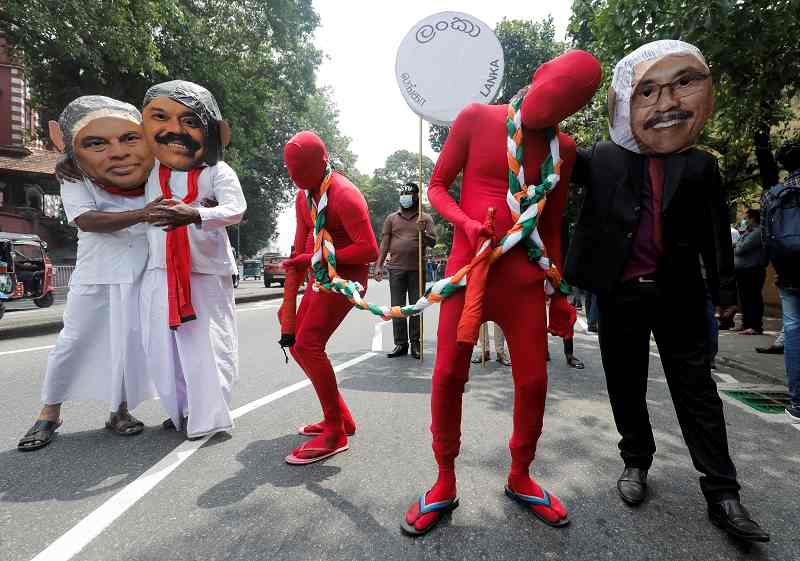
Members of Socialist Youth Union wear masks of Sri Lankan President Gotabaya Rajapaksa, Prime Minister Mahinda Rajapaksa and Finance Minister Basil Rajapaksa and two men dressed in symbol of Ceylon Petroleum Corporation with a rope in Indian national flag colours stand during a protest against the worsening economic crisis in Colombo on March 18.
14:45 JST, April 4, 2022
COLOMBO (Reuters) – The son of Sri Lanka’s prime minister resigned from the cabinet on Monday and several other members have offered to do so, a minister said, just days after President Gotabaya Rajapaksa declared a state of emergency following protests over an economic crisis.
The debt-laden country is struggling to pay for imports of fuel and other essentials due to a severe shortage of foreign currency, leading to hours-long power cuts and widespread demonstrations that continued despite a weekend curfew.
Traffic was back on the streets of the country’s main city Colombo on Monday, but there were reports of sporadic and peaceful protests from across the country.
Youth and Sports Minister Namal Rajapaksa, nephew of Gotabaya and the son of Prime Minister Mahinda Rajapaksa, said on Twitter on Monday he had told the president’s secretary about his resignation with immediate effect.
Namal said he quit in the hope it would help the president and prime minister’s “decision to establish stability” for Sri Lankans and the government.
Education Minister Dinesh Gunawardena told local media late on Sunday that “we handed our letters of resignation to the prime minister”.
“The president and the prime minister will discuss and take relevant decisions,” he said, without clarifying how many ministers had offered to quit.
Udaya Gammanpila, the chief of one of the 11 political parties that form the ruling coalition, said he had met the president and prime minister on Sunday with a plan to form a new cabinet.
“Our initial proposal was to set up an interim government representing all political parties of the government,” Gammanpila of the Pivithuru Hela Urumaya party told Reuters.
The island nation of 22 million, off India’s southern tip, is also grappling with soaring inflation after the government steeply devalued its currency last month ahead of talks with the International Monetary Fund for a loan programme.
The country’s expenditure has exceeded its income under successive governments while its production of tradable goods and services has been inadequate. The twin deficits were badly exposed by the COVID-19 pandemic that crippled its economic mainstay, the tourism industry.








Most Read
Popular articles in the past 24 hours
-

Artisans from Disaster-Hit Areas Work Together to Keep Memories o...
-

Japan Tourist Spot's Capsule Toys Made from Recycled Materials Pr...
-

Space One's No. 3 Kairos Rocket Terminates Mid-Flight
-

Japan’s Space One Kairos 3rd Flight Rocket Launched, but Mission ...
-

Former Unification Church: Proceed Steadily with Liquidation to P...
-
NTT Docomo to Discontinue 3G Service in March
-

Person Apparently Caught in Avalanche on Mt. Kamifurano in Hokkai...
-

LCC Greater Bay Airlines to Launch Regular Service on Fukuoka-Hon...
Popular articles in the past week
-
Tokyo Spends Big on Children, Wins Over Parents
-

South Korea Tightens Rules on Foreigners Buying Homes in Seoul Me...
-

Japan’s Miura, Kihara Announce Withdrawal from Figure Skating Wor...
-
2 Unpublished Early Novellas by Japan's Kenzaburo Oe Discovered, ...
-

Strait of Hormuz Closure Shakes Markets; Prolonged Closure Could ...
-
Nidec Chairman Resigns Amid Accounting Scandal at Major Japanese ...
-
Tourists Ignore Safety Barriers Near Famous Zao ‘Snow Monsters’ i...
-

Iran Situation: Japan Must Exert Diplomatic Efforts without Merel...
Popular articles in the past month
-

Producer Behind Pop Group XG Arrested for Cocaine Possession
-

Japan PM Takaichi’s Cabinet Resigns en Masse
-

Man Infected with Measles Reportedly Dined at Restaurant in Tokyo...
-

Israeli Ambassador to Japan Speaks about Japan’s Role in the Reco...
-

Videos Plagiarized, Reposted with False Subtitles Claiming ‘Ryuky...
-

Prudential Life Insurance Plans to Fully Compensate for Damages C...
-

Woman with Measles Visited Hospital in Tokyo Multiple Times Befor...
-

iPS Treatments Pass Key Milestone, but Broader Applications Far f...
Top Articles in News Services
-
Survey Shows False Election Info Perceived as True
-
Hong Kong Ex-Publisher Jimmy Lai’s Sentence Raises International Outcry as China Defends It
-

Japan’s Nikkei Stock Average Falls as US-Iran Tensions Unsettle Investors (UPDATE 1)
-
Japan’s Nikkei Stock Average Touches 58,000 as Yen, Jgbs Rally on Election Fallout (UPDATE 1)
-
Japan’s Nikkei Stock Average Rises on Tech Rally and Takaichi’s Spending Hopes (UPDATE 1)
JN ACCESS RANKING
-
Producer Behind Pop Group XG Arrested for Cocaine Possession
-
Japan PM Takaichi’s Cabinet Resigns en Masse
-
Man Infected with Measles Reportedly Dined at Restaurant in Tokyo Station
-
Israeli Ambassador to Japan Speaks about Japan’s Role in the Reconstruction of Gaza
-
Videos Plagiarized, Reposted with False Subtitles Claiming ‘Ryukyu Belongs to China’; Anti-China False Information Also Posted in Japan