
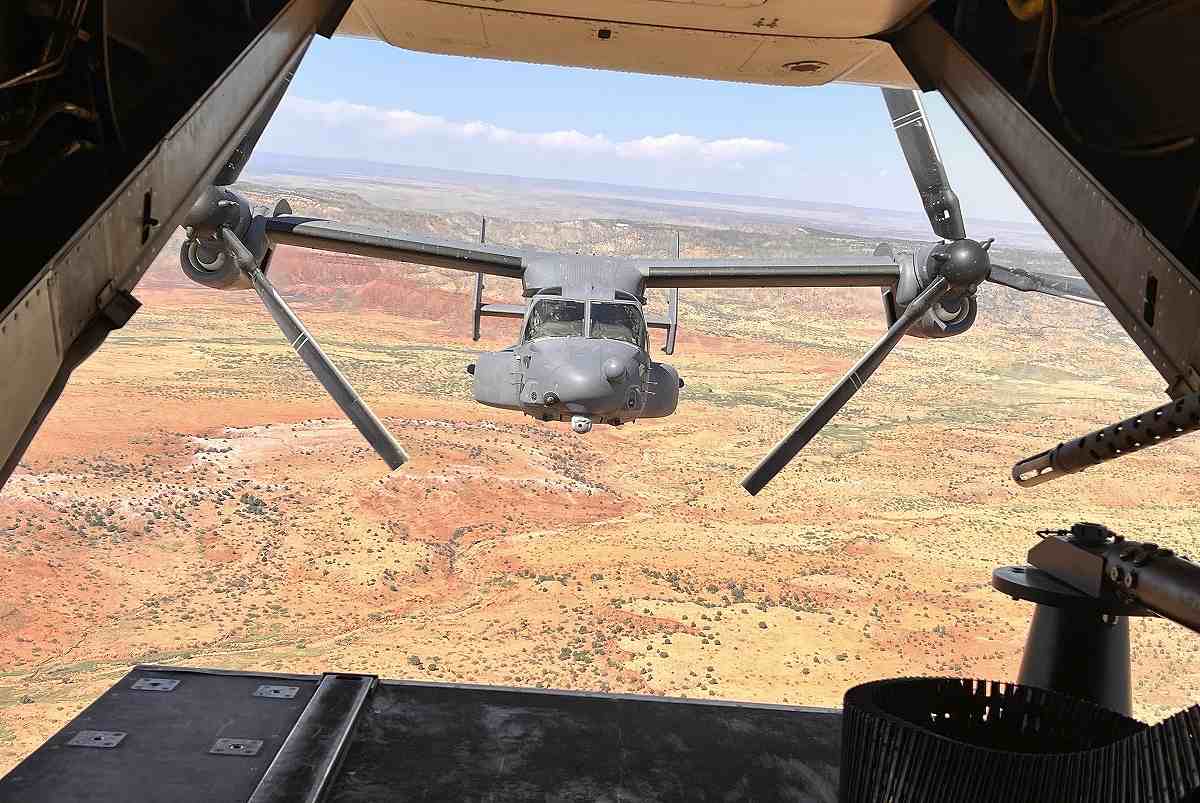
Two Air Force Special Operations Command CV-22B Ospreys fly low and fast in formation on a training range named the Hornet at Cannon Air Force Base, N.M., on Oct. 9.
12:42 JST, December 21, 2024
WASHINGTON (AP) — The military has ordered new safety guidelines for a key part in all Osprey aircraft after a recent accident revealed the same problem that caused a fatal crash in Japan last year.
During a Nov. 20 flight involving a CV-22B Osprey in New Mexico, the crew received warnings that the metal gears inside the aircraft’s transmission, known as the proprotor gearbox, were in trouble.
They lost an engine, but due to lessons learned from the crash in Japan that killed eight service members, the Air Force Special Operations Command crew in New Mexico quickly got the aircraft on the ground and survived.
Investigators opened up the failed and badly damaged transmission from last month’s flight, finding the same type of metal weaknesses — called inclusions — that led to gears breaking apart in a similar way in the Japan crash in November 2023.
Following the New Mexico near-crash, all the military services grounded their Ospreys, which can fly both like a helicopter and an airplane, for the second time this year. The Marines, however, put their Ospreys back in the air days later.
Under guidelines announced Friday, all Ospreys with proprotor gearboxes under a certain number of flight hours will be subject to additional safety restrictions. The restrictions affect the newer transmissions because investigators have found that the metal weaknesses, if they are going to occur, happen early on.
The metal weaknesses have been tied to the way the alloys are manufactured. There is a hardier manufacturing method available, but it will require replacement of the expensive transmissions, a process that likely would take years to complete for all of the approximately 400 aircraft in the military’s fleet.
An in-depth investigation into the Osprey by The Associated Press found that safety issues have increased in the past five years, parts are wearing out faster than expected and that the design of the aircraft itself is directly contributing to many of the accidents.
Naval Air Systems Command, which runs the Osprey program across the military branches, said Friday that the additional safety controls “will remain in place” until the proprotor gearboxes are replaced.
“Due to operational security concerns, the specifics of the V-22 flight-hour threshold, number of aircraft affected and additional flight controls will not be released,” NAVAIR said in a statement.










Most Read
Popular articles in the past 24 hours
-

BOJ Keeping Eye on Economy and Takaichi's ‘Proactive Fiscal Polic...
-

University of Tsukuba Hospital to Introduce Working Dog Next Year...
-

Record 167 Elementary School Students Harmed Via Social Media in ...
-

Mizuho Bank May Have Lost Data on Thousands of Clients
-

Japan’s Hikonyan Cat Mascot to Celebrate 20th Birthday with Party...
-

Japan's Kairos Rocket Set to Launch on Sunday After Delays
-

Humbert Humbert: Husband-Wife Vocal Duo Brings Cheerful Singing t...
-

Mizuho to Cut Up to 5,000 Administrative Jobs with AI-Driven Oper...
Popular articles in the past week
-

Producer Behind Pop Group XG Arrested for Cocaine Possession
-

iPS Treatments Pass Key Milestone, but Broader Applications Far f...
-

Tokyo Skytree's Elevator Stops, Trapping 20 People; All Rescued (...
-

Nepal Bus Crash Kills 19 People, Injures 25 Including One Japanes...
-

Milano Cortina 2026: Japanese Gold Medalist Figure Skater Miura S...
-

Japan’s Major Real Estate Firms Expanding Overseas Businesses to ...
-

Milano Cortina 2026: Japanese Figure Skater Kaori Sakamoto’...
-

Reciprocal Tariffs Ruled Illegal: Judiciary Would Not Tolerate Pr...
Popular articles in the past month
-
Producer Behind Pop Group XG Arrested for Cocaine Possession
-

Japan PM Takaichi’s Cabinet Resigns en Masse
-

Japan Institute to Use Domestic Commercial Optical Lattice Clock ...
-

Man Infected with Measles Reportedly Dined at Restaurant in Tokyo...
-

Israeli Ambassador to Japan Speaks about Japan’s Role in the Reco...
-

Videos Plagiarized, Reposted with False Subtitles Claiming ‘Ryuky...
-

Man Infected with Measles May Have Come in Contact with Many Peop...
-

Prudential Life Insurance Plans to Fully Compensate for Damages C...
Top Articles in News Services
-

Survey Shows False Election Info Perceived as True
-

Hong Kong Ex-Publisher Jimmy Lai’s Sentence Raises International Outcry as China Defends It
-

Japan’s Nikkei Stock Average Touches 58,000 as Yen, Jgbs Rally on Election Fallout (UPDATE 1)
-
Japan’s Nikkei Stock Average Falls as US-Iran Tensions Unsettle Investors (UPDATE 1)
-

Trump Names Former Federal Reserve Governor Warsh as the Next Fed Chair, Replacing Powell
JN ACCESS RANKING
-
Producer Behind Pop Group XG Arrested for Cocaine Possession
-
Japan PM Takaichi’s Cabinet Resigns en Masse
-
Man Infected with Measles Reportedly Dined at Restaurant in Tokyo Station
-
Israeli Ambassador to Japan Speaks about Japan’s Role in the Reconstruction of Gaza
-
Videos Plagiarized, Reposted with False Subtitles Claiming ‘Ryukyu Belongs to China’; Anti-China False Information Also Posted in Japan