
A Chinese Spacecraft Lands on Moon’s Far Side to Collect Rocks in Growing Space Rivalry with US
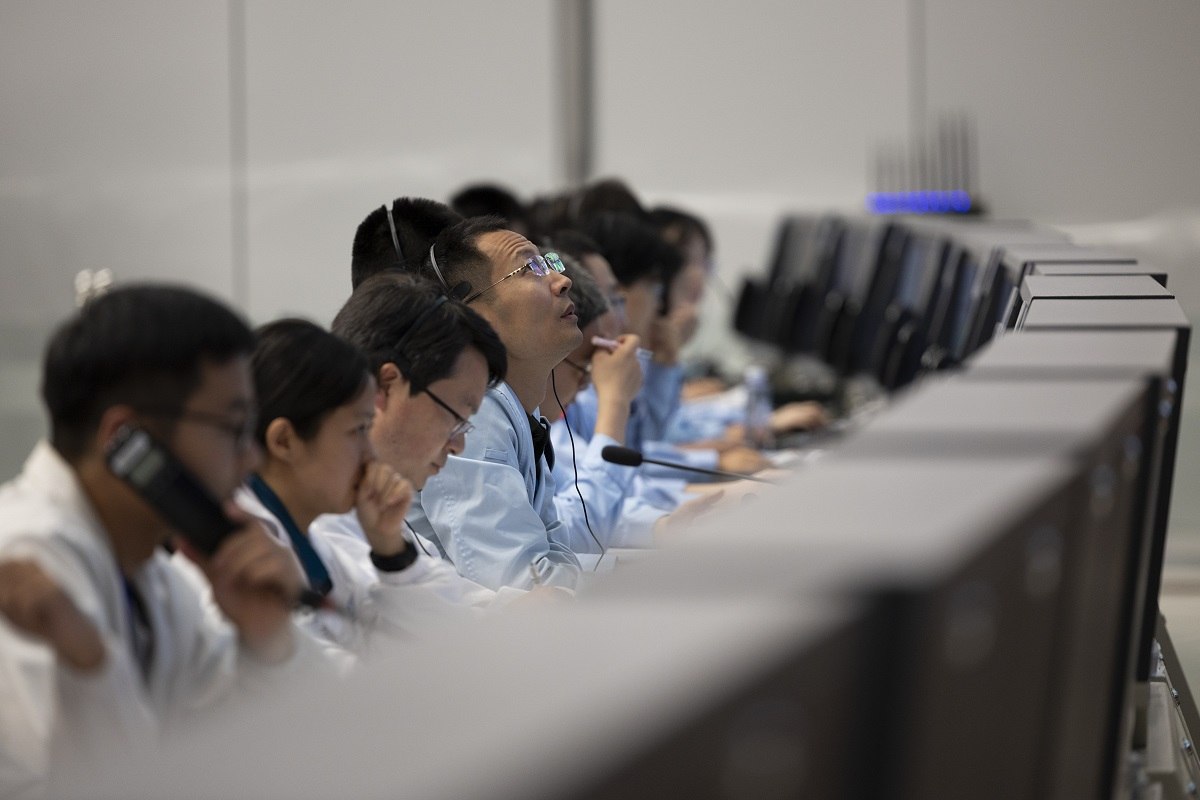
In this photo released by Xinhua News Agency, technical personnel work at the Beijing Aerospace Control Center (BACC) in Beijing, Sunday, June 2, 2024.
13:07 JST, June 2, 2024
BEIJING (AP) — A Chinese spacecraft landed on the far side of the moon Sunday to collect soil and rock samples that could provide insights into differences between the less-explored region and the better-known near side.
The landing module touched down at 6:23 a.m. Beijing time in a huge crater known as the South Pole-Aitken Basin, the China National Space Administration said.
The mission is the sixth in the Chang’e moon exploration program, which is named after a Chinese moon goddess. It is the second designed to bring back samples, following the Chang’e 5, which did so from the near side in 2020.
The moon program is part of a growing rivalry with the U.S. — still the leader in space exploration — and others, including Japan and India. China has put its own space station in orbit and regularly sends crews there.
The emerging global power aims to put a person on the moon before 2030, which would make it the second nation after the United States to do so. America is planning to land astronauts on the moon again — for the first time in more than 50 years — though NASA pushed the target date back to 2026 earlier this year.
U.S. efforts to use private sector rockets to launch spacecraft have been repeatedly delayed. Last-minute computer trouble nixed the planned launch of Boeing’s first astronaut flight Saturday.
Earlier Saturday, a Japanese billionaire called off his plan to orbit the moon because of uncertainty over the development of a mega rocket by SpaceX. NASA is planning to use the rocket to send its astronauts to the moon.
In China’s current mission, the lander is to use a mechanical arm and a drill to gather up to 2 kilograms (4.4 pounds) of surface and underground material for about two days.
An ascender atop the lander will then take the samples in a metal vacuum container back to another module that is orbiting the moon. The container will be transferred to a re-entry capsule that is due to return to Earth in the deserts of China’s Inner Mongolia region about June 25.
Missions to the moon’s far side are more difficult because it doesn’t face the Earth, requiring a relay satellite to maintain communications. The terrain is also more rugged, with fewer flat areas to land.








Most Read
Popular articles in the past 24 hours
-
Japan's Budget on Track for Quick Passage, but Ruling Parties to ...
-

Japan-Based USS Tripoli, Marine Unit to Be Sent to Middle East, U...
-

7 Men Arrested Over Robbery of ¥423 Mil. on Tokyo Street; Members...
-
Ransomware Attacks Hitting Japan's Small, Midsize Firms
-

National Intelligence Council: Proposed Body Must Be Utilized To ...
-

‘Kokuho’ Wins Record 10 Awards at Japan Academy Film Prize; Demon...
-
North Korea Fires about 10 Missiles toward Sea in Show of Force, ...
-

Milano Cortina 2026: Japan’s Daichi Oguri Wins Silver in Pa...
Popular articles in the past week
-

Japan Figure Skating Legend Yuzuru Hanyu Is Proud Disaster Surviv...
-
Govt to Utilize ODA for Ensuring Economic Security; Securing Ener...
-
15 Measles Patients Confirmed in Tokyo in Past 6 Days; 1 May Have...
-
Massive Sewer Pipe Found Jutting Out of Highway in Osaka
-
Japan Govt to Tighten Requirements to Receive Permanent Residency...
-
Power Outage Forces About 980 Passengers in Yokohama to Walk to T...
-
JR Tokai Breaks Ground on Yamanashi Maglev Station; Will Be Part ...
-

Beckoning Cats Get Makeover to Fit Modern Lifestyles with Sleek D...
Popular articles in the past month
-

Producer Behind Pop Group XG Arrested for Cocaine Possession
-

Japan PM Takaichi’s Cabinet Resigns en Masse
-

Man Infected with Measles Reportedly Dined at Restaurant in Tokyo...
-
Japan Figure Skating Legend Yuzuru Hanyu Is Proud Disaster Surviv...
-

iPS Treatments Pass Key Milestone, but Broader Applications Far f...
-

Sanae Takaichi Elected Prime Minister of Japan; Keeps All Cabinet...
-

South Korea Tightens Rules on Foreigners Buying Homes in Seoul Me...
-

Nepal Bus Crash Kills 19 People, Injures 25 Including One Japanes...
Top Articles in News Services
-
Survey Shows False Election Info Perceived as True
-

Japan’s Nikkei Stock Average Falls as US-Iran Tensions Unsettle Investors (UPDATE 1)
-
Japan’s Nikkei Stock Average Rises on Tech Rally and Takaichi’s Spending Hopes (UPDATE 1)
-
Japan to Ban Use of Power Banks on Airplanes
-

North Korea Unveils Image of Kim Jong Un’s Teenage Daughter Firing Rifle
JN ACCESS RANKING
-
Producer Behind Pop Group XG Arrested for Cocaine Possession
-
Japan PM Takaichi’s Cabinet Resigns en Masse
-
Man Infected with Measles Reportedly Dined at Restaurant in Tokyo Station
-
Japan Figure Skating Legend Yuzuru Hanyu Is Proud Disaster Survivor and Gold Medalist, Vows to Continue Support Efforts
-
iPS Treatments Pass Key Milestone, but Broader Applications Far from Guaranteed