
Pangasius Catfish Increasingly Featured on Japanese Restaurant Menus, Home Dining Tables Due to Affordability, Mild Flavor

Sutchi catfish, a type of pangasius
15:30 JST, January 18, 2026
As the popularity of edible catfish climbs, the pangasius genus is becoming a fixture, increasingly featured both on chain restaurants’ menus and consumers’ dinner plates.
Widely consumed overseas, especially in Southeast Asia, this species of catfish serves as an inexpensive and stable commodity in those regions. Its mild flavor lends itself to a wide range of dishes, and its rapid growth rate ensures ease of sourcing.
The import volume of pangasius is increasing, even as familiar options like salmon and eel are withdrawn from dining tables due to poor catches and soaring prices.
Pangasius sushi
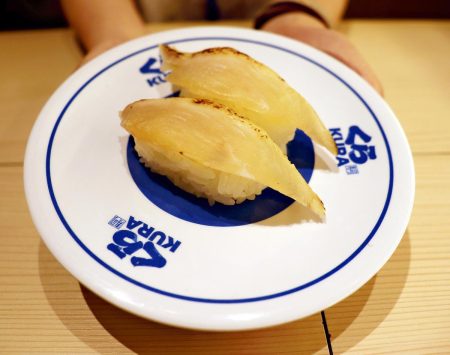
A plate of ikejime pangasius sushi offered at a Kura Sushi restaurant in Naniwa Ward, Osaka
At Kura Sushi Global Flagship Store Namba Parks South, a conveyor belt restaurant in Naniwa Ward, Osaka, a 74-year-old man from Chuo Ward sampled the ikejime pangasius sushi. He praised the dish, saying, “It doesn’t have a fishy smell and is very easy to eat. It’s the perfect choice when I’m looking for a white fish.”
Primarily farmed in Southeast Asian countries, including Vietnam, pangasius is a type of catfish that occasionally grows to be more than one meter in length.
Visually, the fillets resemble common white fish, but their distinctive soft and springy texture is their main appeal.
Domestically, the catfish had been used primarily in white fish fry but quickly became recognized as a substitute for high-priced eel, leading to a broader market and wider distribution.
Kura Sushi Inc., the operator of the sushi chain, added pangasius to its permanent menu in November 2024.
With prices starting from ¥115, the reasonable cost of pangasius is key to its popularity, mainly with families, the company said.
The catfish is farmed and processed in Vietnam, then imported into Japan.
Widely available
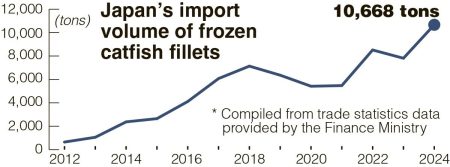
Pangasius is also becoming widely available at supermarkets and mass retailers. Fillets are available at all Costco outlets, the membership-based wholesale retailer. Even the AEON Group has been offering it for sale since 2014.
Its mild flavor makes it suitable for a variety of recipes and cooking methods, such as saute, meuniere, tatsuta-age deep-fried fish, acqua pazza, and nitsuke simmered in a mixture of soy sauce, mirin, and sugar.
“It is easily incorporated into menus, and it still has significant potential for growth,” said an industry source in the food service sector.
The import volume of frozen catfish fillets, including the pangasius genus, was 646 tons when it was first registered in the Finance Ministry’s trade statistics in 2012. The volume had skyrocketed to 10,668 tons in 2024.
Stable procurement
The surge in imports and distribution is largely driven by the promising prospect of stable procurement. Poor catches of well-known seafoods are a frequent occurrence, stemming from rising seawater temperatures and rampant overfishing.
According to the fiscal 2024 White Paper on Fisheries, the combined catch of Pacific saury(sanma), Japanese flying squid and salmon in 2023 saw a drastic reduction — falling to only about 20% of the volume recorded nine years earlier.
Pangasius exhibits rapid growth, developing from fry just a few centimeters long to a marketable size in a matter of months.
“It can be farmed in dense conditions, and its excellent feed efficiency [indicating how much can be produced with a certain amount of feed] allows us to contain production costs. This makes it a valuable food source,” said Prof. Ikuo Hirono of Tokyo University of Marine Science and Technology.




Most Read
Popular articles in the past 24 hours
-

Strait of Hormuz Closure Shakes Markets; Prolonged Closure Could ...
-

Measles Patient Visited Hospital in Bunkyo Ward, Tokyo, Metropoli...
-

Iran Situation: Japan Must Exert Diplomatic Efforts without Merel...
-

Milano Cortina 2026: Japanese Figure Skater Miura Returns to Home...
-

2 of Japan's Opposition Parties Submit Bill to Revise Political F...
-

Takayama Among World's Top 10 Most Welcoming Cities for 2026; 2nd...
-
Chiba Police to Arrest Japanese National in Midair; Man Accused o...
-

Former Nomura Securities Employee Given 18-year Prison Sentence f...
Popular articles in the past week
-

Milano Cortina 2026: Japanese Gold Medalist Figure Skater Miura S...
-

Tokyo Spends Big on Children, Wins Over Parents
-

Japan’s Miura, Kihara Announce Withdrawal from Figure Skating Wor...
-

Yokohama to Test Out Renewable-Powered Offshore Floating Data Cen...
-

BOJ Keeping Eye on Economy and Takaichi's ‘Proactive Fiscal Polic...
-

Tokyo Measles Patient Traveled to Fukuoka Aboard JAL Planes; Susp...
-

Japan’s Takaichi Speaks on New U.S. Tariff in Upper House, Says P...
-

Nidec Chairman Resigns Amid Accounting Scandal at Major Japanese ...
Popular articles in the past month
-

Producer Behind Pop Group XG Arrested for Cocaine Possession
-

Japan PM Takaichi’s Cabinet Resigns en Masse
-

Man Infected with Measles Reportedly Dined at Restaurant in Tokyo...
-

Israeli Ambassador to Japan Speaks about Japan’s Role in the Reco...
-

Videos Plagiarized, Reposted with False Subtitles Claiming ‘Ryuky...
-

Prudential Life Insurance Plans to Fully Compensate for Damages C...
-

Woman with Measles Visited Hospital in Tokyo Multiple Times Befor...
-

iPS Treatments Pass Key Milestone, but Broader Applications Far f...
Top Articles in Features
-

Tokyo’s New Record-Breaking Fountain Named ‘Tokyo Aqua Symphony’
-

Sapporo Snow Festival Opens with 210 Snow and Ice Sculptures at 3 Venues in Hokkaido, Features Huge Dogu
-

High-Hydration Bread on the Rise, Seeing Increase in Specialty Shops, Recipe Searches
-

Heirs to Kyoto Talent: Craftsman Works to Keep Tradition of ‘Kinran’ Brocade Alive Through Initiatives, New Creations
-
Maltese Pavilion’s Famous Ftira Bread Now Available in Osaka; Loaves Became Popular during 2025 Osaka-Kansai Expo
JN ACCESS RANKING
-
Producer Behind Pop Group XG Arrested for Cocaine Possession
-
Japan PM Takaichi’s Cabinet Resigns en Masse
-
Man Infected with Measles Reportedly Dined at Restaurant in Tokyo Station
-
Israeli Ambassador to Japan Speaks about Japan’s Role in the Reconstruction of Gaza
-
Videos Plagiarized, Reposted with False Subtitles Claiming ‘Ryukyu Belongs to China’; Anti-China False Information Also Posted in Japan