
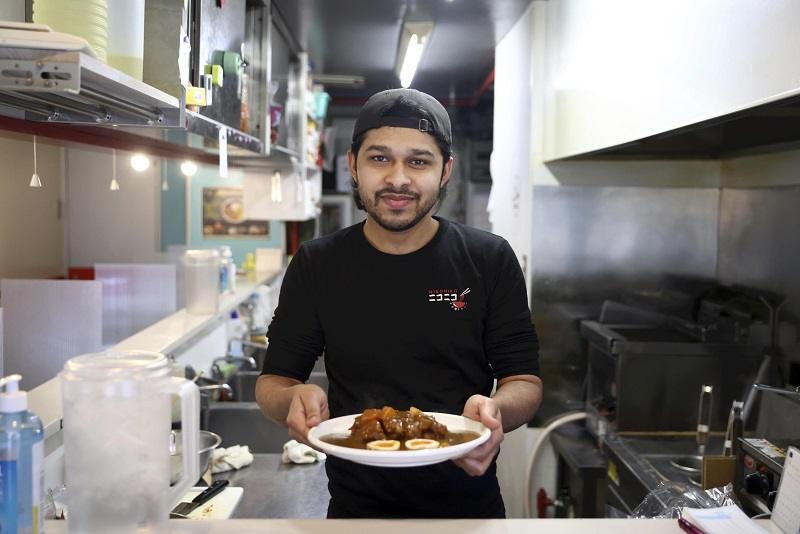
Nasardeen Mohamed Ajath holds a curry and rice dish with deep-fried chicken on top — similar to his first-ever Japanese-style curry — at his restaurant in Chiyoda Ward, Tokyo, on April 8.
16:11 JST, May 17, 2022
A Japanese-style curry restaurant in Tokyo’s Chiyoda Ward was opened by a young Sri Lankan with the aim of spreading the curry of his adopted home country around the world.

Ajath offers prayers at the mosque in front of his restaurant on April 8. Lunch-hour starts at 12:45 p.m. on Fridays, so he carries out the ritual at around noon, while on other days the store opens at 11:30 a.m.
Nasardeen Mohamed Ajath, the 29-year-old owner of NikoNiko Halal Mazemen & Curry in the Kandasudacho district, first came to Japan in 2015 to study. Being a Muslim and unable to consume pork or alcohol, he had trouble finding what he could eat during his stay in Tochigi Prefecture.
“I could not tell which dish was OK for me to eat, so I just kept frying eggs and eating them,” Ajath recalled.
After finishing his studies at a vocational school, Ajath moved to Tokyo in 2019 to find employment. He then came across a dish that would change his life. A Halal Japanese-style curry served by the curry restaurant chain Ichibanya Co. took the Sri Lankan man by surprise.
“It was completely different from the curries in Sri Lanka. A new dish for me, and it was very tasty,” he said.
Ajath had worked for a bakery back home, and cooking was his strong point. He started planning to open a Japanese-style curry restaurant where Muslims visiting Japan would not feel any concerns about eating the food. At the time, many foreign tourists were visiting the country.
He honed his skills in making thick Japanese-style curry by working part-time at a curry restaurant. Then, in January 2021, he opened his restaurant in front of a mosque.
In addition to curry, the restaurant serves mazesoba soupless noodles, another of Ajath’s favorite foods in Japan.
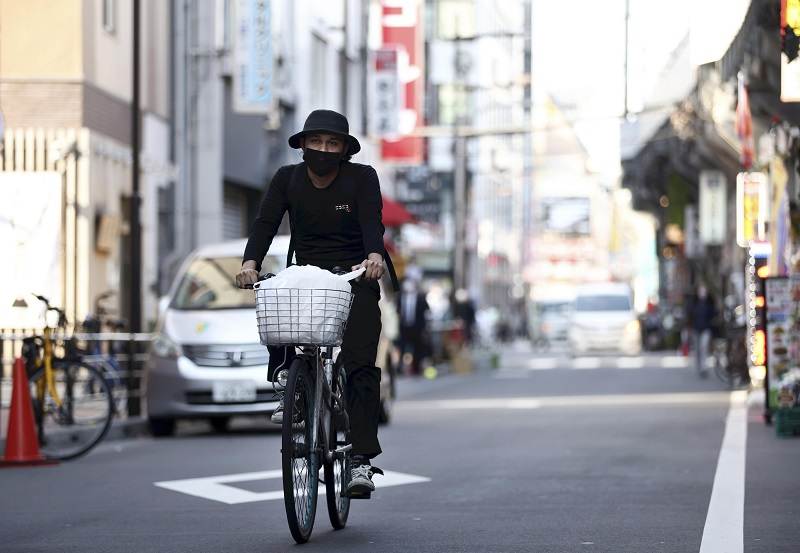
Ajath rides a bicycle to buy ingredients after lunch-hour in Taito Ward on April 12. He pays close attention to what to buy, saying, “I want Muslims to feel safe eating food in Japan.”
Due to the prolonged coronavirus pandemic, however, the number of Muslims visiting the mosque in front of his restaurant has decreased. And the number of foreign tourists to Japan has not returned to pre-pandemic levels, either. Ajath has been holding on by taking such measures as serving Sri Lankan curries to Japanese customers, among other courses of action.
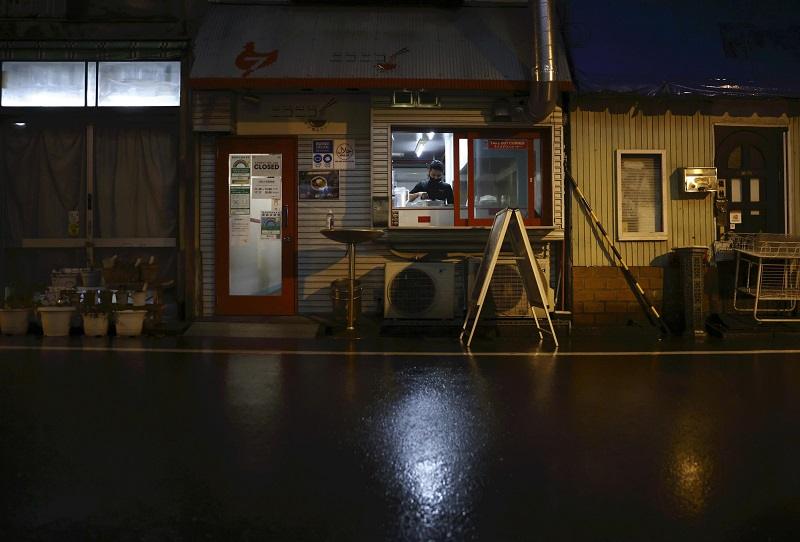
Ajath’s restaurant NikoNiko Halal Mazemen & Curry is seen on Feb. 19 after closing at 8 p.m., as Tokyo was under quasi-emergency priority measures at the time. Its sales dropped by 40%.
On the wall of his restaurant is a world map where customers have pinned their hometowns.
“I want to fill this map with lots of pins,” Ajath said. “I’d like to open restaurants overseas and spread Japanese-style curry around the world.”
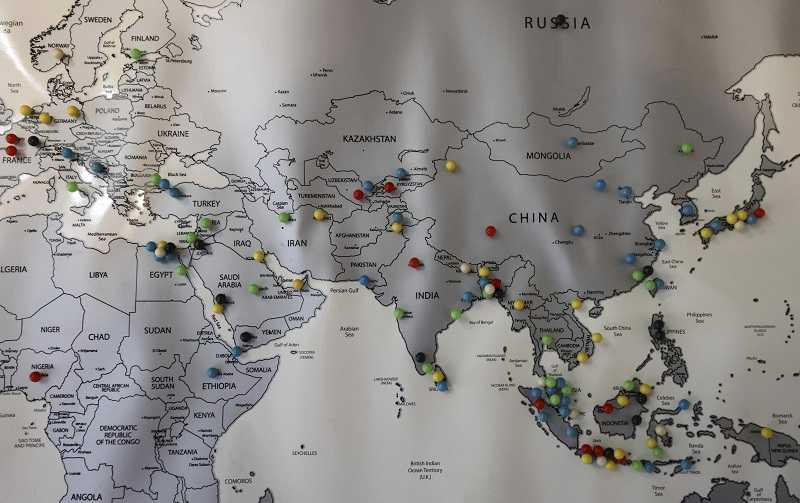
A world map on which customers have pinned their hometowns is seen at Ajath’s restaurant on Feb. 16. “I want to fill this map with pins,” he said.





Most Read
Popular articles in the past 24 hours
-
Japan's Budget on Track for Quick Passage, but Ruling Parties to ...
-

Japan-Based USS Tripoli, Marine Unit to Be Sent to Middle East, U...
-

Ransomware Attacks Hitting Japan's Small, Midsize Firms
-
7 Men Arrested Over Robbery of ¥423 Mil. on Tokyo Street; Members...
-

North Korea Fires about 10 Missiles toward Sea in Show of Force, ...
-

German Journalist Traces Footsteps of Great-Grandfather Who Was P...
-

Hiroshima: Yamato Museum to Reopen on April 23 after Major Renova...
-

CARTOON OF THE DAY (March 14)
Popular articles in the past week
-

Japan Figure Skating Legend Yuzuru Hanyu Is Proud Disaster Surviv...
-
Govt to Utilize ODA for Ensuring Economic Security; Securing Ener...
-
15 Measles Patients Confirmed in Tokyo in Past 6 Days; 1 May Have...
-
Massive Sewer Pipe Found Jutting Out of Highway in Osaka
-
Japan Govt to Tighten Requirements to Receive Permanent Residency...
-
Power Outage Forces About 980 Passengers in Yokohama to Walk to T...
-

JR Tokai Breaks Ground on Yamanashi Maglev Station; Will Be Part ...
-
Beckoning Cats Get Makeover to Fit Modern Lifestyles with Sleek D...
Popular articles in the past month
-

Producer Behind Pop Group XG Arrested for Cocaine Possession
-

Japan PM Takaichi’s Cabinet Resigns en Masse
-

Man Infected with Measles Reportedly Dined at Restaurant in Tokyo...
-
Japan Figure Skating Legend Yuzuru Hanyu Is Proud Disaster Surviv...
-

iPS Treatments Pass Key Milestone, but Broader Applications Far f...
-

Sanae Takaichi Elected Prime Minister of Japan; Keeps All Cabinet...
-

South Korea Tightens Rules on Foreigners Buying Homes in Seoul Me...
-

Nepal Bus Crash Kills 19 People, Injures 25 Including One Japanes...
Top Articles in Features
-

High-Hydration Bread on the Rise, Seeing Increase in Specialty Shops, Recipe Searches
-
Japanese Students Use Traditional Pickle to Create Novel Wagashi Confectionery
-

My Spendthrift Mother Constantly Asks Me for Money
-
Tourists Ignore Safety Barriers Near Famous Zao ‘Snow Monsters’ in Japan
-

Kawazu Cherry Blossoms in Full Bloom in Japan’s Shizuoka Pref.; Festival to Be Held through March 8
JN ACCESS RANKING
-
Producer Behind Pop Group XG Arrested for Cocaine Possession
-
Japan PM Takaichi’s Cabinet Resigns en Masse
-
Man Infected with Measles Reportedly Dined at Restaurant in Tokyo Station
-
Japan Figure Skating Legend Yuzuru Hanyu Is Proud Disaster Survivor and Gold Medalist, Vows to Continue Support Efforts
-
iPS Treatments Pass Key Milestone, but Broader Applications Far from Guaranteed