
Popularity of Piggy Banks Across Time and Place Seen at Bank’s Museum of Money Boxes in Hyogo Pref.
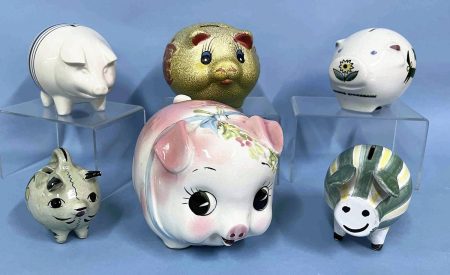
Ceramic piggy banks from Japan, Britain, Norway, Switzerland and other places entertain visitors with their diverse colors and shapes.
16:30 JST, December 21, 2025
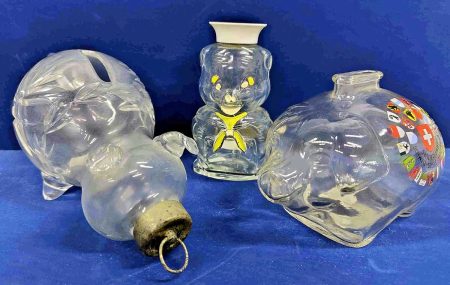
Glass money boxes from the United States and Europe
Money boxes come in all shapes and sizes, but the pig is one of the most familiar shapes, as is indicated by the fact that they are commonly called piggy banks in English. Pig-shaped money boxes have been made all over the world. The joy of saving up with the jingle of coins, aiming for a “full belly,” seems universal across time and place.
We visited the Amagasaki Shinkin Bank’s museum of money boxes from across the world in Amagasaki, Hyogo Prefecture. It has a collection of about 25,000 items from 62 countries, including money boxes from the West, Asia and the Middle East. Pig-shaped money boxes alone number about 450.
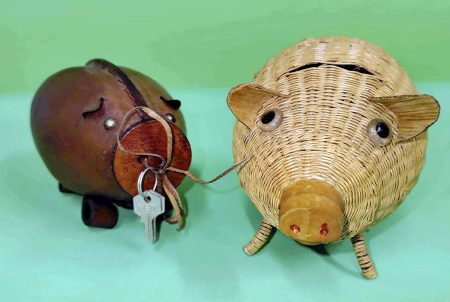
Leather and rattan money boxes
Some of the pig-shaped money boxes have wide-open eyes like anime characters, while others are entirely gold, like lucky charms. While there are simple ceramic ones, there are also transparent glass banks that allow you to see the contents at a glance.
Others are made from unusual materials such as leather and rattan. Money boxes from Japan, China, the United States, Britain, Mexico, Switzerland, Norway — each one of them has its own expression and charm.
Why are there so many pig-shaped money boxes, or piggy banks? “They’ve long been made in various countries as auspicious items to bring good fortune,” said the museum’s director, Tsutomu Mitoori, 65. Mitoori joined the bank in 1984 after graduating from college, and he has been serving as museum director since 2020.
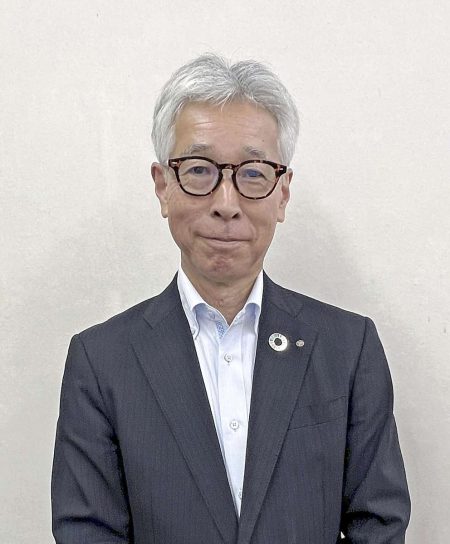
Tsutomu Mitoori
One theory is that pigs have been regarded as symbols of prosperity due to their prolific breeding. Another suggests that pigs represent efficiency, as every part of the animal — from skin to bones — can be utilized.
In Japan, ceramic and vinyl piggy banks became popular after the war. One reason behind their popularity seems to be the fact that their rounded shape is well-suited for holding coins.
Money boxes reflect ordinary people’s longing for wealth. Those used during the early Meiji era (1868-1912) were called “chokin-dama,” or savings balls, and were shaped like a wish-fulfilling jewel, which was believed to grant wishes to its owner. Those made from the Meiji era to the Showa era (1926-1989) were in the shape of storehouses with thick earthen walls, conveying people’s wish to become wealthy enough to own a storehouse.
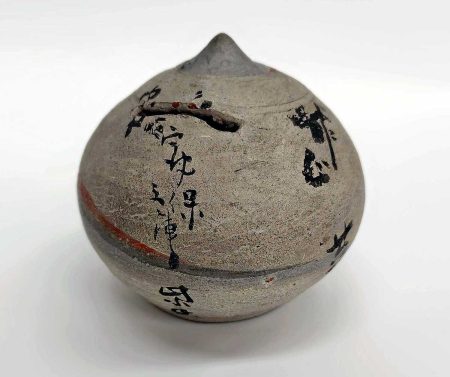
A money box called a “chokin-dama” from the Meiji era
Overseas, auspicious chickens or honeycombs were used as motifs for money boxes.
Each money box reflects the social conditions and trends of its time, serving to pass on the culture of everyday life. People who live in a largely cashless society today have fewer opportunities to handle physical money.
“It might be meaningful to reflect on the times when money boxes were produced and cherished,” Mitoori said.
Coin in hand
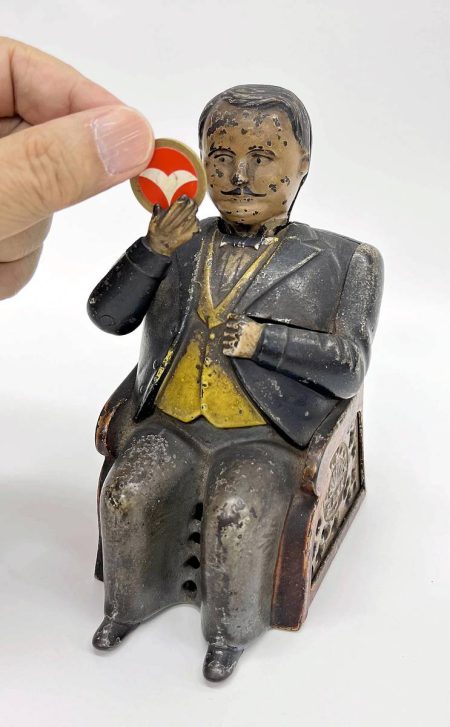
A Tammany Bank money box
There are also unique money boxes that mimic human movements. A Tammany Bank money box from the United States dating back to the 19th century is one such example. When a coin is placed in the seated official’s hand, the arm slowly moves to tuck the coin into his pocket.
A William Tell money box features a mechanism in which coins are launched like arrows into a tower-shaped money bank.
“The movement is so well calculated. I was amazed with the craftsmanship behind the product,” Mitoori said.


Related Tags



Most Read
Popular articles in the past 24 hours
-

10 Foreign Tourists Sustain Injuries After Fire at Capsule Hotel ...
-

World Baseball Classic: Venezuela Beats Japan in Nail-biting Back...
-

Zelenskiy Says Ukraine Wants Money, Technology in Return for Midd...
-
Rapid Services Resume on JR Chuo Line; Suspension Caused by Accid...
-
Rapid Services on JR Chuo Line Suspended; Accident at Kokubunji S...
-

World Baseball Classic: Venezuela Beats Japan in Back-and-Forth Q...
-

World Baseball Classic: Red Sox’s Abreu Hits 3-run Homer, Giving ...
-
Rich Local Ingredients Make Nagato Oden Popular Dish
Popular articles in the past week
-

Japan Figure Skating Legend Yuzuru Hanyu Is Proud Disaster Surviv...
-
15 Measles Patients Confirmed in Tokyo in Past 6 Days; 1 May Have...
-
Massive Sewer Pipe Found Jutting Out of Highway in Osaka
-

Japan Govt to Tighten Requirements to Receive Permanent Residency...
-
Power Outage Forces About 980 Passengers in Yokohama to Walk to T...
-
JR Tokai Breaks Ground on Yamanashi Maglev Station; Will Be Part ...
-

Parents in Japan to Get Instagram Notifications When Teens Repeat...
-
'World's Oldest Bio-Business' Is Japan's Seed Koji Retailing, Mol...
Popular articles in the past month
-

Producer Behind Pop Group XG Arrested for Cocaine Possession
-

Japan PM Takaichi’s Cabinet Resigns en Masse
-

Man Infected with Measles Reportedly Dined at Restaurant in Tokyo...
-
Japan Figure Skating Legend Yuzuru Hanyu Is Proud Disaster Surviv...
-

iPS Treatments Pass Key Milestone, but Broader Applications Far f...
-

Sanae Takaichi Elected Prime Minister of Japan; Keeps All Cabinet...
-

South Korea Tightens Rules on Foreigners Buying Homes in Seoul Me...
-

Nepal Bus Crash Kills 19 People, Injures 25 Including One Japanes...
Top Articles in Culture
-

Director Naomi Kawase’s New Film Explores Heart Transplants in Japan, Production Involved Real Patients, Families
-
Beckoning Cats Get Makeover to Fit Modern Lifestyles with Sleek Designs to Match with Any Kind of Space
-
Exhibition Featuring Yoshiharu Tsuge’s Manga World Underway in Chofu, Tokyo; Unique, Surreal Works Draw Steady Crowds
-
2 Unpublished Early Novellas by Japan’s Kenzaburo Oe Discovered, Show Budding Promise of Future Nobel Prize-Winning Author
-

Japanese Film, Anymart, Wins Critics’ Award at International Film Festival in Berlin, Director’s Debut Feature Film Shocks Audiences
JN ACCESS RANKING
-
Producer Behind Pop Group XG Arrested for Cocaine Possession
-
Japan PM Takaichi’s Cabinet Resigns en Masse
-
Man Infected with Measles Reportedly Dined at Restaurant in Tokyo Station
-
Japan Figure Skating Legend Yuzuru Hanyu Is Proud Disaster Survivor and Gold Medalist, Vows to Continue Support Efforts
-
iPS Treatments Pass Key Milestone, but Broader Applications Far from Guaranteed