
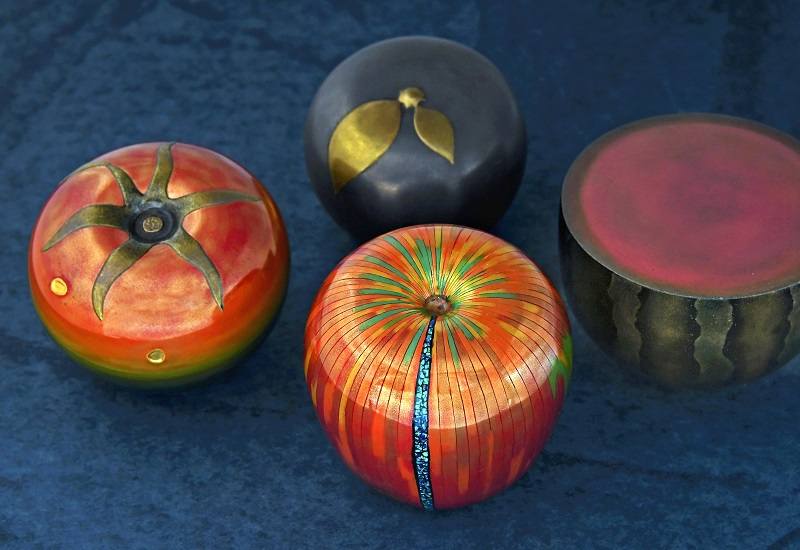
Containers shaped like a tomato, mandarin orange, watermelon and an apple
13:41 JST, May 27, 2021
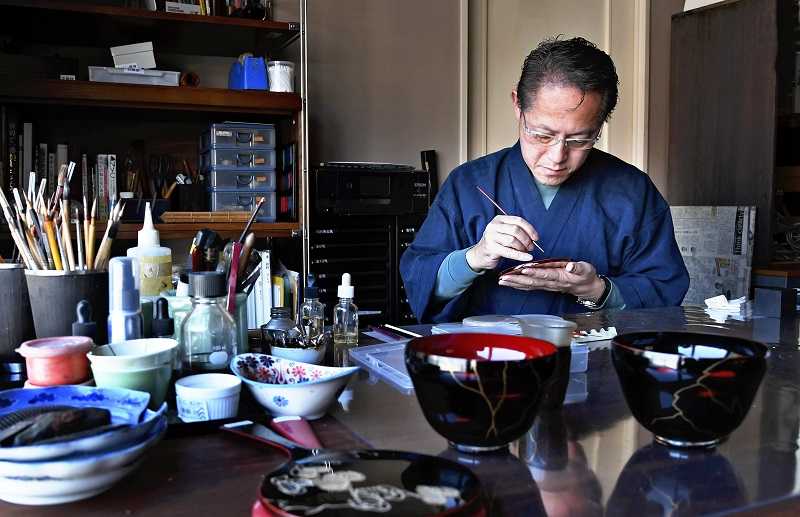
Shokan Matsuda decorates a hand mirror in his studio.
Maki-e is a traditional decorative craft in which designs are drawn on the surface of lacquerware and gold or silver powder is sprinkled over the object. Shokan Matsuda is a master of the technique, creating artworks imbued with a breathtakingly delicate aesthetic.
Matsuda displays an array of tableware in his studio, which opened in 2005 in Tokyo’s Minami-Aoyama district. On one piece, a Chinese phoenix drawn on a candy box is colorful and so dynamic that the bird looks set to fly off the lid. On another, a plover flies above waves on a glass cup. Special techniques are needed to create maki-e glassware.
Containers shaped like fruits and vegetables are quite eye-catching and perfect for holding matcha powder for a tea ceremony. Maki-e techniques neatly re-create the colors of red apples, tomatoes and cut watermelons, as well as their individual textures.
“Traditional crafts need to change with the times,” Matsuda said. “It would be nice if familiar motifs can make people interested in the artwork.”
Born in 1965 in Fukui Prefecture, Matsuda followed his grandfather and father in becoming a maki-e craftsman. He has received many awards at the national lacquerware exhibition, one of the largest competitions centered around this luxurious handicraft that nonetheless is meant for daily use.
The history of maki-e dates back to the Nara period (710-784), and the craft’s origins are said to be in the decorated sheath of a sword kept in the collection of the Shoso-in treasure repository. Small items such as inkstone cases adorned with maki-e were favored by the nobility and samurai.
In the Edo period (1603-1867), maki-e became popular among wealthy merchants, too, leading to the creation of elaborately designed seal cases and incense boxes.
“Items made by maki-e masters in the Edo period are extremely elaborate, and some of them are difficult to reproduce today,” Matsuda said.
The techniques of maki-e masters have been passed down in lacquerware production areas such as Ishikawa and Kyoto prefectures.
Maki-e is classified by various techniques. Hira maki-e, a basic type, is made using a preliminary sketch of a pattern drawn on paper that is then transferred to a bowl or plate, and the lines are traced with lacquer using a special brush.
“We use brush tips of different thicknesses and materials depending on the thickness of the line,” Matsuda said. Another kind is taka maki-e, whose designs stand out, giving them a feeling of three-dimensionality. With togidashi maki-e, the lacquer-coated surface is polished with a grindstone.
Matsuda holds workshops and gives lectures at universities. Despite the coronavirus pandemic, Matsuda said he has received many inquiries about the workshops and is happily surprised by the enthusiasm of people fascinated by maki-e. One of Matsuda’s goals is to have maki-e become known overseas.
“It would be nice for people to encounter maki-e and learn about Japanese sensibilities in the pursuit of beauty.”
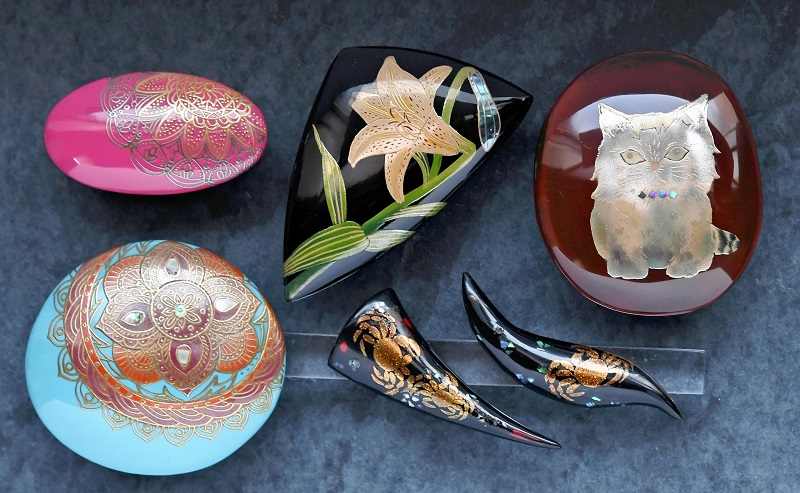
Brooches with cat and flower motifs
Natural stone materials
Matsuda creates a wide range of works using maki-e techniques, including brooches sporting modern patterns of dogs and cats. One of the most striking, though, is his use of natural stones.
He pulled a rock from a riverbed and had a stonemason shape it into an incense case for holding fragrant wooden rods. Matsuda then decorated the top and sides of the stone with morning glories, aiming for the case to be used in tea and incense ceremonies.
Matsuda intentionally chose a craggy stone to emphasize the contrast between the rock’s rough texture and the delicate maki-e.
“Maki-e can be applied to various materials,” he said.




Most Read
Popular articles in the past 24 hours
-

Iran Situation: Japan Must Exert Diplomatic Efforts without Merel...
-
Measles Patient Visited Hospital in Bunkyo Ward, Tokyo, Metropoli...
-
2 Unpublished Early Novellas by Japan's Kenzaburo Oe Discovered, ...
-
Milano Cortina 2026: Japanese Figure Skater Miura Returns to Home...
-

Takayama Among World's Top 10 Most Welcoming Cities for 2026; 2nd...
-
2 of Japan's Opposition Parties Submit Bill to Revise Political F...
-

Former Nomura Securities Employee Given 18-year Prison Sentence f...
-

Bank of Japan and Markets: High Oil Prices Increase Difficulty of...
Popular articles in the past week
-
Milano Cortina 2026: Japanese Gold Medalist Figure Skater Miura S...
-
Tokyo Spends Big on Children, Wins Over Parents
-
Japan’s Miura, Kihara Announce Withdrawal from Figure Skating Wor...
-

Yokohama to Test Out Renewable-Powered Offshore Floating Data Cen...
-
BOJ Keeping Eye on Economy and Takaichi's ‘Proactive Fiscal Polic...
-
Tokyo Measles Patient Traveled to Fukuoka Aboard JAL Planes; Susp...
-
Japan’s Takaichi Speaks on New U.S. Tariff in Upper House, Says P...
-
Nidec Chairman Resigns Amid Accounting Scandal at Major Japanese ...
Popular articles in the past month
-

Producer Behind Pop Group XG Arrested for Cocaine Possession
-

Japan PM Takaichi’s Cabinet Resigns en Masse
-

Man Infected with Measles Reportedly Dined at Restaurant in Tokyo...
-

Israeli Ambassador to Japan Speaks about Japan’s Role in the Reco...
-

Videos Plagiarized, Reposted with False Subtitles Claiming ‘Ryuky...
-

Prudential Life Insurance Plans to Fully Compensate for Damages C...
-

Woman with Measles Visited Hospital in Tokyo Multiple Times Befor...
-

iPS Treatments Pass Key Milestone, but Broader Applications Far f...
Top Articles in Culture
-

Director Naomi Kawase’s New Film Explores Heart Transplants in Japan, Production Involved Real Patients, Families
-

Tokyo Exhibition Offers Inside Look at Impressionism; 70 of 100 Works on ‘Interiors’ by Monet, Others on Loan from Paris
-
Traditional Japanese Silk Hakama Tradition Preserved by Sole Weaver in Sendai
-
Exhibition Featuring Yoshiharu Tsuge’s Manga World Underway in Chofu, Tokyo; Unique, Surreal Works Draw Steady Crowds
-
Japanese Film, Anymart, Wins Critics’ Award at International Film Festival in Berlin, Director’s Debut Feature Film Shocks Audiences
JN ACCESS RANKING
-
Producer Behind Pop Group XG Arrested for Cocaine Possession
-
Japan PM Takaichi’s Cabinet Resigns en Masse
-
Man Infected with Measles Reportedly Dined at Restaurant in Tokyo Station
-
Israeli Ambassador to Japan Speaks about Japan’s Role in the Reconstruction of Gaza
-
Videos Plagiarized, Reposted with False Subtitles Claiming ‘Ryukyu Belongs to China’; Anti-China False Information Also Posted in Japan