
Artificial Intelligence Will Reduce Japan’s Workforce in Next 10 Years, Many Top Executives Say
21:00 JST, January 3, 2026
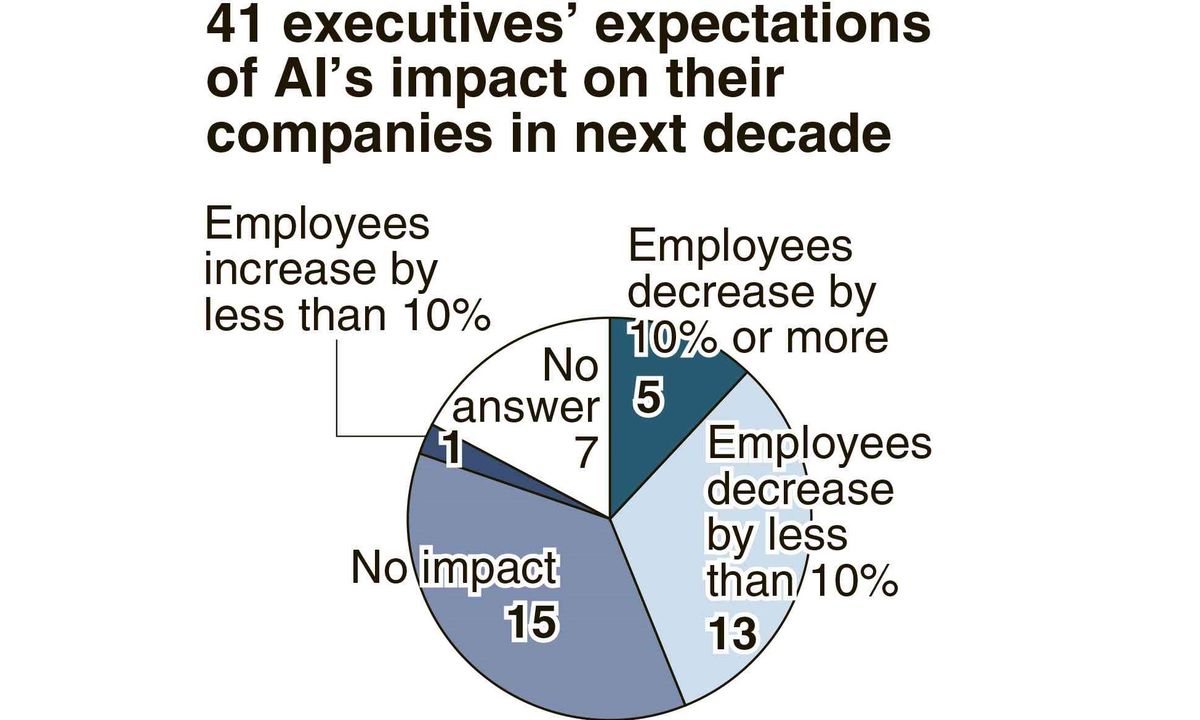
More than 40% of top executives in Japan said their companies’ employees will decrease over the next decade due to the impact of generative artificial intelligence, according to a recent questionnaire by The Yomiuri Shimbun.
The same questionnaire also found that more than 30% of the executives use generative AI as part of their management decisions, but many respondents stressed that they cannot fully depend on the technology for ethical, safety-related, or highly complex management judgments.
The Yomiuri Shimbun asked 41 leaders of major Japanese companies from various industries about the prospects for the economy from late November to mid-December.
Eighteen executives predicted that generative AI would reduce their workforce, with five of them projecting a drop of 10% or more in the number of employees. Many respondents said that AI would replace workers in such areas as data entry, document preparation and call center operations.
Fifteen executives said that they saw no impact of generative AI on their employment. The only respondent predicting an increase in the number of employees, Skylark Holdings Co. Chairman Makoto Tani, said that the company will expand staffing for digitization specialists. He also said using AI will boost productivity, leading to new store openings and business expansion, resulting in hiring more restaurant staff.
Fourteen executives said they use AI as part of their management decisions. Many cited using it for gathering and sorting information. Kirin Holdings Co. CEO Yoshinori Isozaki said that the company uses an AI executive as a pilot project. It is tasked with raising points for discussion at management meetings, with the fundamental premise being that “final decisions are made by humans,” according to Isozaki.
Asked about the types of work that cannot be entrusted to AI going forward, Seibu Holdings Inc. President Ryuichiro Nishiyama raised hospitality, face-to-face customer service and entertainment shows. Ajinomoto Co. President Shigeo Nakamura mentioned final inspections for food safety and quality assurance. Shimizu Corp. President Tatsuya Shimmura cited skilled tasks requiring expertise, such as work on cultural properties.
When asked about artificial general intelligence, which would be capable of handling tasks across various fields, and how soon it might be realized, 10 executives answered within five years, and nine respondents answered five years to nine years. Six people predicted 10 years or more, and 15 respondents said they didn’t know.






Most Read
Popular articles in the past 24 hours
-

Ukrainian Ambassador Closely Watching Japan’s Revision of Defense...
-

Milano Cortina 2026: Sakamoto Serves as Flag Bearer; Japan Earns ...
-
Emperor Turns 66 Ahead of Disaster Milestones
-

Milano Cortina 2026: There Were Cheers across the Country, after ...
-
Luna Sea Drummer Shinya Dies at 56; Powerful Drummer Behind ‘Desi...
-

Milano Cortina 2026: ‘Magical’ Italian Games Close wi...
-

Milano Cortina 2026: Riku-Ryu Duo Stick Together During Closing C...
-

1.2 Mil. Rapeseed Flowers Attract Cute Birds, People in Aichi Pre...
Popular articles in the past week
-

Japan PM Takaichi’s Cabinet Resigns en Masse
-

Man Infected with Measles Reportedly Dined at Restaurant in Tokyo...
-

Sanae Takaichi Elected Prime Minister of Japan; Keeps All Cabinet...
-

Japan's Govt to Submit Road Map for Growth Strategy in March, PM ...
-

Bus Carrying 40 Passengers Catches Fire on Chuo Expressway; All E...
-

Milano Cortina 2026: Figure Skaters Riku Miura, Ryuichi Kihara Pa...
-
U.S. Firm to Build Training Hub in Fukushima N-plant for Debris R...
-

Japan, U.S. Name 3 Inaugural Investment Projects; Reached Agreeme...
Popular articles in the past month
-
Japan PM Takaichi’s Cabinet Resigns en Masse
-

Japan Institute to Use Domestic Commercial Optical Lattice Clock ...
-

Israeli Ambassador to Japan Speaks about Japan’s Role in the Reco...
-
Man Infected with Measles Reportedly Dined at Restaurant in Tokyo...
-

Videos Plagiarized, Reposted with False Subtitles Claiming ‘Ryuky...
-

Man Infected with Measles May Have Come in Contact with Many Peop...
-

Prudential Life Insurance Plans to Fully Compensate for Damages C...
-

Woman with Measles Visited Hospital in Tokyo Multiple Times Befor...
Top Articles in Business
-
Prudential Life Insurance Plans to Fully Compensate for Damages Caused by Fraudulent Actions Without Waiting for Third-Party Committee Review
-
Narita Airport, Startup in Japan Demonstrate Machine to Compress Clothes for Tourists to Prevent People from Abandoning Suitcases
-
Japan, U.S. Name 3 Inaugural Investment Projects; Reached Agreement After Considerable Difficulty
-

Toyota Motor Group Firm to Sell Clean Energy Greenhouses for Strawberries
-

SoftBank Launches AI Service for Call Centers That Converts Harsh Customer Voices into Softer Voices
JN ACCESS RANKING
-
Japan PM Takaichi’s Cabinet Resigns en Masse
-
Japan Institute to Use Domestic Commercial Optical Lattice Clock to Set Japan Standard Time
-
Israeli Ambassador to Japan Speaks about Japan’s Role in the Reconstruction of Gaza
-
Man Infected with Measles Reportedly Dined at Restaurant in Tokyo Station
-
Videos Plagiarized, Reposted with False Subtitles Claiming ‘Ryukyu Belongs to China’; Anti-China False Information Also Posted in Japan