
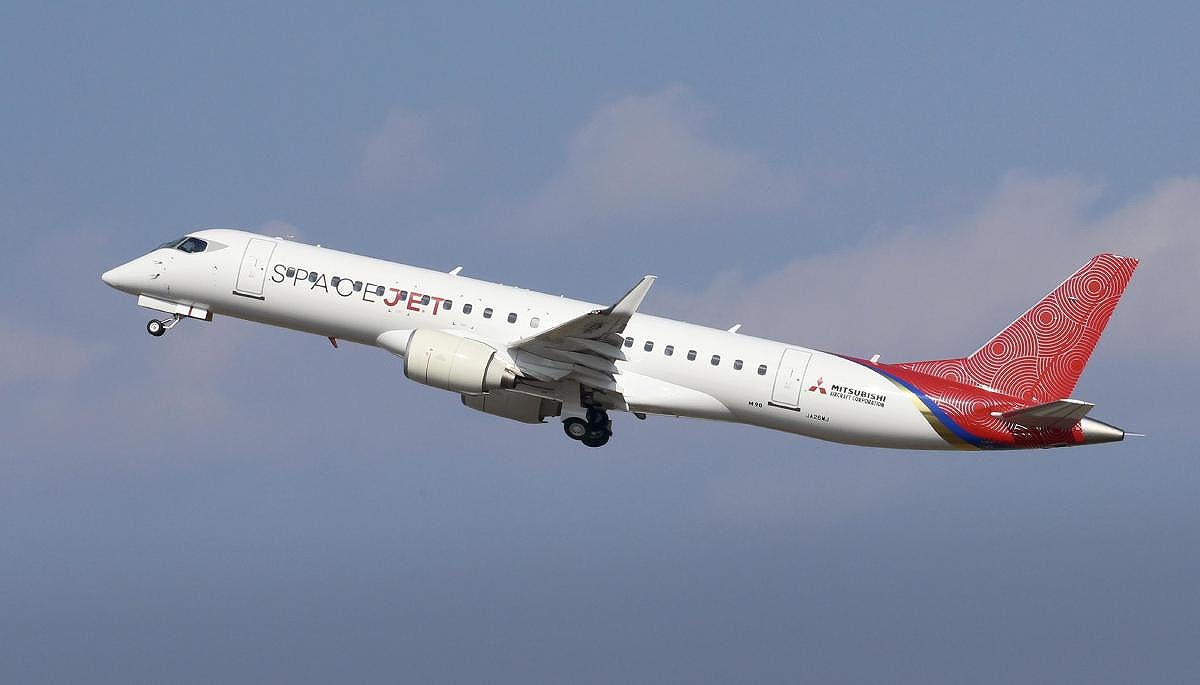
A MSJ test aircraft flies in Aichi Prefecture in 2020.
15:20 JST, February 7, 2023
Mitsubishi Heavy Industries, Ltd announced Tuesday it will discontinue the development of the Mitsubishi Space Jet (MSJ), a domestically produced jet airliner, and withdraw from the business.
About ¥1 trillion has already been spent on the project, and future costs are estimated at several hundred billion yen. The company has therefore concluded that the jet will not be profitable.
Due to its prolonged development, some of the jet’s equipment is now out of date, and it has become difficult for overseas parts manufacturers and others to maintain production for the MSJ.
Significant demand for the aircraft is also not expected, and obtaining the type certification from the Land, Infrastructure, Transport, and Tourism Ministry needed to put the plane into service is expected to take several years.
Engineers working on the jet will be transferred to Mitsubishi Heavy Industries’ defense section, to utilize their knowledge for the next-generation fighter aircraft to be jointly developed by Japan, the U.K. and Italy. The company will also work on decarbonization, such as the electrification of aircraft.
Mitsubishi Heavy Industries will review its cooperation with overseas aircraft manufacturers, as well as how to utilize the facilities and equipment in Aichi Prefecture that have been used for the development of the aircraft.
The company decided to enter the jet production business in 2008, initially aiming to deliver its first aircraft in 2013. However, due to design changes and difficulties in procuring parts, the delivery date was postponed six times, and in October 2020, Mitsubishi Heavy Industries announced that it would “temporarily halt” the project.
The development of a domestically produced passenger plane was the first in half a century — following the YS-11 propeller-driven aircraft, which was a joint effort of the public and private sectors.
Mitsubishi Heavy Industries had received orders for approximately 300 planes from domestic and foreign airlines, including ANA Holdings Inc. and Japan Airlines Co.
The government had provided approximately ¥50 billion in research funding.







Most Read
Popular articles in the past 24 hours
-

Japan’s Major Real Estate Firms Expanding Overseas Businesses to ...
-

Ukrainian Ambassador Closely Watching Japan’s Revision of Defense...
-

Milano Cortina 2026: Sakamoto Serves as Flag Bearer; Japan Earns ...
-
Emperor Turns 66 Ahead of Disaster Milestones
-

Milano Cortina 2026: There Were Cheers across the Country, after ...
-

Luna Sea Drummer Shinya Dies at 56; Powerful Drummer Behind ‘Desi...
-

Milano Cortina 2026: ‘Magical’ Italian Games Close wi...
-

Milano Cortina 2026: Riku-Ryu Duo Stick Together During Closing C...
Popular articles in the past week
-

Japan PM Takaichi’s Cabinet Resigns en Masse
-

Man Infected with Measles Reportedly Dined at Restaurant in Tokyo...
-

Sanae Takaichi Elected Prime Minister of Japan; Keeps All Cabinet...
-

Japan's Govt to Submit Road Map for Growth Strategy in March, PM ...
-

Bus Carrying 40 Passengers Catches Fire on Chuo Expressway; All E...
-

Milano Cortina 2026: Figure Skaters Riku Miura, Ryuichi Kihara Pa...
-

Japan, U.S. Name 3 Inaugural Investment Projects; Reached Agreeme...
-
U.S. Firm to Build Training Hub in Fukushima N-plant for Debris R...
Popular articles in the past month
-
Japan PM Takaichi’s Cabinet Resigns en Masse
-

Japan Institute to Use Domestic Commercial Optical Lattice Clock ...
-

Israeli Ambassador to Japan Speaks about Japan’s Role in the Reco...
-
Man Infected with Measles Reportedly Dined at Restaurant in Tokyo...
-

Videos Plagiarized, Reposted with False Subtitles Claiming ‘Ryuky...
-

Man Infected with Measles May Have Come in Contact with Many Peop...
-

Prudential Life Insurance Plans to Fully Compensate for Damages C...
-

Woman with Measles Visited Hospital in Tokyo Multiple Times Befor...
Top Articles in Business
-
Prudential Life Insurance Plans to Fully Compensate for Damages Caused by Fraudulent Actions Without Waiting for Third-Party Committee Review
-
Narita Airport, Startup in Japan Demonstrate Machine to Compress Clothes for Tourists to Prevent People from Abandoning Suitcases
-
Japan, U.S. Name 3 Inaugural Investment Projects; Reached Agreement After Considerable Difficulty
-

Toyota Motor Group Firm to Sell Clean Energy Greenhouses for Strawberries
-

SoftBank Launches AI Service for Call Centers That Converts Harsh Customer Voices into Softer Voices
JN ACCESS RANKING
-
Japan PM Takaichi’s Cabinet Resigns en Masse
-
Japan Institute to Use Domestic Commercial Optical Lattice Clock to Set Japan Standard Time
-
Israeli Ambassador to Japan Speaks about Japan’s Role in the Reconstruction of Gaza
-
Man Infected with Measles Reportedly Dined at Restaurant in Tokyo Station
-
Videos Plagiarized, Reposted with False Subtitles Claiming ‘Ryukyu Belongs to China’; Anti-China False Information Also Posted in Japan