
15:41 JST, November 9, 2022
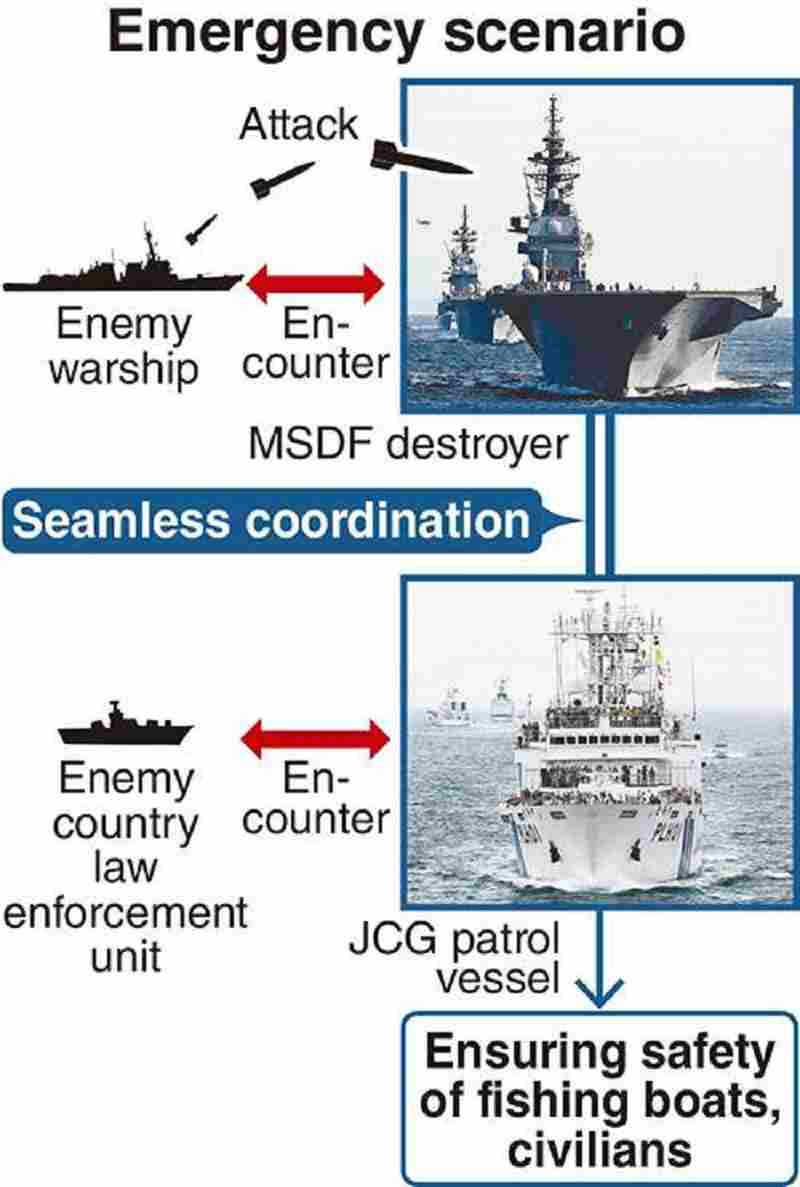
The Maritime Self-Defense Force and the Japan Coast Guard plan to conduct a joint drill simulating an armed attack on the Senkaku Islands for the first time, according to government sources.
The joint MSDF-JCG exercise will be conducted before the end of the fiscal year as part of efforts to strengthen cooperation between the services. After the exercise, the government plans to compile guidelines on procedures and other matters concerning the JCG’s involvement in the event of an armed attack, the sources said.
The exercise is intended to ensure a seamless response between the MSDF and the JCG in waters surrounding the Senkaku Islands in Okinawa Prefecture and elsewhere in the event of an emergency.
The government aims to enhance defense capabilities by significantly increasing the related budgets of the JCG and Self-Defense Forces. The government also plans to establish a cooperative framework between the services.
The JCG — an external bureau of the Land, Infrastructure, Transport and Tourism Ministry — and the MSDF share surveillance information, but they have different systems of command.
The joint MSDF-JCG training exercises conducted so far have been limited to scenarios that do not involve an armed attack situation, such as maritime patrols in which the SDF is responsible for maintaining security.
However, the Liberal Democratic Party and others have stressed the need to conduct realistic drills in anticipation of an emergency.
According to the sources, the upcoming drill will involve the mobilization of an MSDF destroyer assuming an attack such as a missile launch by an enemy vessel during a separate stand-off between a JCG patrol vessel and a law enforcement unit of an enemy country.
The JCG is likely to provide logistical support in the event of an emergency, transporting evacuees and ensuring the safety of fishing boats and other civilian vessels.
Article 80 of the Self-Defense Forces Law states that the prime minister can bring the JCG under the control of the defense minister if the SDF is mobilized in the event of an armed attack. However, guidelines for such scenarios have yet to be formulated.
According to the sources, the government is considering compiling such guidelines amid a situation in which cooperation between the China Coast Guard and the military has been increasing.
In 2018, the CCG came under the command of the Armed Police Force, an organization under the direct control of the Central Military Commission, the Chinese military’s command organ.
CCG vessels that navigate in waters surrounding the Senkakus are backed up by Chinese Navy.
“It seems they’re taking all possible measures to prepare for a clash,” a senior SDF official said.



Most Read
Popular articles in the past 24 hours
-

Sanae Takaichi Elected 105th Prime Minister of Japan; Keeps All C...
-

Japan's Govt to Submit Road Map for Growth Strategy in March, PM ...
-

Riku-Ryu Pair Wins Gold Medal: Their Strong Bond Leads to Major C...
-
LDP Begins Training New Lawmakers to Avoid Scandal, Gaffes; Histo...
-

Japan PM Sanae Takaichi Welcomes Peach Ambassadors Koga Momo Musu...
-
Survey Shows False Election Info Perceived as True
-

Japan’s Plan for Investment in U.S.: Aim for Mutual Development b...
-
Transport Companies See Opportunity in Narita Expansion; Airlines...
Popular articles in the past week
-

Japan PM Takaichi’s Cabinet Resigns en Masse
-

Man Infected with Measles Reportedly Dined at Restaurant in Tokyo...
-

Videos Plagiarized, Reposted with False Subtitles Claiming ‘Ryuky...
-
Sanae Takaichi Elected 105th Prime Minister of Japan; Keeps All C...
-
Japan's Govt to Submit Road Map for Growth Strategy in March, PM ...
-

Milano Cortina 2026: Figure Skaters Riku Miura, Ryuichi Kihara Pa...
-

Tokyo’s New Record-Breaking Fountain Named ‘Tokyo Aqua Symphony’
-
CRA Leadership Election Will Center on Party Rebuilding; Lower Ho...
Popular articles in the past month
-
Japan PM Takaichi’s Cabinet Resigns en Masse
-

Japan Institute to Use Domestic Commercial Optical Lattice Clock ...
-

Israeli Ambassador to Japan Speaks about Japan’s Role in the Reco...
-

Man Infected with Measles May Have Come in Contact with Many Peop...
-
Man Infected with Measles Reportedly Dined at Restaurant in Tokyo...
-

Prudential Life Insurance Plans to Fully Compensate for Damages C...
-

Woman with Measles Visited Hospital in Tokyo Multiple Times Befor...
-
Australian Woman Dies After Mishap on Ski Lift in Nagano Prefectu...
Top Articles in Politics
-
Japan PM Takaichi’s Cabinet Resigns en Masse
-
Sanae Takaichi Elected 105th Prime Minister of Japan; Keeps All Cabinet Appointees from Previous Term
-
Japan’s Govt to Submit Road Map for Growth Strategy in March, PM Takaichi to Announce in Upcoming Policy Speech
-

LDP Wins Historic Landslide Victory
-

LDP Wins Landslide Victory, Secures Single-party Majority; Ruling Coalition with JIP Poised to Secure Over 300 seats (UPDATE 1)
JN ACCESS RANKING
-
Japan PM Takaichi’s Cabinet Resigns en Masse
-
Japan Institute to Use Domestic Commercial Optical Lattice Clock to Set Japan Standard Time
-
Israeli Ambassador to Japan Speaks about Japan’s Role in the Reconstruction of Gaza
-
Man Infected with Measles May Have Come in Contact with Many People in Tokyo, Went to Store, Restaurant Around When Symptoms Emerged
-
Man Infected with Measles Reportedly Dined at Restaurant in Tokyo Station