
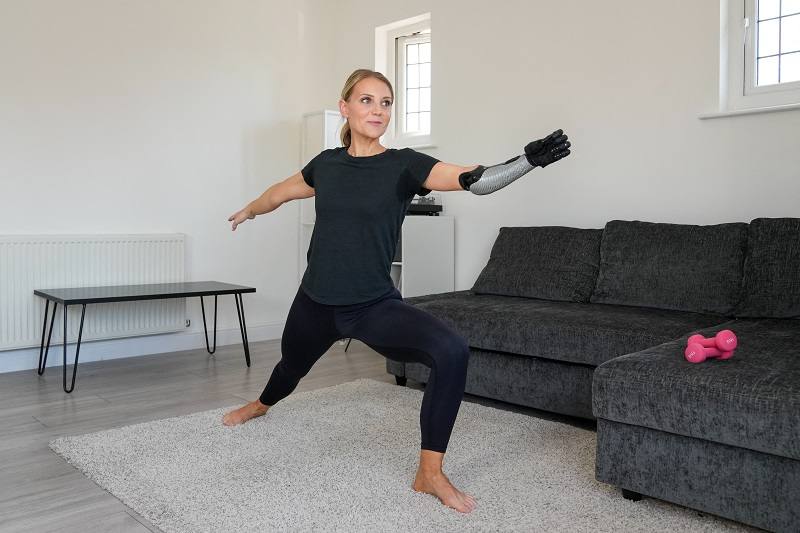
Jessica Smith poses during a workout while using her new bionic hand in London, on Aug. 12.
16:29 JST, September 1, 2022
LEEDS, England (Reuters) — Australian swimmer Jessica Smith has had an uneasy relationship with prosthetics since a childhood accident, but her convictions are being challenged by a British bionic hand that can be updated remotely anywhere in the world.
The 2004 Athens Paralympian was born without a left hand.
Her parents were advised to fit a prosthesis to help with her development, but the device caused her to upset a boiling kettle when she was a toddler, leading to burns on 15% of her body.
“There’s always been an association between the fact this prosthetic aid didn’t actually help, it created the most traumatic event in my life,” she said.
But her curiosity was sparked when she was approached by Covvi, based in Leeds, northern England, to try its Nexus hand.
Knowing it would be an emotional challenge, Smith was fitted with the device in April at the age of 37. “I think that I was ready to try something like this,” she said.
Bionic hands convert electrical impulses from the muscles in the upper arm into movement powered by motors in the hand, enabling a user to hold a glass, open a door or pick up an egg.
Simon Pollard, who founded Covvi five years ago, said he wanted to add bluetooth to the device to allow the company’s specialists to update it via an app.
“The fact we can change some of the things that the customer wants remotely is a really powerful thing and a first to market,” the chief executive said.
Some rival bionic hands can be app-controlled, but Pollard said the ability to talk to a single device set the Nexus apart.
To do that, anonymized data is collected for every user, a task managed by partner NetApp.
Pollard said Covvi had signed up 27 distributors globally, including in Australia, China and the United States, and he aimed to increase monthly production to 100.
Smith, who is a speaker and children’s author, said Covvi was already creating new movements for her.
“I’ve had a few kids ask if I can do different hand gestures, some polite some not so polite,” she said. “I asked Covvi this morning, and I know that will be done in the next couple of hours.”
She said the tech was not just changing her life, it was changing the lives of her three children.
“They think it’s amazing and I’m like half human-half robot,” she said.
She said the “bionic” appearance of the hand was an attraction, given her pride in difference.
“I’m not trying to hide who I am,” she said. “I’m adding and expanding on who I am by being able to access technology that’s never been available before.”




Most Read
Popular articles in the past 24 hours
-
Young People in Japan Grapple with Social Media Addiction
-
Ruling Coalition Calls for Opposition Participation in ‘National ...
-

Japan’s Updated ‘Free and Open Indo-Pacific’ Initiative to Streng...
-

Myaku-Myaku Fan Event Held in Osaka; ‘Its Butt is so Cute!’ Says ...
-
Takaichi Chats with Tunku Tunku, Interactive Mascot for Internati...
-
Milano Cortina 2026: Riku Miura and Ryuichi Kihara Win Japan̵...
-

Ginza West Confectionery Store Staying True to Its Roots
-

Munich Security Conference: Japan Has Growing Role To Play in Reb...
Popular articles in the past week
-

Videos Plagiarized, Reposted with False Subtitles Claiming ‘Ryuky...
-

Woman with No Overseas Travel History Infected with Measles in Na...
-

Milano Cortina 2026: Kokomo Murase Comes Out on Top After Overcom...
-
CRA Leadership Election Will Center on Party Rebuilding; Lower Ho...
-

Tokyo’s New Record-Breaking Fountain Named ‘Tokyo Aqua Symphony’
-
Crime in Japan Ticks Up for 4th Straight Year
-
Japanese Constitutional Revision Debate Expected to be Revived Af...
-

Chemical Tanker Collides with Fishing Boat off Kobe with No Fuel ...
Popular articles in the past month
-

Japan Institute to Use Domestic Commercial Optical Lattice Clock ...
-

Israeli Ambassador to Japan Speaks about Japan’s Role in the Reco...
-

Man Infected with Measles May Have Come in Contact with Many Peop...
-

China Eyes Rare Earth Foothold in Malaysia to Maintain Dominance,...
-

Prudential Life Insurance Plans to Fully Compensate for Damages C...
-

Woman with Measles Visited Hospital in Tokyo Multiple Times Befor...
-

Australian Woman Dies After Mishap on Ski Lift in Nagano Prefectu...
-

Foreign Snowboarder in Serious Condition After Hanging in Midair ...
Top Articles in Science & Nature
-
Japan Institute to Use Domestic Commercial Optical Lattice Clock to Set Japan Standard Time
-
Space Mission Demonstrates Importance of International Cooperation, Astronaut Kimiya Yui Says
-
Japan to Face Shortfall of 3.39 Million Workers in AI, Robotics in 2040; Clerical Workers Seen to Be in Surplus
-
Record 700 Startups to Gather at SusHi Tech Tokyo in April; Event Will Center on Themes Like Artificial Intelligence and Robotics
JN ACCESS RANKING
-
Japan Institute to Use Domestic Commercial Optical Lattice Clock to Set Japan Standard Time
-
Israeli Ambassador to Japan Speaks about Japan’s Role in the Reconstruction of Gaza
-
Man Infected with Measles May Have Come in Contact with Many People in Tokyo, Went to Store, Restaurant Around When Symptoms Emerged
-
Prudential Life Insurance Plans to Fully Compensate for Damages Caused by Fraudulent Actions Without Waiting for Third-Party Committee Review
-
Woman with Measles Visited Hospital in Tokyo Multiple Times Before Being Diagnosed with Disease