
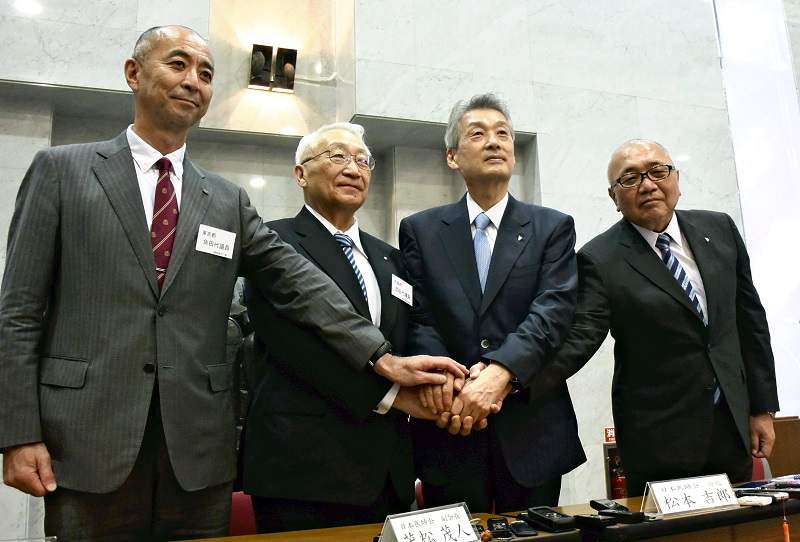
Newly elected Japan Medical Association President Kichiro Matsumoto, second from right, and other new board members attend a press conference in Bunkyo Ward, Tokyo, on Saturday.
20:00 JST, June 26, 2022
The Japan Medical Association has elected a new president, Kichiro Matsumoto, following intense scrutiny over its response to the novel coronavirus pandemic. Matsumoto faces the difficult task of repairing relations with the government and the ruling parties, as well as restoring public trust.
Successive presidents of the association have served as chairpersons of Nihon Ishi Renmei — an influential group that supports the Liberal Democratic Party — and have exerted great influence on national medical policies, including the revision of medical service fees.
Speaking at a post-election press conference on Saturday, Matsumoto said, “As an association, we want to expose our human side to the political world, too, thus helping to facilitate smooth communication with politicians.”
He emphasized he would take a different approach from that of his predecessor, Toshio Nakagawa, who had a strained relationship with the government and the ruling bloc. While in office, Nakagawa declared he would deal with the government on an issue-by-issue basis, and refrained from building relationships with the administration’s senior officials.
Nakagawa also was cautious about hosting the Tokyo Olympics and Paralympics amid the coronavirus pandemic, saying the government’s Go To Travel tourism campaign “definitely triggered a spread of infections.” His remarks drew criticism from the ruling bloc, with one member saying, “Nakagawa made his assertion without any evidence.” These tense relations continued, leading one senior Finance Ministry official to say, “There’s no need to give special consideration to Nakagawa.”
As part of this fiscal year’s medical service fees revisions, the government decided to introduce “refill prescriptions,” which allow prescriptions to be used repeatedly. The association had opposed the system. Refill prescriptions reduce the burden on patients and help curb medical costs, but the system has a negative impact on the management of medical institutions.
As a result, dissatisfaction with Nakagawa grew within the association, and he had to forgo running for office. It is unusual for a president not to run for a second term.
Matsumoto won the election with the full support of Yoshitake Yokokura, a former president of the association who has built good relationships with LDP Vice President Taro Aso and former Prime Minister Shinzo Abe.
The association is a public interest incorporated association that supports physicians across Japan. The current body was established in 1947 and as of December had 173,895 members.






Most Read
Popular articles in the past 24 hours
-

AI Agents Should Consult Humans, Say New Rules from Japanese Govt
-

Japan PM Takaichi’s Cabinet Resigns en Masse
-
U.S. Firm to Build Training Hub in Fukushima N-plant for Debris R...
-
Milano Cortina 2026: Japan Gains Bronze in Speed Skating Women's ...
-
TEPCO's Niigata Pref. Nuclear Power Plant Begins Transmitting Pow...
-

Bus Carrying 40 Passengers Catches Fire on Chuo Expressway; All E...
-
Milano Cortina 2026: Japan’s Ami Nakai Leads Women’s ...
-
Sanae Takaichi Elected Japan's 105th Prime Minister (UPDATE 1)
Popular articles in the past week
-

Videos Plagiarized, Reposted with False Subtitles Claiming ‘Ryuky...
-

Man Infected with Measles Reportedly Dined at Restaurant in Tokyo...
-
Tokyo’s New Record-Breaking Fountain Named ‘Tokyo Aqua Symphony’
-

Milano Cortina 2026: Figure Skaters Riku Miura, Ryuichi Kihara Pa...
-

Milano Cortina 2026: Kokomo Murase Comes Out on Top After Overcom...
-
CRA Leadership Election Will Center on Party Rebuilding; Lower Ho...
-
Crime in Japan Ticks Up for 4th Straight Year
-
Japanese Constitutional Revision Debate Expected to be Revived Af...
Popular articles in the past month
-

Japan Institute to Use Domestic Commercial Optical Lattice Clock ...
-

Israeli Ambassador to Japan Speaks about Japan’s Role in the Reco...
-

Man Infected with Measles May Have Come in Contact with Many Peop...
-

China Eyes Rare Earth Foothold in Malaysia to Maintain Dominance,...
-

Prudential Life Insurance Plans to Fully Compensate for Damages C...
-

Woman with Measles Visited Hospital in Tokyo Multiple Times Befor...
-
Australian Woman Dies After Mishap on Ski Lift in Nagano Prefectu...
-
Foreign Snowboarder in Serious Condition After Hanging in Midair ...
Top Articles in Politics
-

LDP Wins Historic Landslide Victory
-

LDP Wins Landslide Victory, Secures Single-party Majority; Ruling Coalition with JIP Poised to Secure Over 300 seats (UPDATE 1)
-
CRA Leadership Election Will Center on Party Rebuilding; Lower House Defeat Leaves Divisions among Former CDPJ, Komeito Members
-
Japan Tourism Agency Calls for Strengthening Measures Against Overtourism
-

Voters Using AI to Choose Candidates in Japan’s Upcoming General Election; ChatGPT, Other AI Services Found Providing Incorrect Information
JN ACCESS RANKING
-
Japan Institute to Use Domestic Commercial Optical Lattice Clock to Set Japan Standard Time
-
Israeli Ambassador to Japan Speaks about Japan’s Role in the Reconstruction of Gaza
-
Man Infected with Measles May Have Come in Contact with Many People in Tokyo, Went to Store, Restaurant Around When Symptoms Emerged
-
Prudential Life Insurance Plans to Fully Compensate for Damages Caused by Fraudulent Actions Without Waiting for Third-Party Committee Review
-
Woman with Measles Visited Hospital in Tokyo Multiple Times Before Being Diagnosed with Disease