
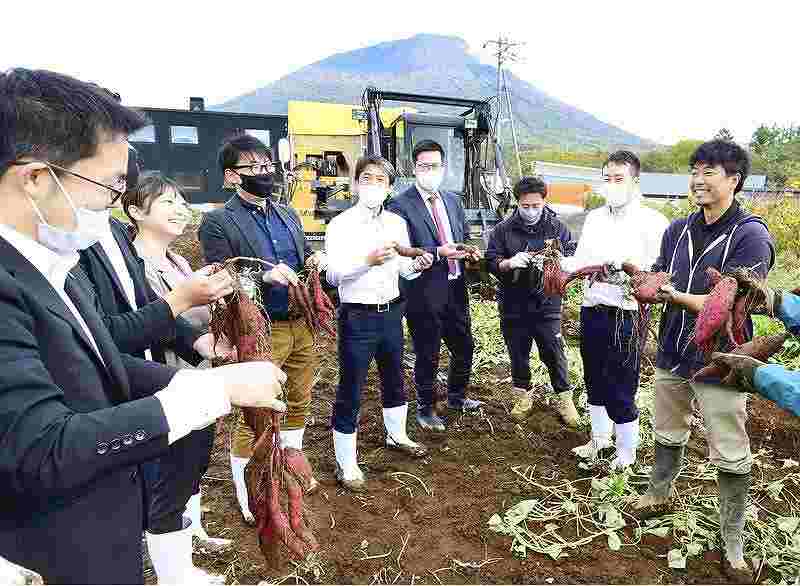
Shin Sasaki, far right, speaks to people involved in a sweet potato project in Makkri, Hokkaido, on Oct. 6.
November 10, 2021
Efforts are underway to make Hokkaido, the main potato producing region in Japan, a growing area for sweet potatoes as well.
Due to rising temperatures in recent years, it may be possible for Hokkaido to also cultivate sweet potatoes, which are generally grown in warmer climates. Demand for sweet potatoes is on the rise, thanks partly to expanding exports to Southeast Asian countries, where there is something of a boom for Japanese-style baked sweet potatoes.
Kyushu and other top production areas in Japan have had their crops damaged by disease, leading both the public and the private sector to look to Hokkaido for a stable supply.
On Oct. 6, people from fruit and vegetable wholesale companies as well as seed and seedling companies gathered on farmland owned by agricultural corporation Vegetable Works Inc. in the village of Makkari at the foot of Mt. Yotei in Hokkaido.
They dug bright purple sweet potatoes out of the earth, which they had planted over about 50 ares of the farmland in June. Together they harvested about 15 tons of sweet potatoes.
“This is the first time for me to grow [sweet potatoes], and they’re pretty easy to cultivate. I’m sure they’ll become more common in Hokkaido,” said Shin Sasaki, 42, the representative director of Vegetable Works.
These sweet potatoes were to be exported to Hong Kong, Singapore and other overseas destinations. The Agriculture, Forestry and Fisheries Ministry is supporting the project through the Japan External Trade Organization.
According to the ministry, exports of domestically produced sweet potatoes in 2020 were valued at ¥2.06 billion, an increase of more than 10 times over a decade. For those involved in sweet potato production, however, this is not cause for unalloyed joy.
One reason why is foot rot, a fungal disease that prevents the growth of stems and other parts of sweet potatoes. Foot rot has been identified in Japan, mostly in southern Kyushu, since 2018, causing lower crop yields for certain varieties.
Moreover, since the nuclear disaster at the Fukushima No. 1 nuclear power plant in Fukushima Prefecture in 2011, farm products harvested near there have had to be tested for radioactive substances. This has been a burden for relevant companies in terms of both time and cost.
Ensuring a stable supply is essential to take advantage of the swelling demand, and how to expand growing areas will be key. Attention has therefore turned to Hokkaido, despite the almost complete absence of production there in the past.
During recent summers, temperatures in the prefecture have climbed over 30 C on an increasing number of days. Snow and frost have also come later, making the environment more suitable to growing sweet potatoes.
“Utilizing as much as possible the brand power of Hokkaido as a source of food, we want to turn the prefecture into a growing area [for sweet potatoes] and expand the market,” said Junichi Kano, 39, who works for Tokyo-based major fruit and vegetable wholesale company Tokyo Seika Co.
Tokyo Seika is leading the sweet potato project in Makkari.




Most Read
Popular articles in the past 24 hours
-

6 Injured at Naked Festival in Japan’s Okayama Prefecture; Police...
-

Reciprocal Tariffs Ruled Illegal: Judiciary Would Not Tolerate Pr...
-

Fiji Defense Minister Hopes Japan Will Support Stabilization of P...
-

Space One Delays Launch of No. 3 Kairos Rocket; Company to Announ...
-

Japanese Film, Anymart, Wins Critics’ Award at International Film...
-

India, Brazil Sign Mining Pact As Modi Targets $20 Billion Trade ...
-

3rd Japan Pacific Islands Defense Dialogue to Begin in Tokyo on S...
-

I Am Surprised by My Mother’s Increased Drinking
Popular articles in the past week
-

Japan PM Takaichi’s Cabinet Resigns en Masse
-

Man Infected with Measles Reportedly Dined at Restaurant in Tokyo...
-

Sanae Takaichi Elected Prime Minister of Japan; Keeps All Cabinet...
-

Japan's Govt to Submit Road Map for Growth Strategy in March, PM ...
-

Bus Carrying 40 Passengers Catches Fire on Chuo Expressway; All E...
-

Milano Cortina 2026: Figure Skaters Riku Miura, Ryuichi Kihara Pa...
-

Japan, U.S. Name 3 Inaugural Investment Projects; Reached Agreeme...
-

U.S. Firm to Build Training Hub in Fukushima N-plant for Debris R...
Popular articles in the past month
-
Japan PM Takaichi’s Cabinet Resigns en Masse
-

Japan Institute to Use Domestic Commercial Optical Lattice Clock ...
-

Israeli Ambassador to Japan Speaks about Japan’s Role in the Reco...
-
Man Infected with Measles Reportedly Dined at Restaurant in Tokyo...
-

Videos Plagiarized, Reposted with False Subtitles Claiming ‘Ryuky...
-

Man Infected with Measles May Have Come in Contact with Many Peop...
-

Prudential Life Insurance Plans to Fully Compensate for Damages C...
-

Woman with Measles Visited Hospital in Tokyo Multiple Times Befor...
Top Articles in Society
-
Man Infected with Measles Reportedly Dined at Restaurant in Tokyo Station
-
Man Infected with Measles May Have Come in Contact with Many People in Tokyo, Went to Store, Restaurant Around When Symptoms Emerged
-
Woman with Measles Visited Hospital in Tokyo Multiple Times Before Being Diagnosed with Disease
-
Australian Woman Dies After Mishap on Ski Lift in Nagano Prefecture
-
Foreign Snowboarder in Serious Condition After Hanging in Midair from Chairlift in Nagano Prefecture
JN ACCESS RANKING
-
Japan PM Takaichi’s Cabinet Resigns en Masse
-
Japan Institute to Use Domestic Commercial Optical Lattice Clock to Set Japan Standard Time
-
Israeli Ambassador to Japan Speaks about Japan’s Role in the Reconstruction of Gaza
-
Man Infected with Measles Reportedly Dined at Restaurant in Tokyo Station
-
Videos Plagiarized, Reposted with False Subtitles Claiming ‘Ryukyu Belongs to China’; Anti-China False Information Also Posted in Japan