
Post-Quake Traffic Jams in Aomori Pref. Shows Issues with Public’s Understanding of Evacuation Rules
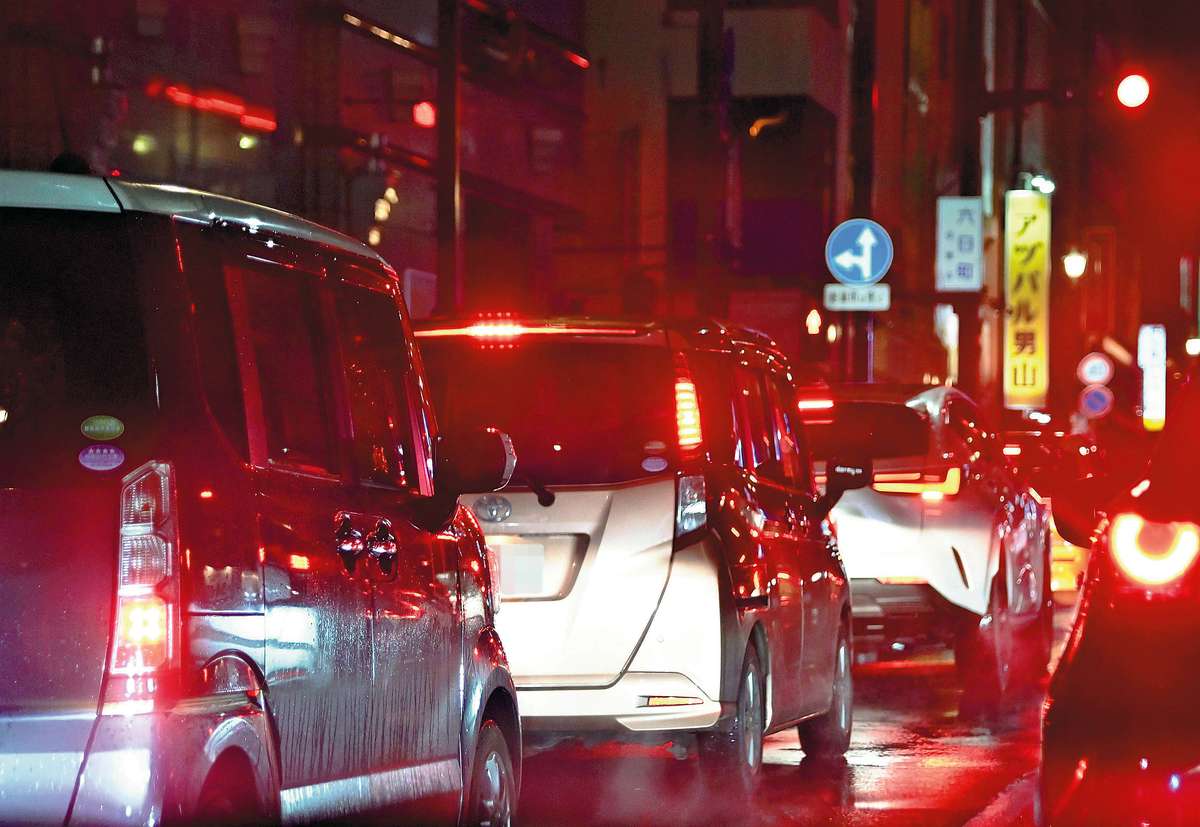
A line of cars is seen in Hachinohe, Aomori Prefecture, at 11:35 p.m. on Dec. 8, about 20 minutes following an earthquake. License plates have been obscured.
16:48 JST, January 8, 2026
People fleeing by car caused traffic jams in Hachinohe, Aomori Prefecture, after a tsunami warning was issued following a magnitude 7.5 earthquake that struck off the east coast late at night on Dec. 8, according to an analysis of smartphone location data.
The analysis was carried out by Agoop Corp. in Tokyo.
The highest tsunami that hit the coast of Hachinohe was 40 centimeters and caused no death or injury. However, issues were exposed with how the public evacuated. The central government has set a rule that people should evacuate on foot. Exceptions include those who have difficulty walking.
“Even when the traffic light turned green, it was impossible to drive forward. If a tsunami really hit us, most of the cars might have been washed away,” said a 38-year-old man living in the city. He had been stuck in traffic while evacuating to a nearby elementary school with four family members.
His house is about 2 kilometers from the coast and was covered by an evacuation order issued by the city. He managed to arrive at the school by taking another route, but the parking lot was full, so he parked on the school yard and waited for the tsunami warning to be lifted.
At the time, evacuation orders had been issued to about 10,000 residents in the coastal area of Hachinohe. As many as 3,445 people, including those who evacuated voluntarily, gathered at schools and city halls. Since it was late at night in winter, many drove to the shelters.
A video created based on smartphone location data by Agoop showing the flow of people on a map following the quake clearly highlights the issue. Dots indicating the locations of smartphone users filled roads leading to higher ground in the city in the 45 minutes after the quake. Compared with a map of the same area at the same time one week prior, there was clearly far more traffic on the roads. Traffic jams even occurred inside tsunami hazard areas.
The government recommends evacuation on foot following an earthquake, taking into consideration such risks as road liquefaction, utility pole collapse and traffic jams. Only those who have difficulty walking or who live far from higher ground are permitted to evacuate by car, depending on local conditions.
The Hachinohe municipal government also has a policy that evacuation by car should be conducted only by people with walking difficulty and other problems in the event that a major tsunami waning has been issued. Traffic jams were seen after the recent quake even though only a tsunami warning was issued – one level below a major tsunami warning – including in areas where no impact from tsunami was expected.
“Even people who didn’t have to evacuate fled by car,” said Hiroyuki Tachiai, an official at the municipal government’s crisis control department.
The city is planning to comprehensively inform the public on the policy of evacuation on foot.
“It’s absolutely necessary to thoroughly make people aware that they should evacuate on foot in principle,” said Tsunenaga Oizumi, a professor at Aomori Chuo Gakuin University an expert on crisis management.
Following an earthquake, drivers are more likely to panic and cause an accident involving those around them. “Through a drill, they should gain awareness that evacuation on foot is safer,” Oizumi said.


Related Tags




Most Read
Popular articles in the past 24 hours
-

Iran Situation: Japan Must Exert Diplomatic Efforts without Merel...
-
Measles Patient Visited Hospital in Bunkyo Ward, Tokyo, Metropoli...
-
2 Unpublished Early Novellas by Japan's Kenzaburo Oe Discovered, ...
-

Prime Minister Sanae Takaichi to Visit Fukushima Pref. on 15th An...
-
Milano Cortina 2026: Japanese Figure Skater Miura Returns to Home...
-

Takayama Among World's Top 10 Most Welcoming Cities for 2026; 2nd...
-
Pass Rate for Overseas Driver's License Conversion Test in Japan ...
-
Former Nomura Securities Employee Given 18-year Prison Sentence f...
Popular articles in the past week
-
Milano Cortina 2026: Japanese Gold Medalist Figure Skater Miura S...
-
Tokyo Spends Big on Children, Wins Over Parents
-

Japan’s Miura, Kihara Announce Withdrawal from Figure Skating Wor...
-

Yokohama to Test Out Renewable-Powered Offshore Floating Data Cen...
-

BOJ Keeping Eye on Economy and Takaichi's ‘Proactive Fiscal Polic...
-
Tokyo Measles Patient Traveled to Fukuoka Aboard JAL Planes; Susp...
-
South Korea Tightens Rules on Foreigners Buying Homes in Seoul Me...
-
Japan’s Takaichi Speaks on New U.S. Tariff in Upper House, Says P...
Popular articles in the past month
-

Producer Behind Pop Group XG Arrested for Cocaine Possession
-

Japan PM Takaichi’s Cabinet Resigns en Masse
-

Man Infected with Measles Reportedly Dined at Restaurant in Tokyo...
-

Israeli Ambassador to Japan Speaks about Japan’s Role in the Reco...
-

Videos Plagiarized, Reposted with False Subtitles Claiming ‘Ryuky...
-

Prudential Life Insurance Plans to Fully Compensate for Damages C...
-

Woman with Measles Visited Hospital in Tokyo Multiple Times Befor...
-

iPS Treatments Pass Key Milestone, but Broader Applications Far f...
Top Articles in Society
-
Producer Behind Pop Group XG Arrested for Cocaine Possession
-
Man Infected with Measles Reportedly Dined at Restaurant in Tokyo Station
-
Woman with Measles Visited Hospital in Tokyo Multiple Times Before Being Diagnosed with Disease
-

Bus Carrying 40 Passengers Catches Fire on Chuo Expressway; All Evacuate Safely
-
Tokyo Skytree’s Elevator Stops, Trapping 20 People; All Rescued (Update 1)
JN ACCESS RANKING
-
Producer Behind Pop Group XG Arrested for Cocaine Possession
-
Japan PM Takaichi’s Cabinet Resigns en Masse
-
Man Infected with Measles Reportedly Dined at Restaurant in Tokyo Station
-
Israeli Ambassador to Japan Speaks about Japan’s Role in the Reconstruction of Gaza
-
Videos Plagiarized, Reposted with False Subtitles Claiming ‘Ryukyu Belongs to China’; Anti-China False Information Also Posted in Japan