
Japan Govt, Ruling Parties Secure Support for FY26 Budget; Possibility of it Being Passed as Originally Drafted in Sight
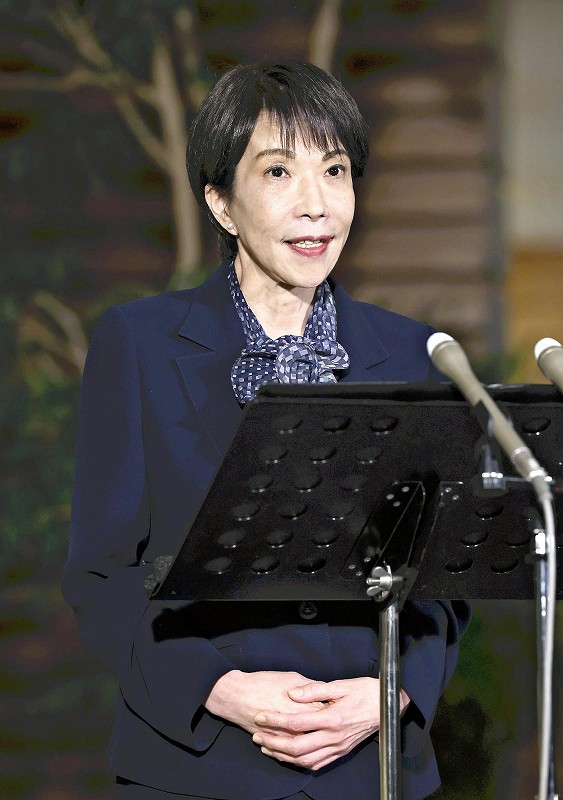
Prime Minister Sanae Takaichi speaks to reporters at the Prime Minister’s Office in Tokyo on Friday.
21:00 JST, December 27, 2025
With the government and ruling parties securing the support of the Democratic Party for the People for the fiscal 2026 budget proposal, the possibility of it being passed as originally drafted by the end of this fiscal year is now in sight.
The ruling coalition of the Liberal Democratic Party and the Japan Innovation Party remain a minority in the House of Councillors, but with the support of the DPFP, the budget proposal would garner a majority of votes.
Within the ruling bloc, there is a view that an environment for smooth progress on budget deliberations — seen as the biggest challenge during an ordinary Diet session to be convened in January — is taking shape.
“I hope budget committee deliberations to be held in the new year will also proceed smoothly,” Itsunori Onodera, chairperson of the LDP’s Research Commission on the Tax System, told reporters after meeting with Prime Minister Sanae Takaichi at the Prime Minister’s Office on Friday.
The Cabinet of former Prime Minister Shigeru Ishiba was forced to revise its budget plan in both Diet chambers during this year’s ordinary Diet session. To avoid a similar situation, the Takaichi Cabinet accepted the DPFP’s demand to review the so-called annual income barrier, the threshold above which income tax is imposed.
In response, DPFP leader Yuichiro Tamaki said, “We will cooperate on the budget proposal.”
The government also plans to submit a bill to the upcoming ordinary Diet session to revise the law on special provisions concerning the issuance of government bonds. The move is meant to extend the effective period of a special measure that allows the issuance of deficit-covering bonds through fiscal 2030.
“We want to consider it positively,” Tamaki added, regarding cooperation on the passage of the bill.
Given that, the government and ruling parties now see the number of factors for potential disruptions in Diet proceedings decreasing.
Unlike the budget proposal, which automatically passes 30 days after being sent to the upper house, the bill follows the same passage process as ordinary legislation.
In light of this, deliberations could stall in the current divided Diet where opposition parties hold a majority in the upper house. Budget execution was delayed in the past under similar circumstances, so this has become a critical issue for the government and ruling parties.
The Constitutional Democratic Party of Japan, which has taken a confrontational stance toward the government and ruling parties, has criticized the budget proposal, and its Secretary General Jun Azumi called it “extravagant spending.”
The party intends to draw up an alternative plan to amend the budget proposal. However, uniting opposition parties to pass an amendment plan has become difficult due to the DPFP’s stance.





Most Read
Popular articles in the past 24 hours
-
Seeking Nuclear Waste Site, Japan Eyes Remote Island of Minami-To...
-

Japan Ministry Asks to Conduct Nuclear Waste Disposal-related Sur...
-

Artisans from Disaster-Hit Areas Work Together to Keep Memories o...
-

Tokyo High Court Upholds Unification Church Dissolution Order; Li...
-

Japan Tourist Spot's Capsule Toys Made from Recycled Materials Pr...
-

CARTOON OF THE DAY (March 4)
-

Japan’s Space One Kairos 3rd Flight Rocket Launched, but Mission ...
-

Men Compete in Fierce Tug-of-War for Aomori Festival
Popular articles in the past week
-
Tokyo Spends Big on Children, Wins Over Parents
-

South Korea Tightens Rules on Foreigners Buying Homes in Seoul Me...
-
Japan’s Miura, Kihara Announce Withdrawal from Figure Skating Wor...
-

BOJ Keeping Eye on Economy and Takaichi's ‘Proactive Fiscal Polic...
-
Tokyo Measles Patient Traveled to Fukuoka Aboard JAL Planes; Susp...
-

Nidec Chairman Resigns Amid Accounting Scandal at Major Japanese ...
-

Strait of Hormuz Closure Shakes Markets; Prolonged Closure Could ...
-

2 Unpublished Early Novellas by Japan's Kenzaburo Oe Discovered, ...
Popular articles in the past month
-

Producer Behind Pop Group XG Arrested for Cocaine Possession
-

Japan PM Takaichi’s Cabinet Resigns en Masse
-

Man Infected with Measles Reportedly Dined at Restaurant in Tokyo...
-

Israeli Ambassador to Japan Speaks about Japan’s Role in the Reco...
-

Videos Plagiarized, Reposted with False Subtitles Claiming ‘Ryuky...
-

Prudential Life Insurance Plans to Fully Compensate for Damages C...
-

Woman with Measles Visited Hospital in Tokyo Multiple Times Befor...
-

iPS Treatments Pass Key Milestone, but Broader Applications Far f...
Top Articles in Politics
-
Japan PM Takaichi’s Cabinet Resigns en Masse
-

Sanae Takaichi Elected Prime Minister of Japan; Keeps All Cabinet Appointees from Previous Term
-

Japan’s Govt to Submit Road Map for Growth Strategy in March, PM Takaichi to Announce in Upcoming Policy Speech
-

LDP Wins Landslide Victory, Secures Single-party Majority; Ruling Coalition with JIP Poised to Secure Over 300 seats (UPDATE 1)
-

LDP Wins Historic Landslide Victory
JN ACCESS RANKING
-
Producer Behind Pop Group XG Arrested for Cocaine Possession
-
Japan PM Takaichi’s Cabinet Resigns en Masse
-
Man Infected with Measles Reportedly Dined at Restaurant in Tokyo Station
-
Israeli Ambassador to Japan Speaks about Japan’s Role in the Reconstruction of Gaza
-
Videos Plagiarized, Reposted with False Subtitles Claiming ‘Ryukyu Belongs to China’; Anti-China False Information Also Posted in Japan