
Overseas Voting System Makes it Difficult for Japanese Citizens Living Abroad to Cast Ballots in Japan National Elections
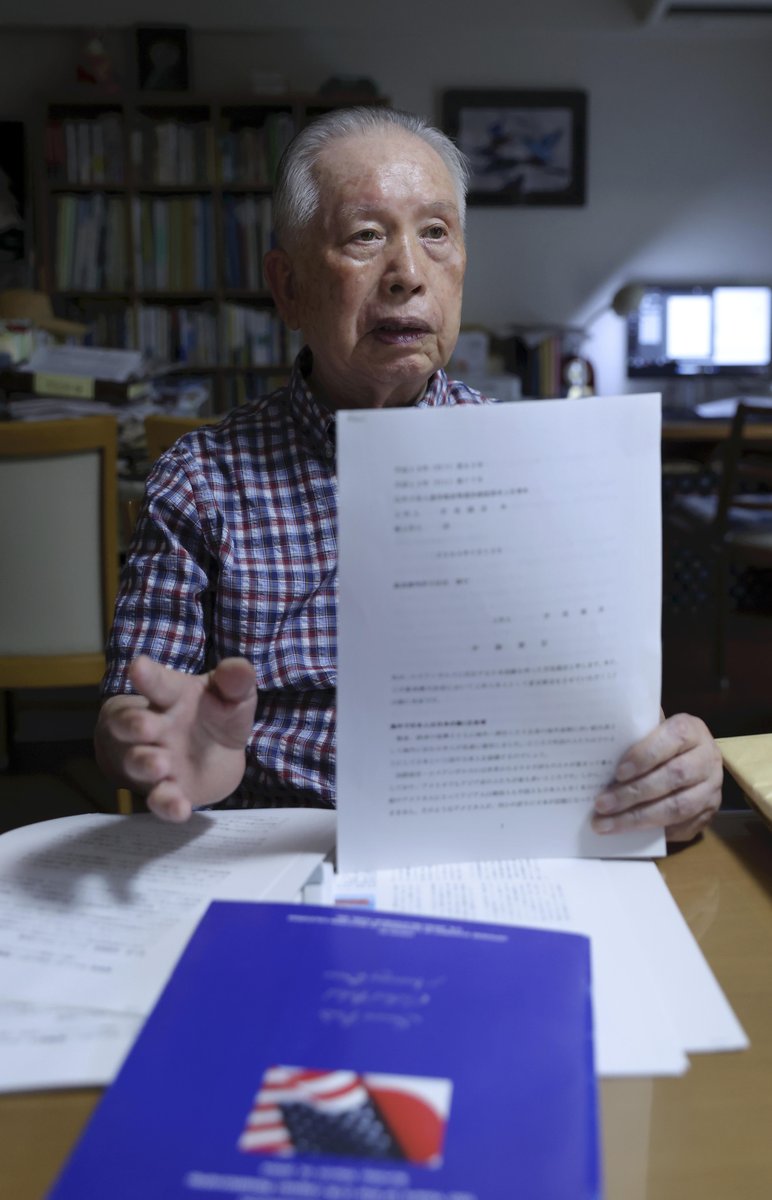
Tatsuhiko Wakao shows court documents in Miyamae Ward, Kawasaki.
7:00 JST, November 8, 2025
Only about 2% -3% of Japanese citizens living overseas utilize the overseas voting system, which allows them to vote in national elections while living abroad, as it is not a quick and easy process.
Twenty years have passed since the Supreme Court ruled the Public Offices Election Law, which then restricted the voting rights of those living abroad, was unconstitutional.
Though lawmakers of a cross-party parliamentary league are talking about introducing online voting for overseas Japanese citizens, some are concerned that it might not be realized soon, as the coalition government is set to discuss reducing the number of Diet seats.
The overseas voting system was first introduced in the 2000 House of Representatives election, but only for the proportional representation segment.
After the Supreme Court ruled the law was unconstitutional in 2005, the system was expanded to include constituency elections starting with the 2007 House of Councillors election. The national examination of Supreme Court justices was also included, starting with the 2024 lower house election.
“We can finally convey the will of Japanese citizens living overseas to national politics,” said Tatsuhiko Wakao, 84, in Kawasaki, remembering how he felt after the ruling.
After working for a company in the United States, he became an independent consultant in Los Angeles in 1991.
“Japan’s path to survival lies in promoting trade,” Wakao said. “The perspectives of those living overseas should also be reflected in national politics.”
Wanting to make it into a reality, he and his colleagues sent signatures to the Diet, and he filed a lawsuit with the Tokyo District Court in November 1996, as secretary general of a plaintiff group comprising 53 people from eight countries, including the United States and European nations.
As the movement gained support, the Public Offices Election Law was amended in 1998, halfway through the first trial, establishing the overseas voting system.
However, it was only limited to elections for the proportional representation segment.
Although the lawsuits were initially unsuccessful, the Supreme Court’s Grand Bench delivered a landmark reversal in September 2005, ruling that “overseas Japanese citizens are guaranteed the right to vote under the Constitution” and declared the government’s actions as unconstitutional.
“Overseas citizens wish for their home country to prosper just as much as those living in Japan,” Wakao said.
Only about 27,000 out of the more than 1 million overseas eligible voters cast their ballots in the upper house election this summer. This figure falls far short of the 59% voter turnout of those living in Japan.
To vote from overseas, individuals must either apply before leaving Japan or visit a local overseas diplomatic mission to register as an overseas voter. Furthermore, they have to either travel to the overseas diplomatic mission or request the municipality where they lived in Japan to send them a ballot, which then has to be sent back to the local government.
Yuki Egashira, 59, a Japanese language teacher living in New Zealand, planned to drive the about six hours one way to the Consular Office in Christchurch for the upper house election but had to give up on the trip due to road closures caused by flooding.
Egashira previously tried to vote by mail, but her ballot did not reach the election commission before the deadline.
“I wanted to vote for a party and a candidate committed to multicultural coexistence,” Egashira said.
Hiroyuki Takenaga, 59, who participated the movement in the 1990s, and continues to advocate for the system through social media from the United States, said there is still a gap between the court ruling and the reality of trying to vote from overseas.
One solution that is gaining traction is to allow overseas Japanese citizens to vote online, a system that has already been implemented in such countries as Estonia and France.
In 2018, an expert panel at the Internal Affairs and Communications Ministry compiled a report stating that “technical and operational challenges can be overcome” by utilizing tools like the My Number card.
The ministry is closely monitoring Diet developments.
“As this affects the core of the electoral system, discussions involving all parties and factions are necessary,” a ministry official said.
However, when the administration of Prime Minister Sanae Takaichi was formed, the Liberal Democratic Party and the Japan Innovation Party agreed to reduce the number of lower house seats, so discussions in the Diet concerning the reduction are likely to attract attention.
“If there is a decrease in the number of lawmakers, the routes through which the state gathers public opinion will also decrease,” Takenaga said.
Prof. Harumichi Yuasa of Meiji University said: “While online voting for overseas Japanese citizens still faces detailed technical challenges, such as security, it is problematic to leave the current situation unchanged when a path to implementation exists. The Diet needs to expedite discussions toward its introduction.”






Most Read
Popular articles in the past 24 hours
-

Milano Cortina 2026: Miura-Kihara Duo, Other Japanese Figure Skat...
-

6 Injured at Naked Festival in Japan’s Okayama Prefecture; Police...
-

Reciprocal Tariffs Ruled Illegal: Judiciary Would Not Tolerate Pr...
-

‘Storytellers’ Being Dispatched Overseas to Promote Japan; Events...
-

Fiji Defense Minister Hopes Japan Will Support Stabilization of P...
-

Space One Delays Launch of No. 3 Kairos Rocket; Company to Announ...
-

Japan, Pacific Island Nations to Work on Deepening Cooperation
-

Japanese Film, Anymart, Wins Critics’ Award at International Film...
Popular articles in the past week
-

Japan PM Takaichi’s Cabinet Resigns en Masse
-

Man Infected with Measles Reportedly Dined at Restaurant in Tokyo...
-

Sanae Takaichi Elected Prime Minister of Japan; Keeps All Cabinet...
-

Japan's Govt to Submit Road Map for Growth Strategy in March, PM ...
-

Bus Carrying 40 Passengers Catches Fire on Chuo Expressway; All E...
-

Milano Cortina 2026: Figure Skaters Riku Miura, Ryuichi Kihara Pa...
-

Japan, U.S. Name 3 Inaugural Investment Projects; Reached Agreeme...
-

U.S. Firm to Build Training Hub in Fukushima N-plant for Debris R...
Popular articles in the past month
-
Japan PM Takaichi’s Cabinet Resigns en Masse
-

Japan Institute to Use Domestic Commercial Optical Lattice Clock ...
-

Israeli Ambassador to Japan Speaks about Japan’s Role in the Reco...
-
Man Infected with Measles Reportedly Dined at Restaurant in Tokyo...
-

Videos Plagiarized, Reposted with False Subtitles Claiming ‘Ryuky...
-

Man Infected with Measles May Have Come in Contact with Many Peop...
-

Prudential Life Insurance Plans to Fully Compensate for Damages C...
-

Woman with Measles Visited Hospital in Tokyo Multiple Times Befor...
Top Articles in Society
-
Man Infected with Measles Reportedly Dined at Restaurant in Tokyo Station
-
Man Infected with Measles May Have Come in Contact with Many People in Tokyo, Went to Store, Restaurant Around When Symptoms Emerged
-
Woman with Measles Visited Hospital in Tokyo Multiple Times Before Being Diagnosed with Disease
-
Australian Woman Dies After Mishap on Ski Lift in Nagano Prefecture
-
Foreign Snowboarder in Serious Condition After Hanging in Midair from Chairlift in Nagano Prefecture
JN ACCESS RANKING
-
Japan PM Takaichi’s Cabinet Resigns en Masse
-
Japan Institute to Use Domestic Commercial Optical Lattice Clock to Set Japan Standard Time
-
Israeli Ambassador to Japan Speaks about Japan’s Role in the Reconstruction of Gaza
-
Man Infected with Measles Reportedly Dined at Restaurant in Tokyo Station
-
Videos Plagiarized, Reposted with False Subtitles Claiming ‘Ryukyu Belongs to China’; Anti-China False Information Also Posted in Japan