
Koizumi Swiftly Increasing Political Presence as Defense Minister, Possibly Aiming at Future Prime Minister Elections
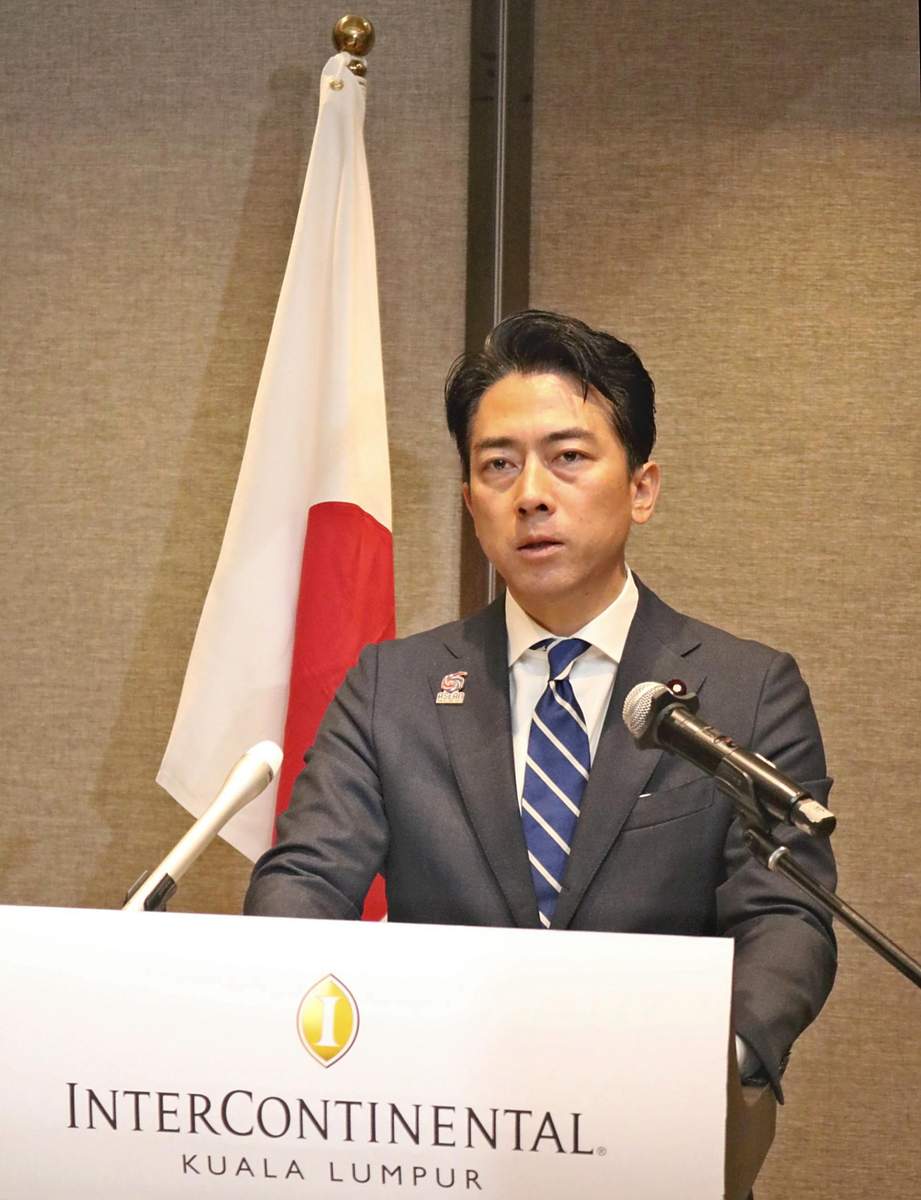
Defense Minister Shinjiro Koizumi answers questions from reporters in Kuala Lumpur on Sunday.
15:48 JST, November 3, 2025
KUALA LUMPUR — Defense Minister Shinjiro Koizumi has been increasing his political presence in the roughly two weeks since taking his post, proactively disseminating information via social media about the movements of other countries’ military forces around Japan and holding meetings twice with U.S. Defense Secretary Pete Hegseth.
With security circumstances surrounding Japan increasing in severity, the Japanese public will be assessing his achievements as defense minister, and his ongoing activities will serve as a litmus test for the future of his career.
On Sunday, Koizumi told reporters, “I was able to firmly explain the Takaichi Cabinet’s stance on strengthening defense policies to defense ministers of the Association of Southeast Asian Nations and other countries in the Indo-Pacific region.”
He made the remark after the meetings in his first overseas visit to Malaysia as defense minister had concluded.
At the ASEAN Defense Ministers’ Meeting Plus on Saturday, Koizumi, Hegseth and South Korean Defense Minister Ahn Gyu-back took group photos at his suggestion to show unity among the three countries.
During his visit to Malaysia, Koizumi held separate meetings with the defense ministers of eight countries and confirmed a desire to cooperate for peace and stability in the Indo-Pacific region.
In the Liberal Democratic Party’s presidential election in October, Koizumi gained fewer votes from rank-and-file party members and members of LDP-affiliated bodies than expected. This contributed to his defeat by Prime Minister Sanae Takaichi in the runoff election.
Koizumi is still seen as a promising candidate in the next prime minister election, and there are many examples in recent years of those with experience in posts such as chief cabinet secretary, internal affairs and communications minister, foreign minister and defense minister being elected prime minister.
For Koizumi, who was criticized for his lack of experience, his current post as defense minister can be a valuable opportunity to earn political achievements.
There are many tasks to consider in order to strengthen Japan’s defense capabilities.
Concerning plans to move up the revision of three major national security and defense documents, including the National Security Strategy, attention is being paid to how much the defense budget will be raised from amounts equivalent to 2% of the nation’s gross domestic product.
Securing new revenue sources for this purpose will not be an easy task, and the Cabinet must make an effort to obtain the public’s understanding.
The coalition agreement between the LDP and the Japan Innovation Party includes a pledge to abolish an operational guideline over exports of defense equipment, which limits allowable exports to five categories such as those for rescue and transportation, during next year’s ordinary Diet session.
However, opposition parties have taken a stance to rigorously question the ruling parties over plans to expand the range of defense equipment exports in the current extraordinary Diet session.
There certainly will be more occasions in which Koizumi’s ability to properly answer questions during Diet deliberations will be put to the test.
Because the defense minister is required to respond to emergencies such as disasters and North Korean ballistic missile launches, it will be difficult for Koizumi to tour provincial regions and gain support from more rank-and-file party members and members of LDP-affiliated bodies.
A veteran LDP member said, “What achievements Mr. Koizumi is able to obtain as defense minister will impact his future.”





Most Read
Popular articles in the past 24 hours
-

Business Hotels Expanding into Regional Areas in Japan, Aiming to...
-
6 Injured at Naked Festival in Japan’s Okayama Prefecture; Police...
-

Fiji Defense Minister Hopes Japan Will Support Stabilization of P...
-

Space One Delays Launch of No. 3 Kairos Rocket; Company to Announ...
-

Milano Cortina 2026: Malinin Highlights Dangers of Social Media i...
-

Reciprocal Tariffs Ruled Illegal: Judiciary Would Not Tolerate Pr...
-
3rd Japan Pacific Islands Defense Dialogue to Begin in Tokyo on S...
-

Japanese Film, Anymart, Wins Critics’ Award at International Film...
Popular articles in the past week
-

Japan PM Takaichi’s Cabinet Resigns en Masse
-

Man Infected with Measles Reportedly Dined at Restaurant in Tokyo...
-

Sanae Takaichi Elected Prime Minister of Japan; Keeps All Cabinet...
-

Japan's Govt to Submit Road Map for Growth Strategy in March, PM ...
-

Bus Carrying 40 Passengers Catches Fire on Chuo Expressway; All E...
-

Milano Cortina 2026: Figure Skaters Riku Miura, Ryuichi Kihara Pa...
-
Japan, U.S. Name 3 Inaugural Investment Projects; Reached Agreeme...
-

U.S. Firm to Build Training Hub in Fukushima N-plant for Debris R...
Popular articles in the past month
-
Japan PM Takaichi’s Cabinet Resigns en Masse
-

Japan Institute to Use Domestic Commercial Optical Lattice Clock ...
-

Israeli Ambassador to Japan Speaks about Japan’s Role in the Reco...
-
Man Infected with Measles Reportedly Dined at Restaurant in Tokyo...
-

Videos Plagiarized, Reposted with False Subtitles Claiming ‘Ryuky...
-

Man Infected with Measles May Have Come in Contact with Many Peop...
-

Prudential Life Insurance Plans to Fully Compensate for Damages C...
-

Woman with Measles Visited Hospital in Tokyo Multiple Times Befor...
Top Articles in Politics
-
Japan PM Takaichi’s Cabinet Resigns en Masse
-
Sanae Takaichi Elected Prime Minister of Japan; Keeps All Cabinet Appointees from Previous Term
-
Japan’s Govt to Submit Road Map for Growth Strategy in March, PM Takaichi to Announce in Upcoming Policy Speech
-

LDP Wins Historic Landslide Victory
-

LDP Wins Landslide Victory, Secures Single-party Majority; Ruling Coalition with JIP Poised to Secure Over 300 seats (UPDATE 1)
JN ACCESS RANKING
-
Japan PM Takaichi’s Cabinet Resigns en Masse
-
Japan Institute to Use Domestic Commercial Optical Lattice Clock to Set Japan Standard Time
-
Israeli Ambassador to Japan Speaks about Japan’s Role in the Reconstruction of Gaza
-
Man Infected with Measles Reportedly Dined at Restaurant in Tokyo Station
-
Videos Plagiarized, Reposted with False Subtitles Claiming ‘Ryukyu Belongs to China’; Anti-China False Information Also Posted in Japan