
Cabinet of Japan’s 1st Female PM Takaichi Receives 71% Approval Rating, Survey Shows; 57% of Respondents Support LDP-JIP Coalition
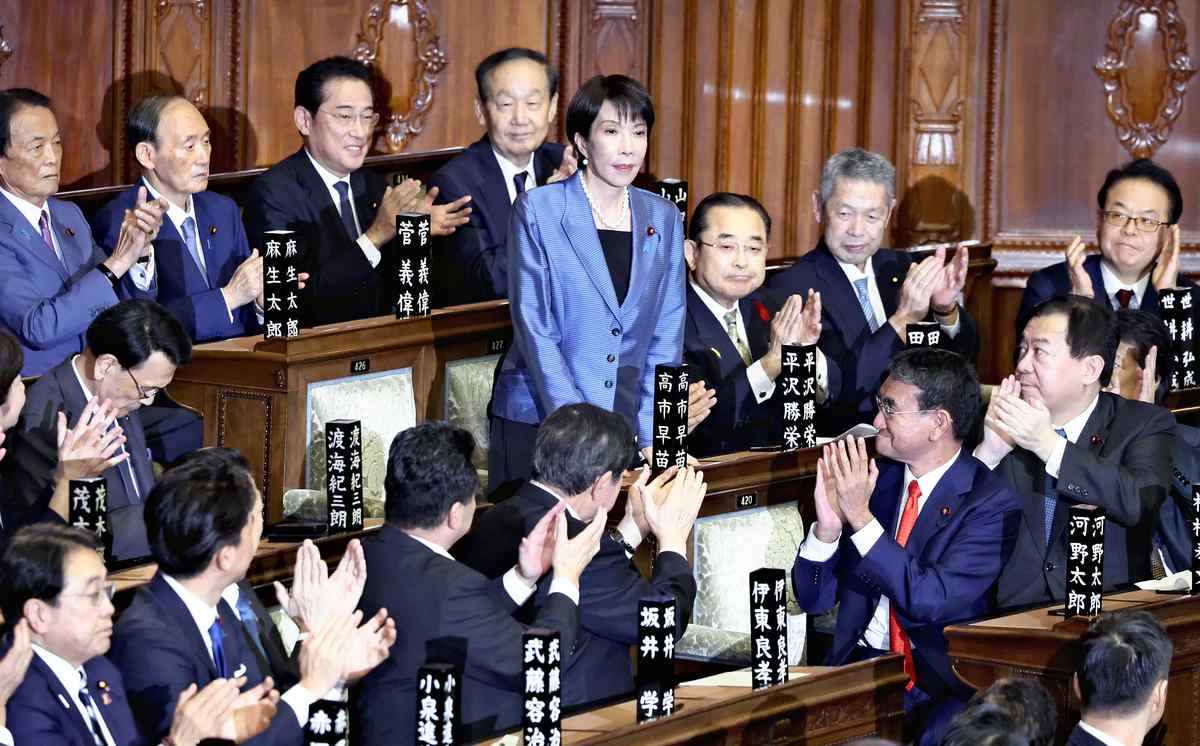
Liberal Democratic Party President Sanae Takaichi bows after being designated prime minister at the plenary session of the House of Representatives on Tuesday.
17:31 JST, October 23, 2025
The approval rating for Prime Minister Sanae Takaichi’s Cabinet stands at 71%, marking a significant rise from 34% in the previous survey conducted in September, when former Prime Minister Shigeru Ishiba was in office, according to a Yomiuri Shimbun survey.
The nationwide survey was conducted from Tuesday, the day the Cabinet was inaugurated, through Wednesday.
The Yomiuri Shimbun has conducted public opinion surveys soon after the inauguration of new cabinets since Prime Minister Masayoshi Ohira’s Cabinet in 1978.
Takaichi’s Cabinet received the fifth-highest approval rating. Former Prime Minister Shinzo Abe’s Cabinet in September 2006, during his first administration, had a 70% approval rating.
The survey showed that more support from younger generations increased the Cabinet’s overall approval rating. The Cabinet’s disapproval rating was 18%, a sharp drop compared to 54% in the previous survey.
Fifty-seven percent of respondents approved of the coalition between the Liberal Democratic Party and the Japan Innovation Party while 31% disapproved.
On Komeito leaving the coalition with the LDP, 77% of respondents said it was appropriate, eclipsing the 12% who said it was inappropriate.
The JIP has said it will support the LDP from outside the Cabinet for the time being. When asked whether the Cabinet should include a JIP member, 28% of respondents said yes while 58% said no.
Fifty-six percent of respondents supported Takaichi’s overall picks for her Cabinet or the LDP leadership, exceeding the 24% who did not.
The LDP and the JIP are aiming to pass legislation during the current Diet session to reduce the number of seats in the House of Representatives by 10%. On whether they should expedite efforts to pass the legislation, 53% said they should while 37% said they should not.
Regarding which policies and issues should be prioritized, with multiple answers allowed, 92% of respondents cited “measures against rising prices”; 74% said “social security, including pension”; 71% said “diplomacy and security”; 62% cited “reducing the number of Diet seats”; and 34% said the “second capital initiative.”
On support for individual political parties, 32% of respondents supported the LDP, up from 27% in the previous survey; 5% supported the JIP, up from 2%; 7% supported Sanseito, down from 8%; 6% supported the Constitutional Democratic Party of Japan, up from 5%; 5% supported the Democratic Party for the People, down from 9%; and 4% supported Komeito, up from 3%.
Thirty-four percent of respondents said they did not support any particular party, down from 35% in the previous survey.
On what respondents hope to see regarding the government, 58% said “a continuation of an LDP-centered administration,” whereas 26% said “a change of government.”
In a survey conducted right after the House of Councillors election in July, 35% said “a continuation of an LDP-centered administration” while 47% said “a change of government.”
On whether the lower house needs to be dissolved as soon as possible in order to hold a general election, 43% said yes while 49% said no.
The phone survey was conducted by calling landlines and mobile phones through random dialing, targeting voters aged 18 and older. For landlines, 426 people answered among the 769 households that were called and where a voter was confirmed to reside. For mobile phones, 631 people responded among the 2,007 who were called. The survey had a total of 1,057 respondents.





Most Read
Popular articles in the past 24 hours
-
Business Hotels Expanding into Regional Areas in Japan, Aiming to...
-

6 Injured at Naked Festival in Japan’s Okayama Prefecture; Police...
-

Fiji Defense Minister Hopes Japan Will Support Stabilization of P...
-

Space One Delays Launch of No. 3 Kairos Rocket; Company to Announ...
-

Milano Cortina 2026: Malinin Highlights Dangers of Social Media i...
-

Reciprocal Tariffs Ruled Illegal: Judiciary Would Not Tolerate Pr...
-

Japanese Film, Anymart, Wins Critics’ Award at International Film...
-

3rd Japan Pacific Islands Defense Dialogue to Begin in Tokyo on S...
Popular articles in the past week
-

Japan PM Takaichi’s Cabinet Resigns en Masse
-

Man Infected with Measles Reportedly Dined at Restaurant in Tokyo...
-

Sanae Takaichi Elected Prime Minister of Japan; Keeps All Cabinet...
-

Japan's Govt to Submit Road Map for Growth Strategy in March, PM ...
-

Bus Carrying 40 Passengers Catches Fire on Chuo Expressway; All E...
-

Milano Cortina 2026: Figure Skaters Riku Miura, Ryuichi Kihara Pa...
-

Japan, U.S. Name 3 Inaugural Investment Projects; Reached Agreeme...
-

U.S. Firm to Build Training Hub in Fukushima N-plant for Debris R...
Popular articles in the past month
-
Japan PM Takaichi’s Cabinet Resigns en Masse
-

Japan Institute to Use Domestic Commercial Optical Lattice Clock ...
-

Israeli Ambassador to Japan Speaks about Japan’s Role in the Reco...
-
Man Infected with Measles Reportedly Dined at Restaurant in Tokyo...
-

Videos Plagiarized, Reposted with False Subtitles Claiming ‘Ryuky...
-

Man Infected with Measles May Have Come in Contact with Many Peop...
-

Prudential Life Insurance Plans to Fully Compensate for Damages C...
-

Woman with Measles Visited Hospital in Tokyo Multiple Times Befor...
Top Articles in Politics
-
Japan PM Takaichi’s Cabinet Resigns en Masse
-
Sanae Takaichi Elected Prime Minister of Japan; Keeps All Cabinet Appointees from Previous Term
-
Japan’s Govt to Submit Road Map for Growth Strategy in March, PM Takaichi to Announce in Upcoming Policy Speech
-

LDP Wins Historic Landslide Victory
-

LDP Wins Landslide Victory, Secures Single-party Majority; Ruling Coalition with JIP Poised to Secure Over 300 seats (UPDATE 1)
JN ACCESS RANKING
-
Japan PM Takaichi’s Cabinet Resigns en Masse
-
Japan Institute to Use Domestic Commercial Optical Lattice Clock to Set Japan Standard Time
-
Israeli Ambassador to Japan Speaks about Japan’s Role in the Reconstruction of Gaza
-
Man Infected with Measles Reportedly Dined at Restaurant in Tokyo Station
-
Videos Plagiarized, Reposted with False Subtitles Claiming ‘Ryukyu Belongs to China’; Anti-China False Information Also Posted in Japan