
Opinions Mixed over Japan Innovation Party’s Demand to Reduce Number of Seats in Diet
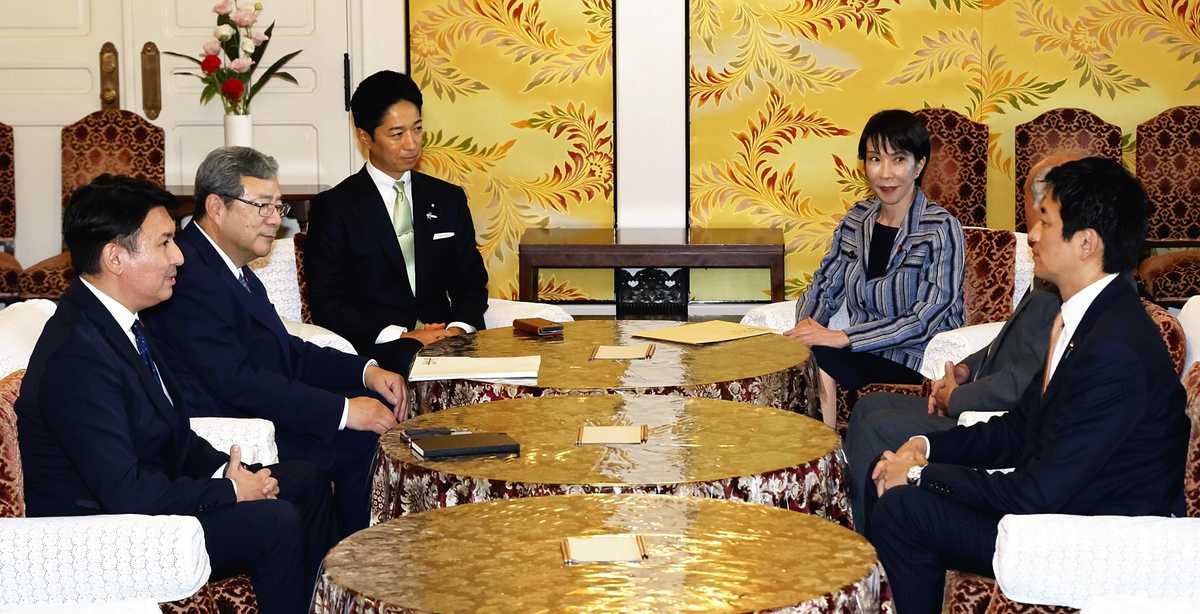
Liberal Democratic Party President Sanae Takaichi, second from right, and Japan Innovation Party coleader Fumitake Fujita, third from left, are seen at a meeting at the Diet Building on Friday.
20:00 JST, October 18, 2025
Reducing the number of Diet seats has been a major topic in policy talks between the ruling Liberal Democratic Party and the Japan Innovation Party as they consider forming a coalition.
Despite the LDP agreeing to reduce the number of seats, there is strong resistance within both the ruling and opposition parties.
“The essence of political reform is reducing the number of Diet members,” JIP leader and Osaka Gov. Hirofumi Yoshimura said on a TV program on Friday.
The JIP has gained support in its stronghold of Osaka by continuing to advocate self-sacrificing reforms including reducing the number of seats in the Osaka prefectural and city assemblies, as well as the remuneration of local government leaders.
Yoshimura said the JIP wants to reduce the number of Diet seats by about 50, which is a little more than 10% of the 465 seats in the House of Representatives.
“And [the targeted seats] might possibly be those from the proportional representation segment,” he said.
Yoshimura made the remarks to apparently underline the determination of the JIP to realize the cuts.
Reducing the number of lower house seats was also an issue in the past.
In 1999, the LDP and the now defunct Liberal Party agreed to first reduce the seats in the proportional representation segment by 20 as a step toward a 50-seat reduction in total when forming a three-party coalition with Komeito.
During a party leader debate in 2012 with then LDP President Shinzo Abe, then Prime Minister Yoshihiko Noda expressed his intention to dissolve the lower house if parties agreed to significantly reduce the number of seats.
Many LDP executives think that reducing the number of seats in the proportional representation segment would have a more significant impact on other parties, so it easier for the LDP to accept the demand.
If the LDP and the JIP reach an agreement in policy talks, the reduction is likely to be included as one of the issues they will work to realize.
However, strong doubts have been raised about reducing the number of lawmakers.
“The measure will further reduce the number of seats in rural areas. Such a sudden reduction is out of the question,” lower house member Ichiro Aisawa, who has led the LDP’s electoral reform efforts, said in a post on X.
Tetsuo Saito, leader of Komeito, which values an election under the proportional representation formula, told reporters on Friday that the primary purpose of the proportional representation segment is to hear the voices of the minority.
“Reducing seats in the proportional representation segment is harassment against Komeito,” a senior Komeito member said.





Most Read
Popular articles in the past 24 hours
-
Business Hotels Expanding into Regional Areas in Japan, Aiming to...
-

6 Injured at Naked Festival in Japan’s Okayama Prefecture; Police...
-

Fiji Defense Minister Hopes Japan Will Support Stabilization of P...
-

Space One Delays Launch of No. 3 Kairos Rocket; Company to Announ...
-

Milano Cortina 2026: Malinin Highlights Dangers of Social Media i...
-

Reciprocal Tariffs Ruled Illegal: Judiciary Would Not Tolerate Pr...
-

Japanese Film, Anymart, Wins Critics’ Award at International Film...
-

3rd Japan Pacific Islands Defense Dialogue to Begin in Tokyo on S...
Popular articles in the past week
-

Japan PM Takaichi’s Cabinet Resigns en Masse
-

Man Infected with Measles Reportedly Dined at Restaurant in Tokyo...
-

Sanae Takaichi Elected Prime Minister of Japan; Keeps All Cabinet...
-

Japan's Govt to Submit Road Map for Growth Strategy in March, PM ...
-

Bus Carrying 40 Passengers Catches Fire on Chuo Expressway; All E...
-

Milano Cortina 2026: Figure Skaters Riku Miura, Ryuichi Kihara Pa...
-

Japan, U.S. Name 3 Inaugural Investment Projects; Reached Agreeme...
-

U.S. Firm to Build Training Hub in Fukushima N-plant for Debris R...
Popular articles in the past month
-
Japan PM Takaichi’s Cabinet Resigns en Masse
-

Japan Institute to Use Domestic Commercial Optical Lattice Clock ...
-

Israeli Ambassador to Japan Speaks about Japan’s Role in the Reco...
-
Man Infected with Measles Reportedly Dined at Restaurant in Tokyo...
-

Videos Plagiarized, Reposted with False Subtitles Claiming ‘Ryuky...
-

Man Infected with Measles May Have Come in Contact with Many Peop...
-

Prudential Life Insurance Plans to Fully Compensate for Damages C...
-

Woman with Measles Visited Hospital in Tokyo Multiple Times Befor...
Top Articles in Politics
-
Japan PM Takaichi’s Cabinet Resigns en Masse
-
Sanae Takaichi Elected Prime Minister of Japan; Keeps All Cabinet Appointees from Previous Term
-
Japan’s Govt to Submit Road Map for Growth Strategy in March, PM Takaichi to Announce in Upcoming Policy Speech
-

LDP Wins Historic Landslide Victory
-

LDP Wins Landslide Victory, Secures Single-party Majority; Ruling Coalition with JIP Poised to Secure Over 300 seats (UPDATE 1)
JN ACCESS RANKING
-
Japan PM Takaichi’s Cabinet Resigns en Masse
-
Japan Institute to Use Domestic Commercial Optical Lattice Clock to Set Japan Standard Time
-
Israeli Ambassador to Japan Speaks about Japan’s Role in the Reconstruction of Gaza
-
Man Infected with Measles Reportedly Dined at Restaurant in Tokyo Station
-
Videos Plagiarized, Reposted with False Subtitles Claiming ‘Ryukyu Belongs to China’; Anti-China False Information Also Posted in Japan