
Inflation, Wages Take Center Stage at LDP Presidential Debate; Candidates Cautious about Recognizing Palestine
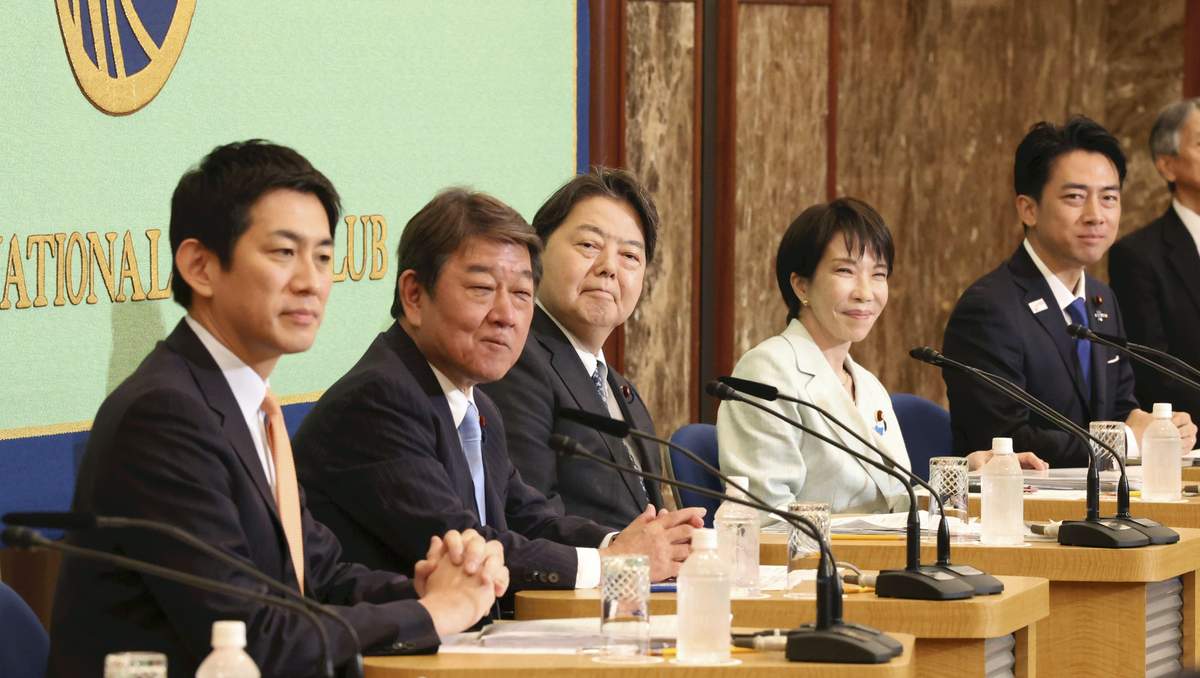
The five contenders in the Liberal Democratic Party’s presidential election listen to a comment during a public debate in Chiyoda Ward, Tokyo, on Wednesday.
15:47 JST, September 25, 2025
Combating rising prices and boosting incomes dominated the agenda during a public debate among the five contenders in the Liberal Democratic Party’s presidential election on Wednesday. Foreign policy and social security reform were among the issues also mentioned.
The candidates presented their positions on key economic policies including growth strategies, wage increases and reining in soaring prices — issues set to have a major bearing on the race to become the LDP’s next leader on Oct. 4.
The debate among the five candidates – former economic security minister Takayuki Kobayashi; former LDP Secretary General Toshimitsu Motegi; Chief Cabinet Secretary Yoshimasa Hayashi; former economic security minister Sanae Takaichi; and Agriculture, Forestry and Fisheries Minister Shinjiro Koizumi – was held at the Japan National Press Club in Tokyo.
Much of the debate was spent discussing efforts to tame rising prices and to increase incomes, matters of great concern to the public.
Kobayashi once more proposed implementing a fixed-rate cut in the income tax rate for a limited period. In 1999, the Cabinet of then Prime Minister Keizo Obuchi reduced income tax by 20%, a figure Kobayashi said “will be used as a reference.” After the limited-time cut ends, Kobayashi said he would drastically overhaul the income tax system, including how deductions are implemented. To continue lowering the burden on middle-income households, Kobayashi said high-income earners would be asked to “shoulder some burden.”
Motegi pledged to boost investment in growth fields such as artificial intelligence and semiconductors, and to boost the growth potential of regional areas by having companies establish facilities and industry hubs there.
Hayashi called for the three-stage introduction of a Japanese version of Britain’s Universal Credit system, which provides support to low- and middle-income households based on their income level. Hayashi outlined a vision for securing financial resources and implementing the system after considering what type of support would be provided to typical households and combining this with existing welfare and other programs.
Takaichi, an advocate of vigorous fiscal spending, said, “We should prioritize investment that will create future financial resources.” She mentioned that deficit-financing bonds should be issued to fund policies to combat rising prices, among other things. She brushed off concerns that government bond prices would fall as the fiscal deficit widens, saying, “Domestic investors hold at least 90% of these bonds.”
Koizumi wants the average annual wage to rise by ¥1 million. He insisted he would use “every policy at his disposal” to achieve this goal, including tax system reforms that promote higher wages, government support to boost the productivity of small and midsize businesses, and implementing government-mandated price increases for medical and nursing care.
The candidates also shared their views on foreign policy issues and social security.
Each candidate indicated they would hold to Japan’s current stance of not recognizing a Palestinian state for the time being. “A comprehensive decision on this is needed,” Koizumi said, while Motegi said, “This card can be played only once. We must tread very carefully.”
On the issue of social security reform, Kobayashi said, “Working generations have to pay many insurance premiums. We will ask elderly people who have the wherewithal to shoulder a little more of this burden.”
After the debate, the five candidates hit the campaign trail in Tokyo’s Akihabara district. They also will attend campaign speech gatherings in Nagoya and Osaka.


Related Tags


Most Read
Most read in the last 24 hours
-

India's Arms Indigenization Quest for Self-Reliance / Desert Dril...
-
Japan Passport Fees Going Down to ¥9,000 in July
-

26-year-old U.S. National Falls While Climbing Mt. Fuji; Accompan...
-

Japanese Side Machida Zelvia Faces Ah-Ahli in Asian Champions Lea...
-

Transfer of Defense Equipment: Increase the Number of Like-minded...
-

Charm of Meiji-Era Poet Takuboku Examined from Viewpoint of Donal...
-
Japan Eyes Trialing Dual-Use Tech Developed by Startups to Promot...
-

CARTOON OF THE DAY (April 24)
Most read in the last 7 days
-
Earthquake Hits Japan's Tohoku Region; 3-meter Tsunami Warning Is...
-

Trump Extends the Ceasefire with Iran but Keeps the Blockade
-
China, South Korea Object to Japanese PM Takaichi's Ritual Offeri...
-

India's Arms Indigenization Quest for Self-Reliance / New Delhi S...
-
Japan to Ban Use of Portable Chargers on Airplanes from April 24,...
-

¥1,000 Coins to Be Issued to Mark Anniversary of Beginning of Jap...
-

Most Serious Cyberattacks against the UK Now from Russia, Iran an...
-
New Challenges Await as Miura-Kihara Retires; Blade Maker, Ex-Coa...
Most read in the last 30 days
-
Earthquake Hits Japan's Tohoku Region; 3-meter Tsunami Warning Is...
-

Police Find Child's Shoe During Search for Missing Boy in Nantan,...
-

Body Found in Nantan, Kyoto Prefecture, During Search for 11-Year...
-

Cherry Blossoms, Rapeseed Flowers Perform Colorful ‘Duet’ in Niig...
-
Trump Extends the Ceasefire with Iran but Keeps the Blockade
-

Olympic Gold Medal-Winning Figure Skaters Riku-Ryu Announce Retir...
-

Nori Prices Surge in Japan Due to Poor Seaweed Production Amid Ri...
-
China, South Korea Object to Japanese PM Takaichi's Ritual Offeri...
Top Articles in Politics
-
India’s Arms Indigenization Quest for Self-Reliance / New Delhi Sticks to Its ‘All-Alignment’ Guns Even after Iran Warship Attack
-
Japan Aims to Enhance Deterrence, Defense Industry by Allowing Exports of Weapons
-
Former Japan PM Murayama’s Farewell Ceremony Held; Former Deputy PM Kono Vows to ‘Carry on Path Toward Peace’
-
Ritsumeikan Asia Pacific University Stripped of Certification for Simplified Visa Procedures Due to Document Failure
-

Japan’s PM Takaichi Seeks to Advance Policies Bearing Her Own ‘Color,’ Eyes Amending Constitution, Building Strong Economy
JN ACCESS RANKING
-
Earthquake Hits Japan’s Tohoku Region; 3-meter Tsunami Warning Issued (Update 1)
-
Police Find Child’s Shoe During Search for Missing Boy in Nantan, Kyoto Prefecture
-
Body Found in Nantan, Kyoto Prefecture, During Search for 11-Year-Old Boy in Area (Update 1)
-
Cherry Blossoms, Rapeseed Flowers Perform Colorful ‘Duet’ in Niigata
-
Trump Extends the Ceasefire with Iran but Keeps the Blockade
Most read in the last 24 hours
-
India's Arms Indigenization Quest for Self-Reliance / Desert Dril...
-
Japan Passport Fees Going Down to ¥9,000 in July
-
26-year-old U.S. National Falls While Climbing Mt. Fuji; Accompan...
-
Japanese Side Machida Zelvia Faces Ah-Ahli in Asian Champions Lea...
-
Transfer of Defense Equipment: Increase the Number of Like-minded...
Most read in the last 7 days
-
Earthquake Hits Japan's Tohoku Region; 3-meter Tsunami Warning Is...
-
Trump Extends the Ceasefire with Iran but Keeps the Blockade
-
China, South Korea Object to Japanese PM Takaichi's Ritual Offeri...
-
India's Arms Indigenization Quest for Self-Reliance / New Delhi S...
-
Japan to Ban Use of Portable Chargers on Airplanes from April 24,...
Most read in the last 30 days
-
Earthquake Hits Japan's Tohoku Region; 3-meter Tsunami Warning Is...
-
Police Find Child's Shoe During Search for Missing Boy in Nantan,...
-
Body Found in Nantan, Kyoto Prefecture, During Search for 11-Year...
-
Cherry Blossoms, Rapeseed Flowers Perform Colorful ‘Duet’ in Niig...
-
Trump Extends the Ceasefire with Iran but Keeps the Blockade