
Japan’s CDPJ Seeks Unified Opposition Vote in Prime Minister Election, but JIP, DPFP Remain Unlikely to Agree
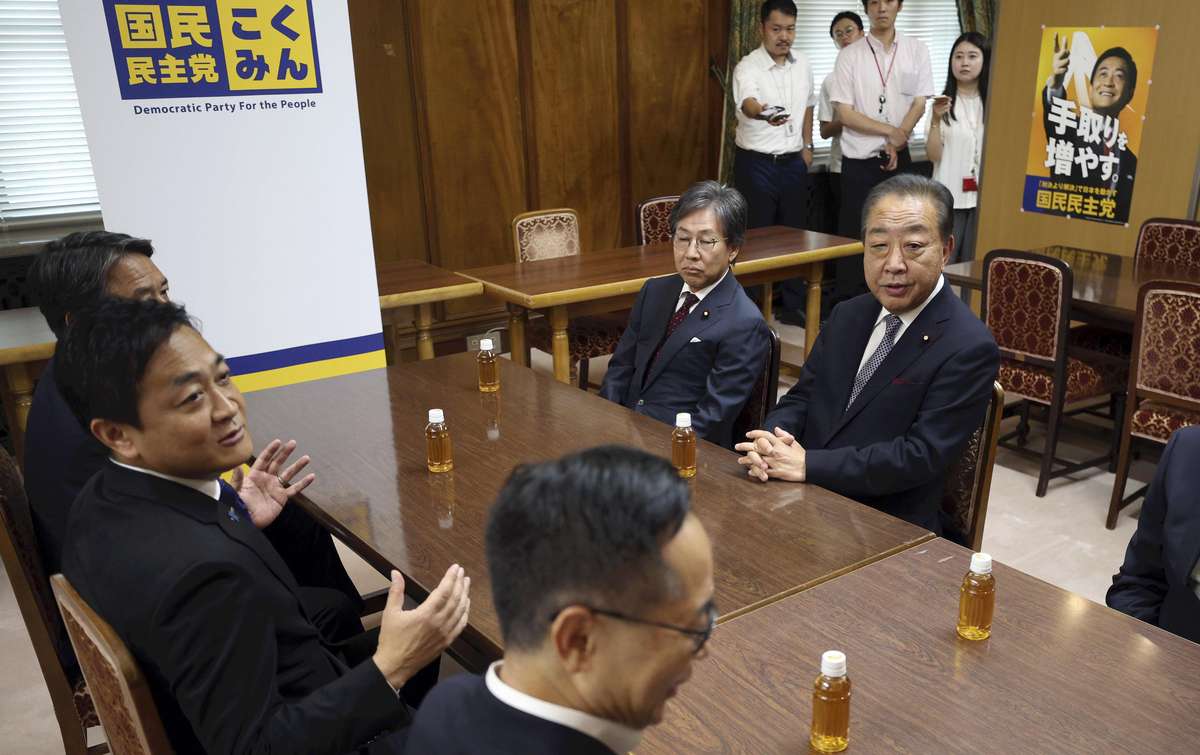
Yoshihiko Noda, leader of the Constitutional Democratic Party of Japan, right, meets with Yuichiro Tamaki, leader of the Democratic Party for the People, left, and others at the Diet on Thursday.
14:16 JST, September 19, 2025
The Constitutional Democratic Party of Japan is working hard to secure cooperation from other opposition parties ahead of a vote to choose the prime minister, which will be conducted during the extraordinary Diet session following the ruling Liberal Democratic Party leadership election.
The Japan Innovation Party and the Democratic Party for the People are reluctant to cooperate with the CDPJ, the largest opposition party, as they disagree on fundamental policies such as the Constitution, foreign affairs and security. The prospect of the opposition parties unifying their vote therefore appears to dim.
CDPJ leader Yoshihiko Noda met with JIP coleader Fumitake Fujita at the Diet on Thursday and called for “collaboration in various fields.” Noda subsequently held separate meetings with DPFP leader Yuichiro Tamaki and Japanese Communist Party Chairperson Tomoko Tamura.
The ruling coalition currently holds 220 seats — 196 by the LDP and 24 by Komeito — in the House of Representatives, with the threshold for a majority being 233. Therefore, with sufficient unity among the opposition in the vote to choose the prime minister, a change of government is possible.
Noda’s intention is to unify votes for himself by proceeding with discussions with each opposition party.
“We will discuss openly and frankly what kind of government vision the opposition should pursue,” he said at a press conference on Wednesday.
In the prime ministerial election following the House of Representatives election last November, the runoff vote narrowed to incumbent Prime Minister Shigeru Ishiba and Noda. However, the second largest opposition party, JIP, and the third largest DPFP instead voted for their own party leaders. This resulted in a total of 84 invalid votes, allowing Ishiba to continue his tenure.
The formation of a government centered on the CDPJ would require the cooperation of both the JIP and the DPFP.
One JIP executive said, “Voting for Noda is not an option” — an opinion that has been repeatedly voiced by others in the party. At a press conference, Fujita said regarding the vote to choose the prime minister, “We will follow the same approach as before.”
Tamaki also said that voting for himself was his “basic position,” adding, “Forming a government with a party that we disagree with on security and energy policy would only lead to an unfortunate future,” thus rejecting the idea of cooperation with the CDPJ.





Most Read
Popular articles in the past 24 hours
-

6 Injured at Naked Festival in Japan’s Okayama Prefecture; Police...
-

Reciprocal Tariffs Ruled Illegal: Judiciary Would Not Tolerate Pr...
-

Fiji Defense Minister Hopes Japan Will Support Stabilization of P...
-

Space One Delays Launch of No. 3 Kairos Rocket; Company to Announ...
-

Japanese Film, Anymart, Wins Critics’ Award at International Film...
-

India, Brazil Sign Mining Pact As Modi Targets $20 Billion Trade ...
-

3rd Japan Pacific Islands Defense Dialogue to Begin in Tokyo on S...
-

I Am Surprised by My Mother’s Increased Drinking
Popular articles in the past week
-

Japan PM Takaichi’s Cabinet Resigns en Masse
-

Man Infected with Measles Reportedly Dined at Restaurant in Tokyo...
-

Sanae Takaichi Elected Prime Minister of Japan; Keeps All Cabinet...
-

Japan's Govt to Submit Road Map for Growth Strategy in March, PM ...
-

Bus Carrying 40 Passengers Catches Fire on Chuo Expressway; All E...
-

Milano Cortina 2026: Figure Skaters Riku Miura, Ryuichi Kihara Pa...
-

Japan, U.S. Name 3 Inaugural Investment Projects; Reached Agreeme...
-

U.S. Firm to Build Training Hub in Fukushima N-plant for Debris R...
Popular articles in the past month
-
Japan PM Takaichi’s Cabinet Resigns en Masse
-

Japan Institute to Use Domestic Commercial Optical Lattice Clock ...
-

Israeli Ambassador to Japan Speaks about Japan’s Role in the Reco...
-
Man Infected with Measles Reportedly Dined at Restaurant in Tokyo...
-

Videos Plagiarized, Reposted with False Subtitles Claiming ‘Ryuky...
-

Man Infected with Measles May Have Come in Contact with Many Peop...
-

Prudential Life Insurance Plans to Fully Compensate for Damages C...
-

Woman with Measles Visited Hospital in Tokyo Multiple Times Befor...
Top Articles in Politics
-
Japan PM Takaichi’s Cabinet Resigns en Masse
-
Sanae Takaichi Elected Prime Minister of Japan; Keeps All Cabinet Appointees from Previous Term
-
Japan’s Govt to Submit Road Map for Growth Strategy in March, PM Takaichi to Announce in Upcoming Policy Speech
-

LDP Wins Historic Landslide Victory
-

LDP Wins Landslide Victory, Secures Single-party Majority; Ruling Coalition with JIP Poised to Secure Over 300 seats (UPDATE 1)
JN ACCESS RANKING
-
Japan PM Takaichi’s Cabinet Resigns en Masse
-
Japan Institute to Use Domestic Commercial Optical Lattice Clock to Set Japan Standard Time
-
Israeli Ambassador to Japan Speaks about Japan’s Role in the Reconstruction of Gaza
-
Man Infected with Measles Reportedly Dined at Restaurant in Tokyo Station
-
Videos Plagiarized, Reposted with False Subtitles Claiming ‘Ryukyu Belongs to China’; Anti-China False Information Also Posted in Japan