
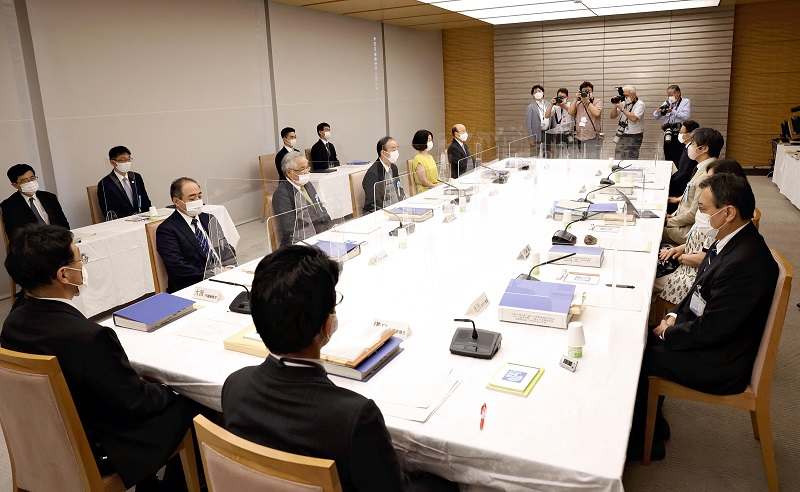
An expert panel discusses the succession to the Imperial throne at the Prime Minister’s Office in July.
16:44 JST, October 28, 2021
Only 26% of politicians responding to a Yomiuri Shimbun survey supported limiting succession to the Imperial throne to men descended from the Imperial male line as currently specified by law.
The Yomiuri surveyed candidates in the upcoming House of Representatives election about the Imperial Household Law. Currently, the Imperial family consists of 17 members, including the Emperor and the Emperor Emeritus. There are three men — Crown Prince Akishino, Prince Hisahito and Prince Hitachi — in line for the throne.
The survey’s findings reflected deep concern about there being no candidates for the throne after the youngest of the three, 15-year-old Prince Hisahito.
Thirty-five percent of respondents said they would approve of a female emperor in the male line, while 24% would support an emperor descended from the female line. This indicates a certain amount of support for the possibility of female or female-line emperors.
However, the survey results varied somewhat by political party.
Among ruling Liberal Democratic Party candidates, the largest number of respondents, or 57%, said they would maintain the current system. Many candidates, mainly conservatives, favor continuing the succession of men in the male line.
Among candidates belonging to LDP coalition partner Komeito, the largest proportion of 50% were willing to back a female emperor in the male line, while only 6% favored maintaining the current system.
Among opposition candidates, 37% of Constitutional Democratic Party of Japan and 86% of Japanese Communist Party candidates approved of a female-line emperor. Among the CDPJ candidates, the largest percentage, or 45%, approved of a female emperor in the male line.
Komeito, CDPJ and JCP candidates seemed amenable to female and female-line emperors mainly from the perspective of gender equality.
To ensure a sufficient number of members in the Imperial family, an interim report compiled by a government expert panel in July suggested the establishment of “female Imperial branches” to allow women to remain in the Imperial family even after they marry. The report also included the idea of allowing men descended from the male line of the former Imperial family to return.
LDP candidates were divided on the issue of female Imperial family members maintaining their royal status after marriage, with 43% in favor, including those “somewhat in favor,” and 40% opposed, including candidates “somewhat opposed.”
Among the Komeito candidates, 56% were in favor.
Within opposition parties, 75% of CDPJ and 73% of JCP candidates were in favor, while 77% of Nippon Ishin no Kai (Japan Innovation Party) candidates were opposed.
Regarding the return of male members in the male line who lost their Imperial family status in the past, 69% of LDP candidates were in favor. There appears to be considerable support for this measure within the LDP, as a way to maintain the current system of a male emperor in the male line.
Komeito candidates were split, with 31% in favor and 37% opposed. Among the Nippon Ishin no Kai candidates, 88% were in favor, while 55% of CDPJ and 86% of JCP candidates opposed.







Most Read
Popular articles in the past 24 hours
-

Business Hotels Expanding into Regional Areas in Japan, Aiming to...
-

Milano Cortina 2026: Japan Sees Leap in Olympic Performance Throu...
-

6 Injured at Naked Festival in Japan’s Okayama Prefecture; Police...
-

Fiji Defense Minister Hopes Japan Will Support Stabilization of P...
-

Milano Cortina 2026: Malinin Highlights Dangers of Social Media i...
-

Space One Delays Launch of No. 3 Kairos Rocket; Company to Announ...
-

3rd Japan Pacific Islands Defense Dialogue to Begin in Tokyo on S...
-

Reciprocal Tariffs Ruled Illegal: Judiciary Would Not Tolerate Pr...
Popular articles in the past week
-

Japan PM Takaichi’s Cabinet Resigns en Masse
-

Man Infected with Measles Reportedly Dined at Restaurant in Tokyo...
-

Sanae Takaichi Elected Prime Minister of Japan; Keeps All Cabinet...
-

Japan's Govt to Submit Road Map for Growth Strategy in March, PM ...
-

Bus Carrying 40 Passengers Catches Fire on Chuo Expressway; All E...
-

Milano Cortina 2026: Figure Skaters Riku Miura, Ryuichi Kihara Pa...
-

Japan, U.S. Name 3 Inaugural Investment Projects; Reached Agreeme...
-

U.S. Firm to Build Training Hub in Fukushima N-plant for Debris R...
Popular articles in the past month
-
Japan PM Takaichi’s Cabinet Resigns en Masse
-

Japan Institute to Use Domestic Commercial Optical Lattice Clock ...
-

Israeli Ambassador to Japan Speaks about Japan’s Role in the Reco...
-
Man Infected with Measles Reportedly Dined at Restaurant in Tokyo...
-

Videos Plagiarized, Reposted with False Subtitles Claiming ‘Ryuky...
-

Man Infected with Measles May Have Come in Contact with Many Peop...
-

Prudential Life Insurance Plans to Fully Compensate for Damages C...
-

Woman with Measles Visited Hospital in Tokyo Multiple Times Befor...
Top Articles in Politics
-
Japan PM Takaichi’s Cabinet Resigns en Masse
-
Sanae Takaichi Elected Prime Minister of Japan; Keeps All Cabinet Appointees from Previous Term
-
Japan’s Govt to Submit Road Map for Growth Strategy in March, PM Takaichi to Announce in Upcoming Policy Speech
-

LDP Wins Historic Landslide Victory
-

LDP Wins Landslide Victory, Secures Single-party Majority; Ruling Coalition with JIP Poised to Secure Over 300 seats (UPDATE 1)
JN ACCESS RANKING
-
Japan PM Takaichi’s Cabinet Resigns en Masse
-
Japan Institute to Use Domestic Commercial Optical Lattice Clock to Set Japan Standard Time
-
Israeli Ambassador to Japan Speaks about Japan’s Role in the Reconstruction of Gaza
-
Man Infected with Measles Reportedly Dined at Restaurant in Tokyo Station
-
Videos Plagiarized, Reposted with False Subtitles Claiming ‘Ryukyu Belongs to China’; Anti-China False Information Also Posted in Japan