
Japan Prime Minister Has Tough Road Ahead in Running Diet; May Struggle to Pass Supplementary Budget Proposal
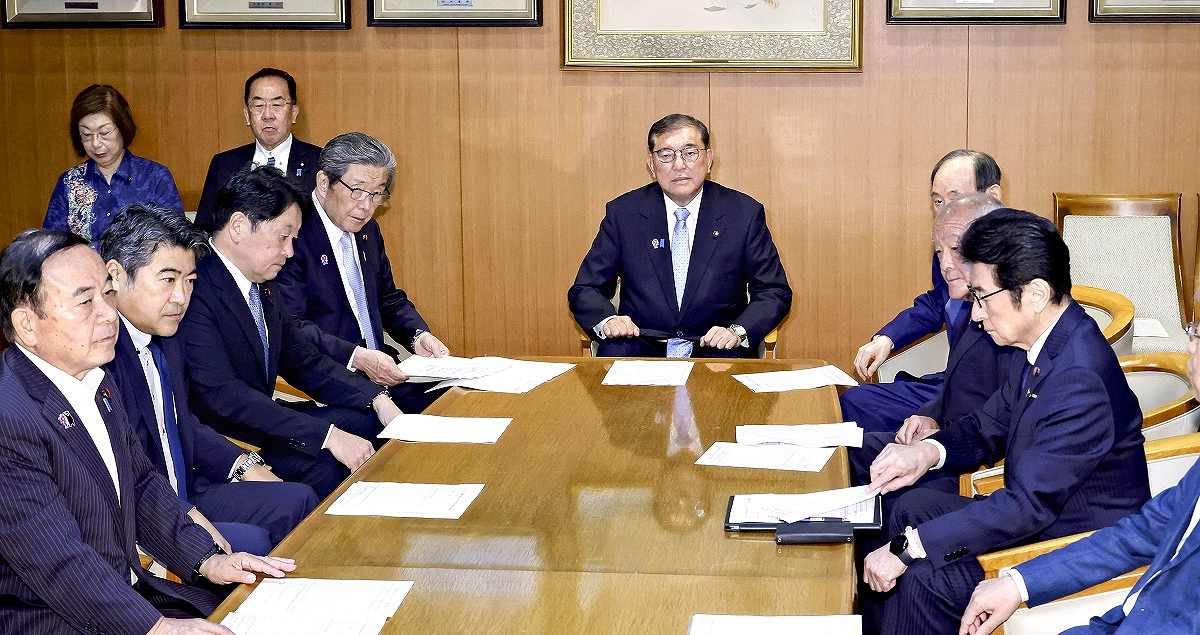
Prime Minister Shigeru Ishiba and other senior members of the Liberal Democratic Party before the start of an extraordinary board meeting at the party headquarters in Tokyo on Monday.
16:12 JST, July 22, 2025
Despite declaring his intention to stay in office following the ruling bloc’s loss of its majority in Sunday’s House of Councillors election, Prime Minister Shigeru Ishiba is likely to face difficulties both inside and outside his Liberal Democratic Party.
Not only will Ishiba have to manage the Diet with the LDP and coalition partner Komeito as minority ruling parties in both the House of Representatives and the upper house, there appear to be moves within the LDP to get Ishiba to resign from his post.
Ishiba aims to find a way forward with the opposition parties, but it remains to be seen whether he can gain their cooperation. His administration could end up adrift.
“The road ahead of us is truly a thorny one. We will sincerely work on national politics,” Ishiba said at a press conference in his capacity as LDP president on Monday afternoon.
Commenting on his reason to stay in office, Ishiba stressed that he “never makes decisions based on [his] own interests.”
LDP party members have reacted harshly to Ishiba’s announcement that he would remain in office after the ruling parties lost their majority in both houses of the Diet.
“Please bear in mind that there is growing discontent among the younger party lawmakers,” the LDP’s Executive Acting Secretary General Tatsuo Fukuda was quoted as saying to Ishiba at an extraordinary party board meeting prior to the press conference.
The LDP failed to capture a seat in the Osaka prefectural district for the first time in 27 years.
Shigeharu Aoyama, an LDP upper house lawmaker and head of the LDP’s Osaka prefectural chapter, told reporters early on Monday: “The prime minister should quit. How can an administration that has been rejected by the sovereign people in both houses of the Diet negotiate with the administration of [U.S.] President [Donald] Trump?”
Calls for Ishiba’s resignation have spread from veterans to younger party members, further weakening his support base within the party. If this develops into a full-fledged movement to make Ishiba step down as prime minister, it could threaten his remaining in office.
A member of the party’s leadership said, “Our priority now is to maintain the government, but it’s possible that a party presidential election will be held in the near future.”
It will also be harder to manage the Diet. Ishiba intends to submit a supplementary budget proposal for fiscal 2025 — which is necessary to implement measures against high prices, such as cash handouts — to the extraordinary Diet session to be convened in autumn.
The support of some opposition parties is indispensable to pass the supplementary budget proposal, which will finance one of the signature pledges made in the upper house election campaign. If it does not pass, his administration will inevitably come to a standstill.
At the same time, the opposition parties will pose a threat to Ishiba if they unite. In the last ordinary Diet session, the opposition parties banded together to dismiss the chair of the lower house Committee on Financial Affairs and then passed a bill to abolish the provisional gasoline tax rate in the lower house.
The bill was scrapped in the upper house, where the ruling parties held the majority of the seats, but the situation highlighted the weakness of minority ruling parties.
If the opposition parties unite in favor of a no-confidence motion against the Cabinet, it will be passed by the lower house, and Ishiba will be forced to decide whether his Cabinet should resign en masse or he should dissolve the lower house. Regarding the possibility of a no-confidence motion, Yoshihiko Noda, president of the Constitutional Democratic Party of Japan, told reporters on Monday, “This is not the time to answer with a prediction.” However, Noda also insisted, “How long will [Ishiba] continue with slothful politics?”
A mid-ranking LDP lawmaker said: “Dissolution of the lower house under Prime Minister Ishiba is impossible. If a no-confidence motion against the Cabinet is submitted, that will mean the end of his administration.”
Even if Ishiba resigns and a new LDP president is elected to succeed him, that new party leader might not be chosen as the new prime minister in the Diet due to the fact that the LDP and Komeito are minority ruling parties. Ishiba’s decision to stay in office was partly inspired by that fact.
The opposition camp has no vision to lead the government, and Ishiba has told those around him that he would rather stay in office than cause turmoil, even if he is criticized for that decision. However, it is not clear how much leadership he will be able to exert under the current circumstances.







Most Read
Popular articles in the past 24 hours
-

Tokyo Skytree's Elevator Stops, Trapping 20 People; All Rescued (...
-

Japan’s Major Real Estate Firms Expanding Overseas Businesses to ...
-

China, India Tapping into Promising African Market; Beijing Annou...
-

Ukrainian Ambassador Closely Watching Japan’s Revision of Defense...
-
Emperor Turns 66 Ahead of Disaster Milestones
-

Milano Cortina 2026: Sakamoto Serves as Flag Bearer; Japan Earns ...
-

Milano Cortina 2026: There Were Cheers across the Country, after ...
-

Luna Sea Drummer Shinya Dies at 56; Powerful Drummer Behind ‘Desi...
Popular articles in the past week
-

Japan PM Takaichi’s Cabinet Resigns en Masse
-

Man Infected with Measles Reportedly Dined at Restaurant in Tokyo...
-

Sanae Takaichi Elected Prime Minister of Japan; Keeps All Cabinet...
-

Japan's Govt to Submit Road Map for Growth Strategy in March, PM ...
-

Bus Carrying 40 Passengers Catches Fire on Chuo Expressway; All E...
-

Milano Cortina 2026: Figure Skaters Riku Miura, Ryuichi Kihara Pa...
-

Japan, U.S. Name 3 Inaugural Investment Projects; Reached Agreeme...
-

U.S. Firm to Build Training Hub in Fukushima N-plant for Debris R...
Popular articles in the past month
-
Japan PM Takaichi’s Cabinet Resigns en Masse
-

Japan Institute to Use Domestic Commercial Optical Lattice Clock ...
-

Israeli Ambassador to Japan Speaks about Japan’s Role in the Reco...
-
Man Infected with Measles Reportedly Dined at Restaurant in Tokyo...
-

Videos Plagiarized, Reposted with False Subtitles Claiming ‘Ryuky...
-

Man Infected with Measles May Have Come in Contact with Many Peop...
-

Prudential Life Insurance Plans to Fully Compensate for Damages C...
-

Woman with Measles Visited Hospital in Tokyo Multiple Times Befor...
Top Articles in Politics
-
Japan PM Takaichi’s Cabinet Resigns en Masse
-
Sanae Takaichi Elected Prime Minister of Japan; Keeps All Cabinet Appointees from Previous Term
-
Japan’s Govt to Submit Road Map for Growth Strategy in March, PM Takaichi to Announce in Upcoming Policy Speech
-

LDP Wins Historic Landslide Victory
-

LDP Wins Landslide Victory, Secures Single-party Majority; Ruling Coalition with JIP Poised to Secure Over 300 seats (UPDATE 1)
JN ACCESS RANKING
-
Japan PM Takaichi’s Cabinet Resigns en Masse
-
Japan Institute to Use Domestic Commercial Optical Lattice Clock to Set Japan Standard Time
-
Israeli Ambassador to Japan Speaks about Japan’s Role in the Reconstruction of Gaza
-
Man Infected with Measles Reportedly Dined at Restaurant in Tokyo Station
-
Videos Plagiarized, Reposted with False Subtitles Claiming ‘Ryukyu Belongs to China’; Anti-China False Information Also Posted in Japan