
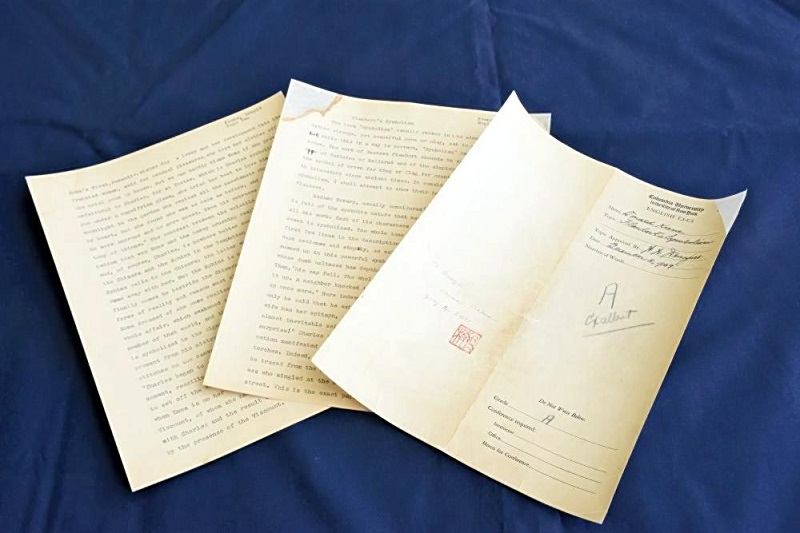
Pages from Donald Keene’s dissertation on Gustave Flaubert
7:00 JST, May 8, 2022
A dissertation on Gustave Flaubert written by Donald Keene in his youth is introduced in a magazine went on sale on Saturday.
Keene, a U.S.-born Japanese scholar, died at 96 in 2019. He was a 17-year-old student at Columbia University when he wrote the dissertation, “Flaubert’s Symbolism.” The text is discussed in detail in the June issue of Shincho monthly literary magazine. Keene studied French literature before he studied Japanese literature.
“[The dissertation] gives a glimpse of the exquisite sense of literature and writing prowess he showed later in his life,” said translator Yukio Kakuchi, 73.
The approximately 20-page typed dissertation is dated Dec. 5, 1939. His teacher marked it with the grade of “A” on the front page, accompanied by the remark “Excellent.” The dissertation was discovered among source materials about Keene donated to the Kita Ward office in Tokyo. Kakuchi, who has translated Keene’s works into Japanese for many years, studied the text in detail.
Keene, a prodigy from childhood, skipped grades and enrolled in the university when he was 16. By that time, he was already able to read Flaubert in French, having begun to learn the language in junior high school.

Donald Keene
Flaubert was a leading novelist of 19th-century France. In the dissertation, Keene takes up seven of his novels, including “Madame Bovary,” “Salammbo” and “A Sentimental Education.” Regarding “Madame Bovary,” which tells the story of a woman who marries an insipid doctor and suffers anguish, Keene describes the tone of the work as gray and points out that it is full of symbolic personalities that can be called characteristic of all Flaubert works.
Keene goes on to discuss what the things that appear in Flaubert’s novels symbolize. For example, a wedding bouquet thrown into a fire in “Madame Bovary” represents her wish to end the dull days she spends with her husband.
On top of that, he concludes that Flaubert’s travails are reflected in a single phrase or a single word and that if one becomes aware of it, each and every one of those words and phrases become meaningful and reveal significance. He also emphasizes the importance of careful reading.
Keene subsequently encountered an English translation of “The Tale of Genji,” and his interest in Japanese literature began growing.
The dissertation will be displayed at the exhibition “Donald Keene: 100th Anniversary Exhibition A life-long pursuit of Japanese Culture” at the Kanagawa Museum of Modern Literature in Yokohama from May 28.





Most Read
Popular articles in the past 24 hours
-

Milano Cortina 2026: Miho Takagi Won Bronze in Women’s 500-...
-

Japan’s Lotteria Restaurant Operator Co. Changes Name, Will Rebra...
-

Revitalization of Shipbuilding Industry: Counter Chinese, S. Kore...
-

Japan's Foreign Minister Says No Contact With China's Counterpart...
-

1st Overseas Suke-San Udon to Open in Taiwan; Company Aims for Mo...
-

Japan’s Nikkei Stock Average Dips as Soft Data, Post-Election Lul...
-

Toilet Vehicles Provide Comfort During Disaster; Vehicles Popular...
-

Man Killed at Home in Japan’s Hiroshima Prefecture; Wife Also Inj...
Popular articles in the past week
-

Prudential Life Insurance Plans to Fully Compensate for Damages C...
-

Woman with No Overseas Travel History Infected with Measles in Na...
-

Videos Plagiarized, Reposted with False Subtitles Claiming ‘Ryuky...
-

Milano Cortina 2026: Kokomo Murase Comes Out on Top After Overcom...
-

CRA Leadership Election Will Center on Party Rebuilding; Lower Ho...
-

Crime in Japan Ticks Up for 4th Straight Year
-

Tokyo’s New Record-Breaking Fountain Named ‘Tokyo Aqua Symphony’
-

Japanese Constitutional Revision Debate Expected to be Revived Af...
Popular articles in the past month
-

Japan Institute to Use Domestic Commercial Optical Lattice Clock ...
-

Israeli Ambassador to Japan Speaks about Japan’s Role in the Reco...
-

Man Infected with Measles May Have Come in Contact with Many Peop...
-

China Eyes Rare Earth Foothold in Malaysia to Maintain Dominance,...
-
Prudential Life Insurance Plans to Fully Compensate for Damages C...
-

Woman with Measles Visited Hospital in Tokyo Multiple Times Befor...
-
Australian Woman Dies After Mishap on Ski Lift in Nagano Prefectu...
-
Foreign Snowboarder in Serious Condition After Hanging in Midair ...
Top Articles in Society
-
Man Infected with Measles May Have Come in Contact with Many People in Tokyo, Went to Store, Restaurant Around When Symptoms Emerged
-
Woman with Measles Visited Hospital in Tokyo Multiple Times Before Being Diagnosed with Disease
-
Australian Woman Dies After Mishap on Ski Lift in Nagano Prefecture
-
Foreign Snowboarder in Serious Condition After Hanging in Midair from Chairlift in Nagano Prefecture
-
Record-Breaking Snow Cripples Public Transport in Hokkaido; 7,000 People Stay Overnight at New Chitose Airport
JN ACCESS RANKING
-
Japan Institute to Use Domestic Commercial Optical Lattice Clock to Set Japan Standard Time
-
Israeli Ambassador to Japan Speaks about Japan’s Role in the Reconstruction of Gaza
-
Man Infected with Measles May Have Come in Contact with Many People in Tokyo, Went to Store, Restaurant Around When Symptoms Emerged
-
Prudential Life Insurance Plans to Fully Compensate for Damages Caused by Fraudulent Actions Without Waiting for Third-Party Committee Review
-
Woman with Measles Visited Hospital in Tokyo Multiple Times Before Being Diagnosed with Disease