
U.S.-U.K. Deal Indicates Flexibility in Japan-U.S. Negotiations; Govt Officials Keen to Prioritize Elimination of Auto Tariff
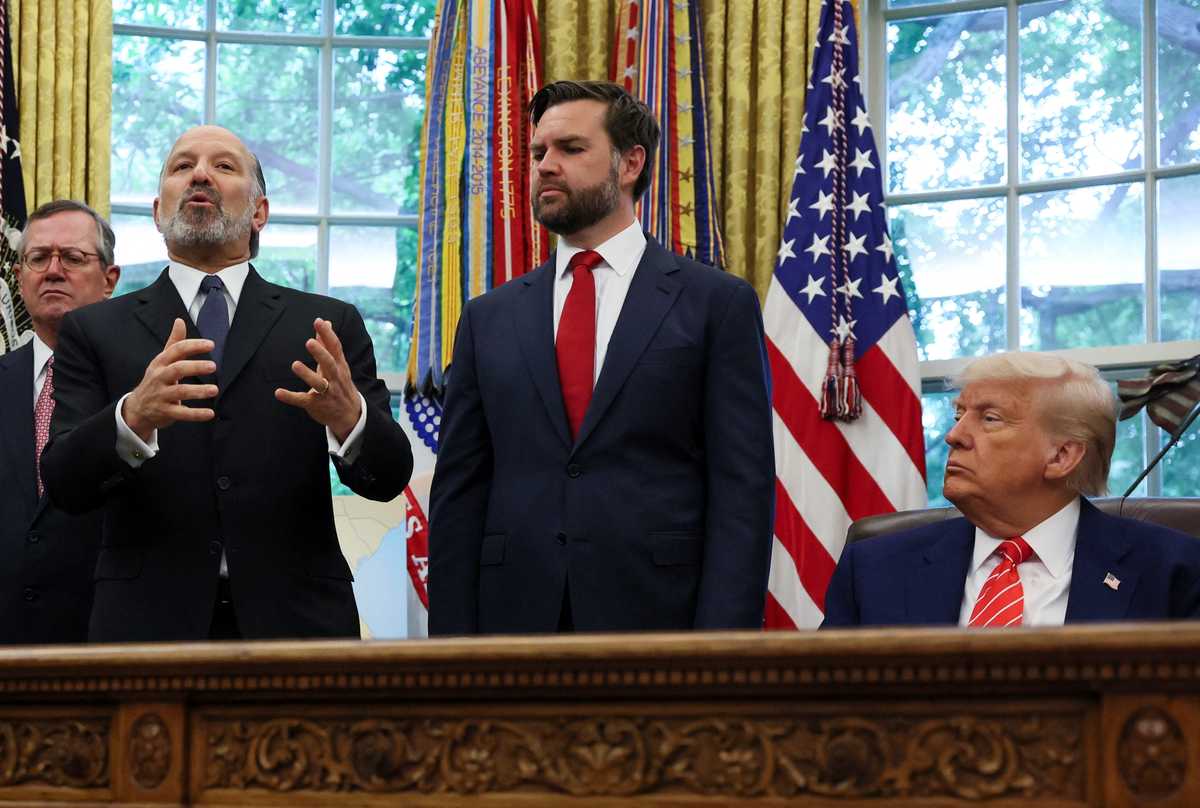
U.S. President Donald Trump is flanked by Vice President JD Vance, as he listens to Commerce Secretary Howard Lutnick speak during an announcement about a trade deal with the U.K., at the White House in Washington on Thursday.
15:47 JST, May 10, 2025
The news that the United States and the United Kingdom have reached an agreement in their tariff negotiations has raised the hopes of some in the Japanese government that their own talks with United States can reach a suitable conclusion at an early date.
However, others are wary that negotiations may be prolonged given the different situation Japan is in from the United Kingdom, with which the United States runs a trade surplus.
The administration of U.S. President Donald Trump on Thursday announced a trade deal with the United Kingdom, the first such agreement in its series of negotiations with U.S. trade partners. The United States allowed some exceptions in its negotiations, suggesting some flexibility.
While the accord is expected to have some impact on the Japan-U.S. talks, Trump sees the large U.S. trade deficit with Japan as a problem. It remains uncertain whether Japan will be able to achieve the kind of results the United Kingdom has managed.
“We will closely examine the agreement and see if there is anything we can use as a reference,” said Economy, Trade and Industry Minister Yoji Muto in a press conference on Friday.
The United States has said that what will be discussed in the Japan-U.S. negotiations will be what it calls the additional part of its “reciprocal tariff” and that the automobile tariff is not subject to negotiation.
Yet, the United States and the United Kingdom agreed to reduce U.S. tariffs on British auto imports to 10%. A senior Foreign Ministry official welcomed the move, saying, “It was great for us to find out that the automobile tariff is not excluded.”
In fact, the auto tariff is on the table in the Japan-U.S. working-level negotiations that started this month, according to a source close to the negotiations. “We were not told that [the auto tariff] is not subject to negotiation,” the source said.
The U.S.-U.K. agreement means the levy on British vehicles will drop from 25% to 10% up to an annual quota of 100,000 units.
“Japan exports about 1.37 million cars to the U.S. — a significantly larger number” said a senior government official. “We want to avoid a quota.”
The Japanese government is set to seek the elimination of the auto tariff, which is expected to significantly impact domestic industries.
“The agreement with the U.K. leaves in place the auto tariff and the ‘reciprocal tariff.’ We wonder what concessions we will have to make in order for the auto tariff to be eliminated,” said a senior government official engaged in economic affairs.
“We will not strike a deal unless we can achieve results on the auto tariff. We will continue negotiations for six months or even an entire year, if necessary,” said another senior official.
“There is a high hurdle to clear in the Japan-U.S. negotiations in order to reach an agreement. But the precedent of the U.S.-U.K. agreement suggests that there is a room for Japan to negotiate over auto and other tariffs,” said Atsuhito Wakabayashi of the Japan Research Institute. “It will be important [for the government] to look for bargaining chips in areas such as shipbuilding, in which Japan can cooperate with the United States.”





Most Read
Popular articles in the past 24 hours
-

Ukrainian Ambassador Closely Watching Japan’s Revision of Defense...
-

Milano Cortina 2026: Sakamoto Serves as Flag Bearer; Japan Earns ...
-
Emperor Turns 66 Ahead of Disaster Milestones
-
Milano Cortina 2026: There Were Cheers across the Country, after ...
-
Luna Sea Drummer Shinya Dies at 56; Powerful Drummer Behind ‘Desi...
-

Milano Cortina 2026: ‘Magical’ Italian Games Close wi...
-
Milano Cortina 2026: Riku-Ryu Duo Stick Together During Closing C...
-

1.2 Mil. Rapeseed Flowers Attract Cute Birds, People in Aichi Pre...
Popular articles in the past week
-

Japan PM Takaichi’s Cabinet Resigns en Masse
-

Man Infected with Measles Reportedly Dined at Restaurant in Tokyo...
-

Sanae Takaichi Elected Prime Minister of Japan; Keeps All Cabinet...
-

Japan's Govt to Submit Road Map for Growth Strategy in March, PM ...
-

Bus Carrying 40 Passengers Catches Fire on Chuo Expressway; All E...
-

Milano Cortina 2026: Figure Skaters Riku Miura, Ryuichi Kihara Pa...
-
U.S. Firm to Build Training Hub in Fukushima N-plant for Debris R...
-

Japan, U.S. Name 3 Inaugural Investment Projects; Reached Agreeme...
Popular articles in the past month
-
Japan PM Takaichi’s Cabinet Resigns en Masse
-

Japan Institute to Use Domestic Commercial Optical Lattice Clock ...
-

Israeli Ambassador to Japan Speaks about Japan’s Role in the Reco...
-
Man Infected with Measles Reportedly Dined at Restaurant in Tokyo...
-

Videos Plagiarized, Reposted with False Subtitles Claiming ‘Ryuky...
-

Man Infected with Measles May Have Come in Contact with Many Peop...
-

Prudential Life Insurance Plans to Fully Compensate for Damages C...
-

Woman with Measles Visited Hospital in Tokyo Multiple Times Befor...
Top Articles in Politics
-
Japan PM Takaichi’s Cabinet Resigns en Masse
-
Sanae Takaichi Elected Prime Minister of Japan; Keeps All Cabinet Appointees from Previous Term
-
Japan’s Govt to Submit Road Map for Growth Strategy in March, PM Takaichi to Announce in Upcoming Policy Speech
-

LDP Wins Historic Landslide Victory
-

LDP Wins Landslide Victory, Secures Single-party Majority; Ruling Coalition with JIP Poised to Secure Over 300 seats (UPDATE 1)
JN ACCESS RANKING
-
Japan PM Takaichi’s Cabinet Resigns en Masse
-
Japan Institute to Use Domestic Commercial Optical Lattice Clock to Set Japan Standard Time
-
Israeli Ambassador to Japan Speaks about Japan’s Role in the Reconstruction of Gaza
-
Man Infected with Measles Reportedly Dined at Restaurant in Tokyo Station
-
Videos Plagiarized, Reposted with False Subtitles Claiming ‘Ryukyu Belongs to China’; Anti-China False Information Also Posted in Japan